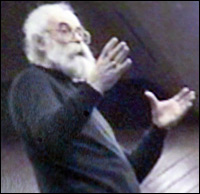
Security forces in Serbia have arrested one of the most wanted men in the world: Radovan Karadzic, the former leader of Serb nationalist forces in Bosnia. Karadzic had been a fugitive since his indictment on war crimes charges more than a decade ago.
Among other charges, Karadzic was held responsible for the three-year siege of Sarajevo, where more than 10,000 civilians were killed. He was the man first associated with the chilling term “ethnic cleansing.”
In 1991, as Yugoslavia came apart, Karadzic presided over a Serb mini-state inside Bosnia that was to be “cleansed” of non-Serbs. Yet Karadzic always said he was innocent. When Western diplomats came to confront him about the expulsion of all non-Serbs from the land under his control, Karadzic insisted that the Muslims and Croats had all left on their own, saying, “There is no single sign of any ethnic cleansing here.”
But Muslim refugees from Serb-held territory, like Sefika Demirovic, told a different, far more violent story.
“We had 10 minutes to come together on the football ground. We walked, and there were six or seven bodies in front of us. We had to walk over them. It was all bloody, we didn’t know who it was. We had to have our hands up with a white flag in front of us,” Demirovic recounted.
Karadzic came from the cosmopolitan city of Sarajevo, where Bosnian Muslims, Serbs, Croats and Jews lived together. But he wanted Sarajevo split in two, with one side serving as the Bosnian Serb capital. When Sarajevans resisted the effort to divide their city, the Bosnian Serb army surrounded it; by June 1992, it was shut off from the outside world.
Gordana Knezevic spoke for thousands of Sarajevo residents: “I don’t know when the spring was finished, and I don’t know when the summer started. And there are only two seasons now. There is a war season and, somewhere in the world, there is a peace season — not for us here.”
The worst was yet to come. Bosnian Serb forces overran the U.N. troops protecting the Muslim enclave of Srebrenica in eastern Bosnia. The Serbs rounded up thousands of men and boys and executed them. When the massacre became known, the United States and other NATO countries launched air strikes against the Serb forces.
Karadzic was outraged; what had gone on in Srebrenica, he said, was between Serbs and Muslims — and was none of NATO’s business.
“Why they take one side in a civil war? And I do think that they have created a precedent that may endanger world peace and that may trigger third world war,” he said.
But Karadzic’s days as a spokesman for the Bosnian Serbs were numbered. The newly organized International Criminal Tribunal at The Hague indicted him for orchestrating the siege of Sarajevo; later, he was held responsible for the Srebrenica slaughter. Along with Gen. Ratko Mladic, the commander of the Bosnian Serb army, Karadzic was formally charged with genocide.
For more than a decade, he was in hiding, moving from village to village in the Serb-dominated part of Bosnia, in the neighboring republic of Montenegro and in Serbia itself.
In the end, he was arrested Monday in Serbia, where there is now a new government anxious to have better relations with Europe. Karadzic had become an obstacle. A special “action team” of the Serbian security services located him and arrested him Monday — 15 years after the siege of Sarajevo and 13 years after the slaughter at Srebrenica.
Haris Silajdzic, a former prime minister of the Muslim-led Bosnian government, told the BBC Monday night that the people of Sarajevo are relieved.
“They have waited too long, which was a disgrace for the international community, for the law of justice and of course for Serbia. And I’m glad that this will now open the way for better cooperation and improvement in this part of the world,” Silajdzic said.
With the arrest of Karadzic, attention turns now to Mladic. For years, he has enjoyed the protection of old friends in the Serbian security services. But many of his allies are no longer in power, and his days as a free man may also be drawing to a close.
Copyright 2023 NPR. To see more, visit https://www.npr.org. 9(MDM3NjYwMjA5MDE1MjA1MzQ1NDk1N2ZmZQ004) "Bosnian-Serb War Fugitive Arrested After 13 Years 2")