Big as the Super Bowl, but the difference is, they really not like Kendrick.
When J. Cole and Drake decided to go a little too heavy on the GOAT talk on their 2023 collab “First Person Shooter,” and J. Cole (not even Drake!) drew attention to the idea that he and Drizzy put themselves on the Compton rapper’s level, a long-brewing contempt finally bubbled over. In the year since Kendrick Lamar put out his first response with a combative verse on Future and Metro Boomin‘s “Like That,” he has conquered the radio, the Grammys and America’s biggest stage, lapping anyone who believed they were his peers in the process.
At Super Bowl LIX, Kendrick indulged in layering the personal with the political. He made sure his history-making halftime concert was more than just a show. It was a victory lap for a year’s worth of work taking the culture to new heights and his pettiness to new lows.
The rap beef between Kendrick Lamar and Drake dominated 2024 for good reason. As a flag-bearer for the art form of rap, Kendrick’s disdain for the “singing n****” had been brewing inside him for years. They began as collaborators, with Drake guesting on the R&B-idling, good kid, m.A.A.d city cut “Poetic Justice” and even inviting Lamar to be his tour opener. In 2013, when Lamar planted the flag claiming he was the best competitor in rap, coming for every one of his contemporaries on his “Control” guest verse, he didn’t single Drake out, but it was a slight Drake held onto.
From then on, the seeds of animosity had been planted. As years passed and the two artists’ paths diverged, one found the music industry’s sweet spot balancing the rap-pop ratio. He broke records held by The Beatles. He pumped out an excess of music and became a commercial star like hip-hop has never seen. The other studied himself, his surroundings, the system and the art form of lyricism. He burrowed into the corners of his creativity and delivered paced-out concept albums that interrogated power. One of those albums was awarded a Pulitzer Prize. After years of being separate yet still in each other’s orbit, May 2024 was the moment they finally converged again.
There are no rules in rap beef, so when this clash of titans finally went down, it set new precedents in ruthlessness. Now, even after the music portion ended last May, the long tail of the conflict has reached new crescendos, too. With infectious pop elements, Kendrick Lamar’s “Not Like Us” bested Drake at his own specialty, breaking streaming and Billboard chart records. The new, scorched-earth energy Lamar has been able to channel fueled his sixth studio album, GNX, which set its own records upon release, surpassing one billion streams in less than a month of its release.
Outside of hip-hop’s court of public opinion, the music has set new precedents in the court of law and in institutions like the Recording Academy. In January, Drake took the trajectory of a diss track into legal spaces for the first time by suing Universal Music Group for defamation, arguing that the label knowingly distributing and promoting a track that accuses the Toronto rapper of pedophilia and child grooming — an accusation Drake has repeatedly denied — has put his life and reputation in danger. In February, having garnered multiple nominations for “Not Like Us,” Lamar took home five Grammy Awards for the track, including record and song of the year, cementing the urgency, execution and impact of a diss track into history for the first time. And then came the Super Bowl.
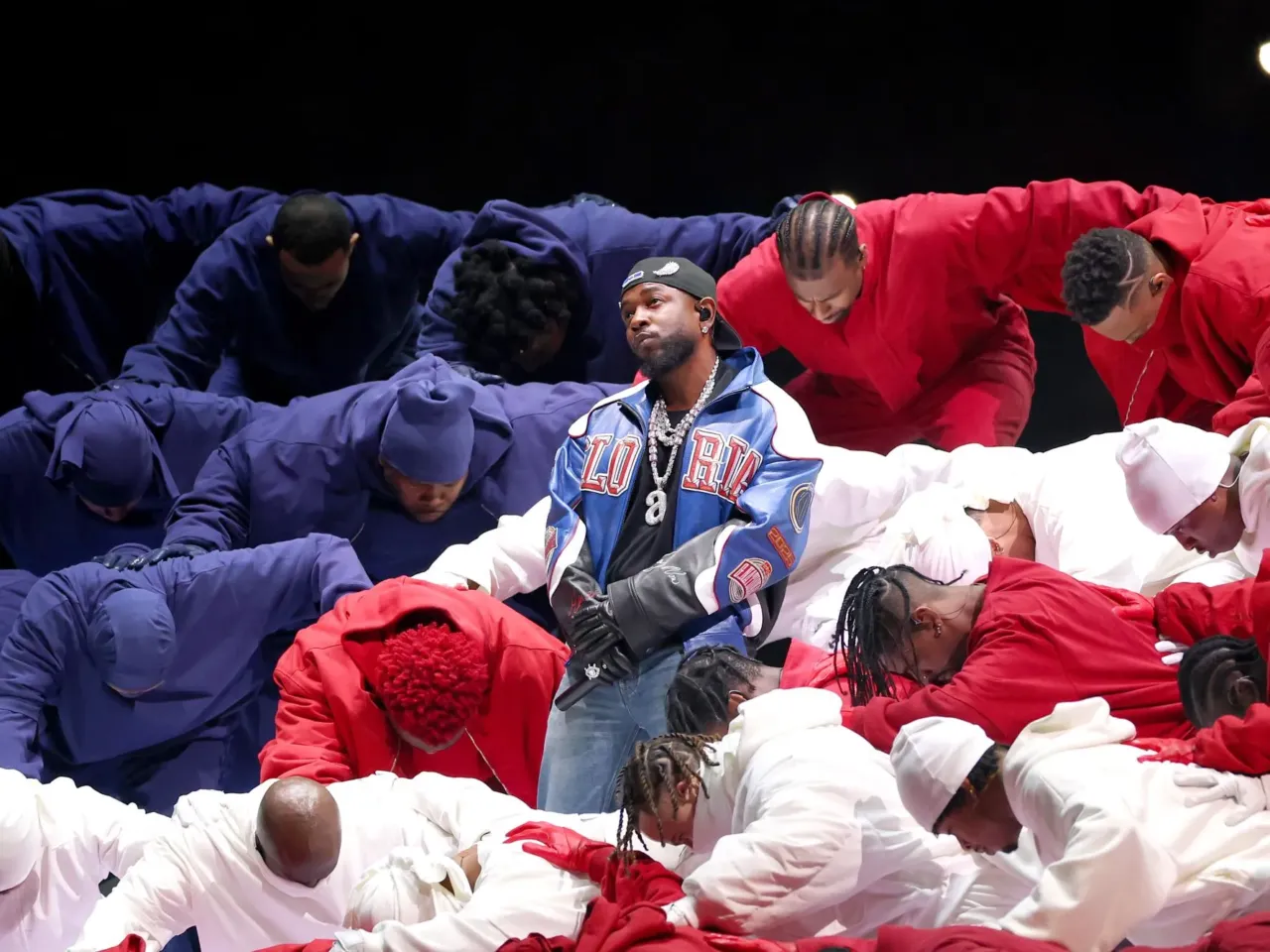
Every element of Kendrick Lamar’s highly anticipated halftime performance held multiple meanings. Lamar, a lyricist known for triple and quadruple entendres, turned the field into a PlayStation game controller, a setup of how moving through America as a Black person requires tactical precision. As the show progressed, his moves across the controller got more gully, breaking the rules of engagement. He hired Samuel L. Jackson to play a lurking Uncle Sam, the stand-in for the nation’s punitive carceral state, the adjudicator of political correctness, the deductor of life for the Compton rapper bringing his ghetto “homeboys” with him as the “old culture cheat code.” He invited fellow Compton native Serena Williams as a surprise guest, who as a now-retired tennis champion free from her own unsportsmanlike rules, got to really do her walk.
He arranged for Black dancers to be dressed in red, white and blue, a visual that pulled double duty on the field, too. First, when in just the right formation, the dancers created an American flag that enveloped K.Dot. Second, similar to his Juneteenth Pop Out show in Los Angeles, the red and blue dancers blended to symbolize unity between Bloods and Crips, two gangs that have come to define South LA with their ebb-and-flow peace and rivalry. At the Superdome, just as at the Pop Out, Lamar made it clear that no matter the set or setting, this is about the real over the fake. And yes, of course, he performed “Not Like Us.” It may have been fun, but for K.Dot, there were no games being played.
Even though it was an audience of millions watching and deciphering Easter Eggs along the way, the 37-year-old auteur made it clear he was really performing for an audience of one. But which one? On a national level, it could be argued he was responding to President Trump’s Super Bowl attendance and everything the new administration stands to snuff out about our diverse humanity. That’d be a move in line with Lamar’s discography. (“Forty acres and a mule, this is bigger than the music,” he proclaimed toward the end of the show.) But on a personal level, while orchestrating this performance full of political symbolism, Lamar was also diabolically staring into the eyes of his defeated rap adversary. He took the opportunity to prioritize his ego over ethos and ran with it.
While Lamar has continued to make history in America and set himself up to take this victory lap on the road with SZA on an upcoming national summer tour, Drake has opted for performing halfway around the world. The Canadian rapper is currently on the road in Australia. It’s possibly the farthest place from hip-hop’s birth place. (“Not Like Us” is still certified three-times platinum there.) So far, Drake has appeared onstage donning a smoking hoodie full of bullet holes to communicate he can’t be killed. But Sunday, Lamar smirked as he made unflinching eye contact with the camera to rap the line, “Say Drake, I hear you like ’em young.” A screenshot of this moment has already been made into countless memes to signify the moment someone snaps, but in the case of the originator, there’s calibrated, clear-eyed serenity to Kendrick. He knew then, months after the battle had been over, he’d officially rewrote the rules of war.
Copyright 2025 NPR