SCOTT SIMON, HOST:
After enormously destructive wildfires hit Los Angeles, the new exhibit at UCLA’s Fowler Museum asked visitors to see fire in a different way. Andrea Gutierrez recently visited the exhibit.
ANDREA GUTIERREZ, BYLINE: I’m drawn to the room across the gallery that’s giving off an orange glow. In it, lights shine through hundreds of California poppies hanging from the ceiling. Not real poppies, paper, each on their own string. Their shadows flicker on the walls in a way that feels familiar, like the way the sky looks during a wildfire.
LEAH MATA FRAGUA: You know, that was kind of the intent behind it – to cast those shadows and to evoke kind of that eerie feeling of fire.
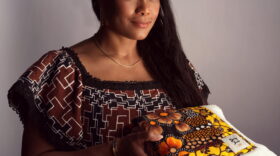
GUTIERREZ: This is Leah Mata Fragua, an artist and member of the Northern Chumash Tribe. She says that poppies and fire are a natural fit.
MATA FRAGUA: After a burn, they’re one of the first flowers to reappear. And if you drive by burn scars, then you start seeing these poppies emerge.
GUTIERREZ: Mata Fragua’s materials are all plant-based. And when the exhibition ends, she plans to burn it all. The ashes she’ll put in her garden to grow materials for future installations.
MATA FRAGUA: So these poppies will continue in other ways.
GUTIERREZ: The poppies are part of an exhibition called “Fire Kinship: Southern California Native Ecology And Art.” It challenges visitors to rethink their own relationships with fire.
DAISY OCAMPO DIAZ: And really looking at indigenous fire stewardship practices, which were already existing.
GUTIERREZ: This is Daisy Ocampo Diaz, one of the exhibition’s curators. She’s of the Caxcan Tribe. This show has been in the works since well before the Eaton and Palisades fires became some of the most destructive in California history. And it coincides with an era in which tribes throughout the state have been steadily revitalizing their own fire stewardship practices, which, for millennia, helped to maintain a landscape where fire is endemic.
OCAMPO DIAZ: The timing is obviously very pertinent.
GUTIERREZ: At the heart of the exhibit is the practice of cultural burning and how it’s much more than just a way of preventing wildfire.
LORENE SISQUOC: This red is our natural red or brown. And of the taller ones, you’ll probably see more.
GUTIERREZ: This moment comes early in the exhibition. Lorene Sisquoc, an elder on the Cahuilla Reservation, shows youth how to gather juncus, a type of grass used in basket weaving. The really good stuff is at the bottom of the plant, so weavers need to pull on it regularly.
SISQUOC: And go as close as you can, but watch your eyes from getting poked. And then pull.
OCAMPO DIAZ: Historically, each community, each village had patches of the material they needed. And every three to five years is usually around that ideal time. You burned that patch because you saw it wasn’t in great shape.
GUTIERREZ: Any overgrowth can suffocate an entire patch.
OCAMPO DIAZ: So you’d need fire to pretty much burn all the juncus grass without killing its roots.
DANNY MANNING: Sometimes, the cultural part gets lost in the fire part.
GUTIERREZ: This is Danny Manning of the Tosidum Maidu in Northern California. He’s a fire practitioner. Tribes invite him to help plan their cultural burns. He says the actual burn might take only a day or two.
MANNING: But the other 98% is the cultural part, is actually taking care of the land and gathering the pieces you need for your basketry or your medicine.
GUTIERREZ: Last year, that patch of juncus on the Cahuilla Reservation was finally burned for the first time in a very long time.
OCAMPO DIAZ: It had been 200 years.
GUTIERREZ: Ocampo Diaz says that burn did exactly what it was supposed to. When she checked on it recently, it had new sprouts.
OCAMPO DIAZ: That’s what it needed – healthy, strong grass.
GUTIERREZ: It’s that healthy growth that just might keep the next fire at bay.
For NPR News, I’m Andrea Gutierrez, in Los Angeles. Transcript provided by NPR, Copyright NPR.
NPR transcripts are created on a rush deadline by an NPR contractor. This text may not be in its final form and may be updated or revised in the future. Accuracy and availability may vary. The authoritative record of NPR’s programming is the audio record.