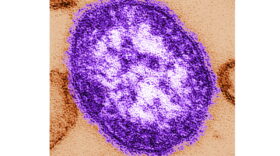
Well, the first thing to know is that measles is one of the most contagious diseases on Earth — more than Ebola, smallpox or just about any other infectious disease.
Loading…
Before widespread vaccination eliminated the disease in the U.S., pretty much everyone got measles in childhood. And 400-500 children used to die from it each year.But the vaccine’s power to beat back measles outbreaks starts to crumble when vaccination rates drop low enough. We asked scientists to help us decipher how lower vaccination rates can affect spread and what that means for the current outbreak.
The math of measles spread
To understand just how easily measles spreads, it helps to know a scientific concept known as the basic reproduction number, or R naught. That’s the number of people, on average, that a single infected person can transmit a disease to.
The R naught for measles ranges from 12 to 18. In other words, if one person is infected, they will infect as many as 18 others on average. That’s much higher than with other infectious diseases, such as Ebola with an R naught of 2.
However, R naught is a theoretical number. “It’s not some magical constant,” says Justin Lessler, an epidemiologist at the University of North Carolina Gillings School of Global Public Health.
It assumes that no one has immunity to a given disease. That’s what the “naught” refers to, as in zero immunity. It’s useful for comparing the infectious potential of different diseases. But in the real world, a lot of different factors can alter how easily measles transmits.
This brings us to a concept known as the effective reproduction number. That’s the number of people that a sick person can infect in a given population at any specific time. It changes as more people become immune through infection or vaccination.
It also changes depending on how people behave. Do infected people isolate? Are vulnerable, unvaccinated people clustered together, socializing with each other? That kind of situation “gives an opportunity for the virus to exist in a place,” Lessler says.
And, the most effective firewall against transmission is vaccination.
The graphic below shows how much a lower vaccination rate can affect measles’ spread in a theoretical group of kindergartners who cluster together every weekday in a classroom.
Loading…
If a disease has a reproduction number under 1, infections will spread slowly and an outbreak will eventually die out, because each infected person spreads it to fewer than one other person on average.On the flipside, here’s where exponential case growth can happen. Let’s say a measles outbreak has an effective reproduction number of 3, like in the graphic above. That might not sound so bad, until you consider that those three people can go on to infect three others, and so on and so on.
In fact, the original strain of the virus that causes COVID had a reproduction number of around 3, and we all saw how that went, says Matt Ferrari, a professor of biology and the director of the Center for Infectious Disease Dynamics at Penn State University.
“It’s not unreasonable to think that measles could spread as fast as [pre-vaccine] SARS-CoV-2 in populations, particularly in school settings, where kids are vaccinated at 80-85%,” Ferrari says.
Vulnerable Texas counties
The kindergarten vaccination rate for measles in Gaines County, the epicenter of the current outbreak in Texas, is just below 82%. That’s well below the 95% vaccination rate threshold needed to protect communities against measles outbreaks, according to the Centers for Disease Control and Prevention.
Loading…
About half of the counties in Texas have a kindergarten vaccination rate below that 95% threshold. In Foard County, Texas, the rate stands at just under 67%. In a classroom with that vaccination rate, one infected child would infect five other unvaccinated classmates with measles on average.
You can find even lower vaccination rates if you drill down to the school level. One private school in Fort Worth, Texas, reported a kindergarten vaccination rate of just over 14%. That’s not to say the outbreak will reach places like this, but if it did, they’d be very vulnerable.
Lessler says many factors will determine how far this outbreak spreads and how big it gets. That includes how many people get vaccinated in response to the outbreak, whether exposed people are quarantined, and how well contact tracing works so exposed people don’t infect others.
And that’s critical, because a person infected with measles can be contagious from four days before the telltale measles rash appears, until four days after, says Dr. Carla Garcia Carreno, a pediatric infectious disease specialist with Children’s Medical Center Plano in Texas.
“So you can be spreading it without knowing you have the measles,” Carreno says. A person with measles can emit infectious particles that linger in the air for up to two hours, long after they’ve left the room. “That’s what makes it also difficult to control.”
Lessler says in conditions where under-vaccinated people are grouped together — such as the close-knit rural community where the current outbreak is largely spreading — measles has the potential to cause reasonably sized outbreaks. But he thinks the firewall provided by higher vaccination and immunity levels in the broader population will eventually tamp down the outbreak.
“Are we at risk of getting, like in the old days, thousands or tens of thousands of cases from this outbreak? That’s probably pretty unlikely,” Lessler says. “The [vaccination] firewall is still pretty strong at that sort of broad level.”
But if measles vaccination rates continue their downward trend amid rising anti-vaccine sentiment, he says the days when measles outbreaks involve thousands of cases could return within the next five to 10 years.
Copyright 2025 NPR