Updated April 05, 2025 at 16:18 PM ET
TEL AVIV, Israel — Palestinian medical officials say they obtained video footage that refutes Israel’s claims about the killing of 15 rescue and aid workers in the southern Gaza Strip last month.
Israel’s military initially said “several vehicles were identified advancing suspiciously toward [Israeli] troops without headlights, or emergency signals” on March 23, and the soldiers opened fire.
But the Palestine Red Crescent Society released a video Saturday it said was found in a cellphone with one of the killed paramedics. It shows clearly marked rescue vehicles with headlights on and red emergency lights flashing. The video was filmed inside one of the vehicles in the convoy.
In the video, there is heavy gunfire over the course of several minutes, and a man’s voice says in Arabic, “Mom, forgive me. This is the path I chose, to help people.”
🚨 Video That Exposes the Israeli Occupation’s Lies
The Palestine Red Crescent Society has obtained a video from the family of a martyred EMT, found on his mobile phone after his body was recovered from a mass grave in Gaza. He was among 15 ambulance and relief team members… pic.twitter.com/8iWqULxijC
— PRCS (@PalestineRCS) April 5, 2025
An Israeli military official, speaking on condition of anonymity to discuss an ongoing investigation, told reporters that senior military officials were completing an inquiry Saturday and would present their findings to the military’s chief of staff Sunday.
He denied allegations that soldiers had shot medics at close range or that medics’ hands had been cuffed, and said soldiers had covered the bodies in a net and buried them under sand to avoid wild animals from disturbing the bodies.
“All claims, including the documentation circulating about the incident, will be thoroughly and deeply examined to understand the sequence of events and the handling of the situation,” the military said Saturday.
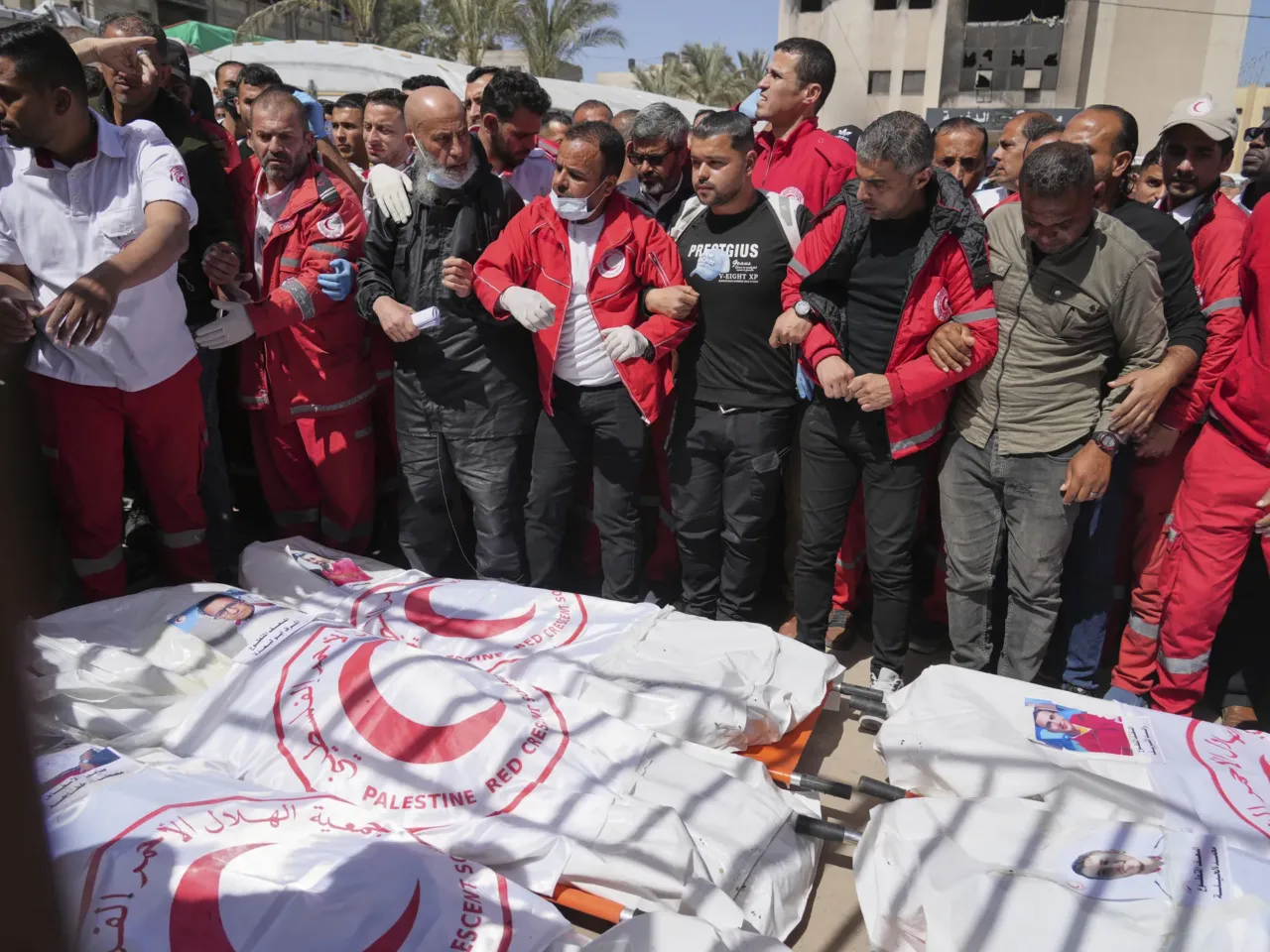
After the incident, the crew was missing for more than a week. Rescue teams finally discovered the bodies of 14 Palestinian emergency responders and a United Nations staffer under a mound of sand on March 31.
“One by one they were hit, they were struck. Their bodies were gathered and buried in this mass grave,” Jonathan Whittall, an official with the U.N. Office for the Coordination of Humanitarian Affairs, said in a video at the site where the bodies were found. “They were here to save lives. Instead, they ended up in a mass grave. … It’s an absolute horror what happened here.”
The U.N. says 408 aid workers have been killed in more than 17 months of war in Gaza.
Israel is expanding its military offensive in Gaza after breaking a ceasefire in the war that followed the Oct. 7, 2023, Hamas-led attack on Israel. Israel says it’s fighting to pressure the Palestinian militant group to release hostages and to defeat Hamas.
Shir David contributed to this report from Tel Aviv.
Copyright 2025 NPR