Copyright © 2026 VPM, all rights reserved.
PBS is a 501(c)(3) not-for-profit organization.
VPM News Morning Edition
NEXT UP: 9:00 AM

Thanks to our sponsors – Become a Sponsor

The new film ‘Tatami’ reveals an Iranian judoka’s fight beyond the mat

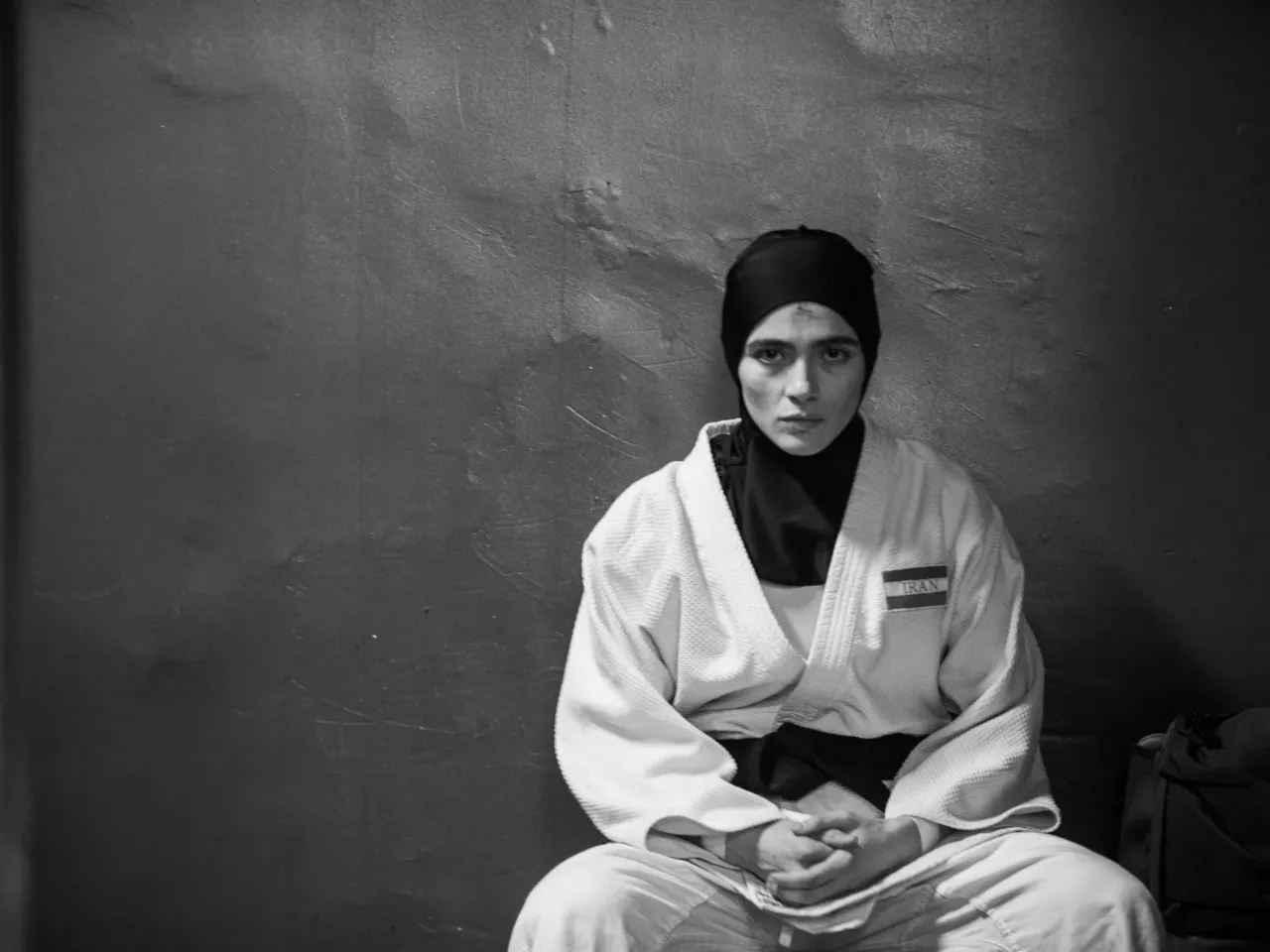
Arienne Mandi plays Iranian judoka Leila Hosseini in the new film Tatami, co-directed by Guy Nattiv and Zar Amir.
XYZ Films / Flawless
Arienne Mandi plays Iranian judoka Leila Hosseini in the new film Tatami, co-directed by Guy Nattiv and Zar Amir.

What happens when the pressure to compete is not just about winning, but about survival?

In the new political thriller Tatami, that question plays out through the story of Leila Hosseini, an Iranian judoka competing at the World Judo Championships in Tbilisi, Georgia. When she’s scheduled to face an Israeli opponent, Iranian government agents order her to fake an injury and withdraw. They threaten to harm her family if she refuses, and her own safety appears at risk.

Inspired by the real experiences of Iranian athletes who were forced to abandon their dreams and sometimes leave their homes and loved ones, Tatami explores their impossible choice: acquiesce to the regime and forfeit the match or compete despite the risks.

The feature film is a victory in its own right, the first of its kind to be co-directed by an Israeli and an Iranian — Oscar winner Guy Nattiv and Zar Amir, who won the 2022 best actress award at Cannes for her role in the film Holy Spider.

“Because I’m not Iranian, I wanted to open myself to Iranian talent and then I saw [Iranian-born Danish director Ali Abbasi’s] Holy Spider and my jaw dropped when I saw Zar’s performance,” said Nattiv.

In addition to co-directing the film, Amir also plays the role of Maryam Ghanbari, Leila’s coach since childhood. Iranian officials pressure the coach to force her protégée to fake an injury and withdraw from the competition.

Amir and Arienne Mandi, who plays Leila in the film, trained with real judokas as they prepared for roles inspired by stories like that of Saeid Mollaei, who was ordered by Iranian authorities to lose intentionally at the 2019 world championships in Tokyo to avoid going up against the Israeli judoka Sagi Muki.
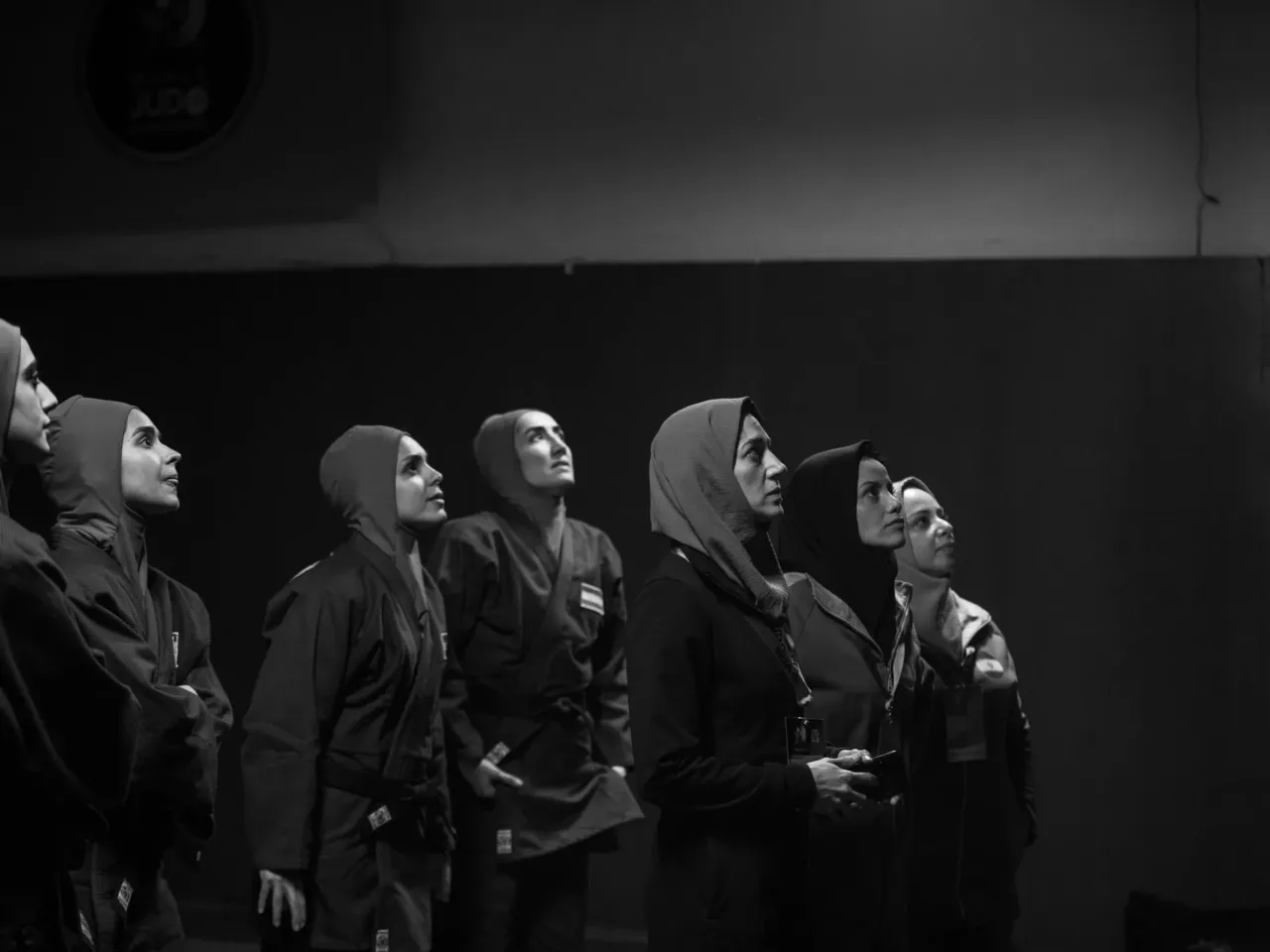
Coach Maryam Ghanbari, played by Tatami co-director Zar Amir (center), watches the screen with other judo athletes as Leila's match begins.
Coach Maryam Ghanbari, played by Tatami co-director Zar Amir (center), watches the screen with other judo athletes as Leila’s match begins. / XYZ Films/Flawless

When Nattiv first approached her, Amir wasn’t sure at first that she was ready to take part in the project.

“I was a bit afraid, but then at some point I just realized that I’m doing as Maryam does in the movie. I’m hesitating,” she said, “So I’m happy that we did it and that it was such a smooth and lovely collaboration.”

The film was largely shot in secret due to security concerns for this rare Iranian-Israeli partnership. “We had to call this project a different name, we spoke only English, we were in different hotels and it was a closed set. So we just wanted to make sure that we are not a target,” Nattiv explained.

Besides Iran and Israel perceiving each other as existential threats, Nattiv sees a more subtle reason for Iran trying so desperately to stop Leila from potentially competing against an Israeli athlete.

Judo “is a sport where you have to honor your opponent because you have to bow. There’s a [lot of] respect. And the Islamic regime does not want the Iranian judoka to lose to an Israeli because you have to honor her or him by bowing, and they see that as an insult in a way,” Nattiv said.

For Amir, it’s about Tehran’s political agenda. “We need this imaginary enemy. This is the way totalitarian regimes survive, especially in the Middle East, but it’s so absurd. So more and more people don’t obey,” she said.

Amir’s work is shaped by her personal history. She fled Iran in 2008 and later received threats after her win at Cannes.

“When I do a movie like Holy Spider or Tatami, it’s not just only making a movie for me. It’s so important how we do this movie, how we bring these kinds of stories to cinema,” Amir said, “I don’t mind anymore if I get threats. I think since I show it that I don’t have any fear, I really get less and less threats.”


Tatami arrives at a fraught juncture for Israel and Iran, whose long-simmering conflict exploded into an all-out war this month, making the film especially prescient.

“Collaboration between so-called enemies will heal more. So from my point of view, I just feel that art heals. This is our weapon. Make art, not war,” said Nattiv. “We made a film about Iran, but I also feel that in a way, Israel has become totalitarian.”

Amir said their work together was “a window to a new culture,” one not far from her own.

“It’s just like we are sisters and brothers. We like the same music. We like the same food,” she said. “There is no other way. We have to shake our hands and try to love each other, to understand each other.”

The broadcast version of this story was produced by Olivia Hampton, who edited the digital version.

Copyright 2025 NPR

Tags

Michel Martin is the weekend host of All Things Considered and host of the Consider This Saturday podcast, where she draws on her deep reporting and interviewing experience to dig in to the week's news. Outside the studio, she has also hosted "Michel Martin: Going There," an ambitious live event series in collaboration with Member Stations.

Martin came to NPR in 2006 and launched Tell Me More, a one-hour daily NPR news and talk show that aired on NPR stations nationwide from 2007-2014 and dipped into thousands of important conversations taking place in the corridors of power, but also in houses of worship, and barber shops and beauty shops, at PTA meetings, town halls, and at the kitchen table.

She has spent more than 25 years as a journalist — first in print with major newspapers and then in television. Tell Me More marked her debut as a full-time public radio show host. Martin says, "What makes public radio special is that it's got both intimacy and reach all at once. For the cost of a phone call, I can take you around the world. But I'm right there with you in your car, in your living room or kitchen or office, in your iPod. Radio itself is an incredible tool and when you combine that with the global resources of NPR plus the commitment to quality, responsibility and civility, it's an unbeatable combination."

Martin has also served as contributor and substitute host for NPR newsmagazines and talk shows, including Talk of the Nation and News & Notes.

Martin joined NPR from ABC News, where she worked since 1992. She served as correspondent for Nightline from 1996 to 2006, reporting on such subjects as the congressional budget battles, the U.S. embassy bombings in Africa, racial profiling and the aftermath of Hurricane Katrina. At ABC, she also contributed to numerous programs and specials, including the network's award-winning coverage of Sept. 11, a documentary on the Anita Hill-Clarence Thomas controversy, a critically acclaimed AIDS special and reports for the ongoing series "America in Black and White." Martin reported for the ABC newsmagazine Day One, winning an Emmy for her coverage of the international campaign to ban the use of landmines, and was a regular panelist on This Week with George Stephanopoulos. She also hosted the 13-episode series Life 360, an innovative program partnership between Oregon Public Broadcasting and Nightline incorporating documentary film, performance and personal narrative; it aired on public television stations across the country.

Before joining ABC, Martin covered state and local politics for the Washington Post and national politics and policy at the Wall Street Journal, where she was White House correspondent. She has also been a regular panelist on the PBS series Washington Week and a contributor to NOW with Bill Moyers.

Martin has been honored by numerous organizations, including the Candace Award for Communications from The National Coalition of 100 Black Women, the Joan Barone Award for Excellence in Washington-based National Affairs/Public Policy Broadcasting from the Radio and Television Correspondents' Association and a 2002 Silver Gavel Award, given by the American Bar Association. Along with her Emmy award, she received three additional Emmy nominations, including one with WNYC's Robert Krulwich, at the time an ABC contributor as well, for an ABC News program examining children's racial attitudes. In 2019, Martin was elected into the American Academy of Arts and Sciences for outstanding achievement in journalism. She is the 2021 recipient of PMJA's 2021 Leo C. Lee Award.

A native of Brooklyn, N.Y., Martin graduated cum laude from Radcliffe College at Harvard University in 1980 and earned a Master of Arts from the Wesley Theological Seminary in 2016.

Related Stories