Copyright © 2026 VPM, all rights reserved.
PBS is a 501(c)(3) not-for-profit organization.
VPM News Morning Edition
NEXT UP: 9:00 AM

Thanks to our sponsors – Become a Sponsor

Accordion master Flaco Jimenez has died at 86

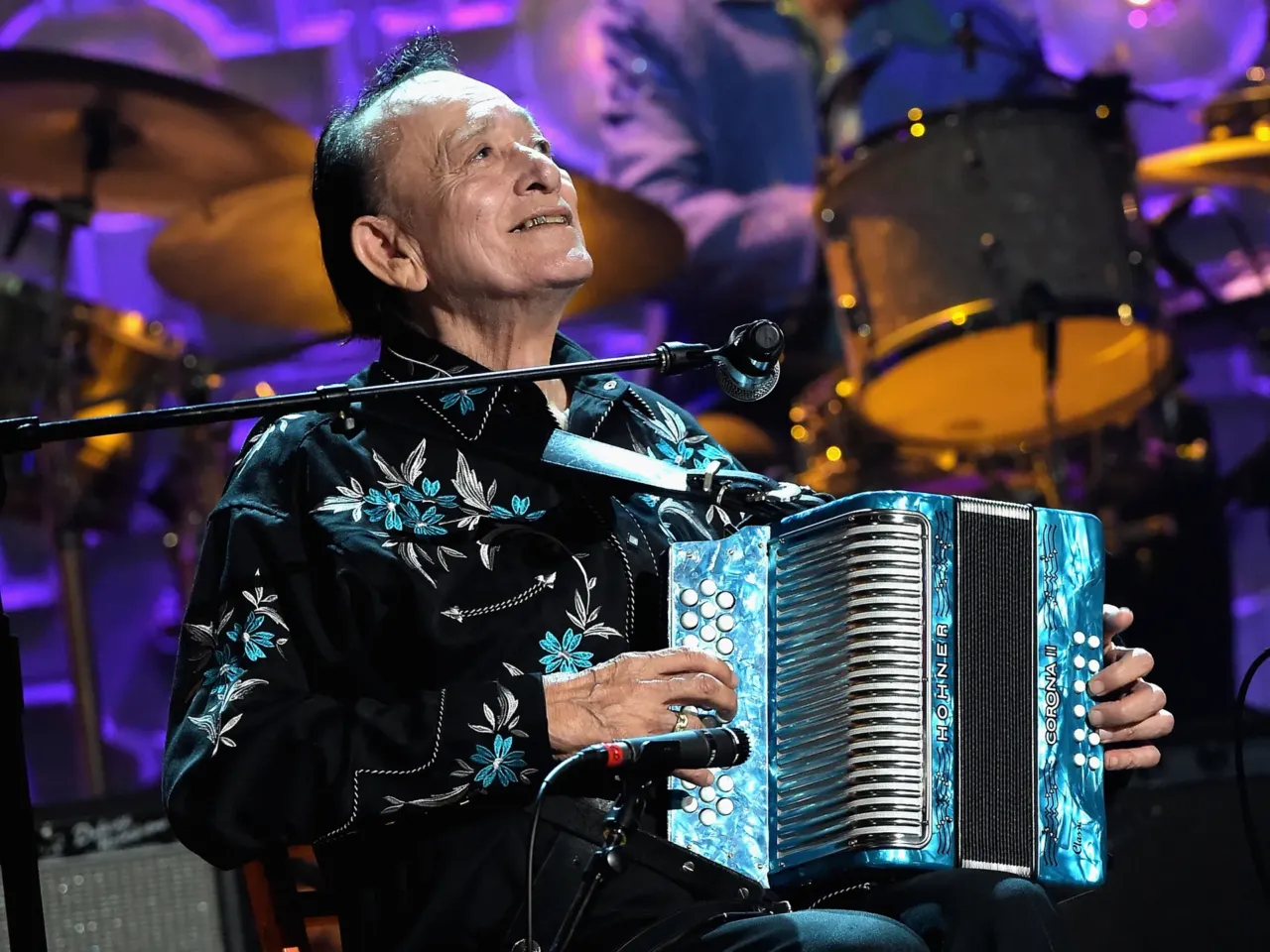
The accordion playing of Flaco Jimenez, seen here performing during the 2014 Americana Music Association Honors and Awards Show at the Ryman Auditorium in Nashville, Tenn., came to define contujo and Tejano music of South Texas over a career that spanned more than 70 years.
Rick Diamond / Getty Images
The accordion playing of Flaco Jimenez, seen here performing during the 2014 Americana Music Association Honors and Awards Show at the Ryman Auditorium in Nashville, Tenn., came to define contujo and Tejano music of South Texas over a career that spanned more than 70 years.

The master of the Tex-Mex accordion Leonardo “Flaco” Jimenez, whose tradition-drenched sound came to define conjunto or Tejano music of South Texas, has died. Throughout a career that spanned more than 70 years, he carried that sound to an international audience through his work with megastars across genres. He was 86 years old.

A statement posted by his family on Jimenez’s official Facebook page did not provide a cause of death.

“It is with great sadness that we share tonight the loss of our father, Flaco Jimenez,” the statement reads. “He was surrounded by his loved ones and will be missed immensely. Thank you to all of his fans and friends — those who cherished his music. And a big thank you for all of the memories. His legacy will live on through his music and all of his fans. The family requests privacy during this time of sadness and grievance.”

There is a scene in the legendary 1976 documentary, Chulas Fronteras, where Flaco is playing at a dancehall in South Texas. He’s wearing a fancy cowboy shirt. He’s dripping sweat. His gold teeth are flashing. He grins ecstatically while Mexican-American couples swirl across the dance floor. The fingers on right hand fly across his Hohner button accordion as he sings of the trickster gringo who stole his girl away.

At this moment in the mid-’70s, Flaco was largely unknown outside of Spanish-speaking Texas, still undiscovered by the anglo music world. He would go on to collaborate with Ry Cooder, Dr. John, the Texas Tornados and Carlos Santana, and win a Grammy Lifetime Achievement Award.

But the essential Flaco — his nickname means skinny — never lost his roots in the rich musical traditions of Mexican Texas.

He picked up the accordion from his father, Santiago Jimenez Sr., one of the pioneers of conjunto. Don Santiago was influenced by the exuberant polkas played by German and Czech oom-pah dance bands in South and Central Texas.

“He (my dad) liked it that much that he got hold of a one-row accordion somehow and started learning how to copy the German polkas,” Flaco told NPR in 2003. “Then he started playing around the neighborhood where he lived, just local house dances.”

Flaco’s brother, Santiago Jr., is also an accordion virtuoso who learned from their father. His considerable skills were overshadowed by his superstar brother. But Flaco said he and his brother received no formal instruction. In 2014, Flaco told NPR’s Scott Simon that he taught himself without his father’s permission.

“I wanted to grab the accordion because dad is still at work. He came home early. All of a sudden he just opens the door and I said, ‘Oh man, I’m going to get it,’ ” Flaco recalled. But instead of being mad, his father was pleased. “The first thing he did, he went straight to me, he gave me a big, big hug and then started crying. See, he was so proud of my self-taught playing.”

Flaco Jimenez became the A-list Tex-Mex accordionist for any artist who wanted that west-side San Antonio baile feel in their song. From the late ’80s through the ’90s, he was popping up everywhere, recording with artists as varied as Bob Dylan, Dwight Yoakum, and the Rolling Stones.

“Flaco Jimenez brought that Tex-Mex, Mexican-American feel to the blues, to rock, to country,” said Josh Baca, another San Antonio accordionist and protégé of Flaco’s, who plays with Los Texmaniacs.

During his long life, Flaco influenced a generation of talented young accordion players with the music that he always described as alegre, happy. “When you would turn on the radio, you know, oh man, that’s Flaco!” Baca said, “You know it’s him playing the accordion. Flaco has always stayed true to his sound and to what he plays.”

He also stayed true to his hometown of San Antonio, the undisputed conjunto capital.

“In San Antonio, he is beloved and he was the greatest ambassador of conjunto music worldwide,” said Hector Saldaña, Texas music curator at the Wittliff Collections at Texas State University. “Just recently I was talking with some visitors from Germany and they were asking questions about Flaco Jimenez.”

Saldana has written that Flaco Jimenez was to San Antonio what Louis Armstrong was to New Orleans.

Copyright 2025 NPR

John Burnett is a national correspondent based in Austin, Texas, who has been assigned a new beat for 2022—Polarized America—to explore all facets of our politically and culturally divided nation. Prior to this assignment, Burnett covered immigration, Southwest border affairs, Texas news and other national assignments. In 2018, 2019 and again in 2020, he won national Edward R. Murrow Awards from the Radio-Television News Directors Association for continuing coverage of the immigration beat. In 2020, Burnett along with other NPR journalists, were finalists for a duPont-Columbia Award for their coverage of the Trump Administration's Remain in Mexico program. In December 2018, Burnett was invited to participate in a workshop on Refugees, Immigration and Border Security in Western Europe, sponsored by the RIAS Berlin Commission.

Though he is assigned to the National Desk, his beat has sometimes stretched around the world.

He has filed stories from more than 30 countries since joining NPR in 1986. In 2012, he spent five months in Nairobi as the East Africa Correspondent, followed by a stint during 2013 as the network's religion reporter. His special reporting projects have included working in New Orleans during and after Hurricane Katrina, as an embedded reporter with the First Marine Division during the 2003 invasion of Iraq, and continuing coverage of the U.S. drug war in the Americas. His reports are heard regularly on NPR's award-winning newsmagazines Morning Edition, All Things Considered, and Weekend Edition.

Burnett's 2008 groundbreaking four-part series "Dirty Money"—which examined how law enforcement agencies have gotten hooked on and, in some cases, corrupted by seized drug money—won three national awards: a Scripps Howard National Journalism Award for Investigative Reporting, a Sigma Delta Chi Society of Professional Journalists Award for Investigative Reporting, and an Edward R. Murrow Award for the accompanying website. His 2007 three-part series "The Forgotten War," which took a critical look at the nation's 30-year war on drugs, won a Nancy Dickerson Whitehead Award for Excellence in Reporting on Drug and Alcohol Problems.

In 2006, Burnett's memoir, Uncivilized Beasts & Shameless Hellions: Travels with an NPR Correspondent, was published by Rodale Press. In that year, he also served as an Ethics Fellow at the Poynter Institute for Media Studies in St. Petersburg, Florida.

In 2004, Burnett won a national Edward R. Murrow Award for investigative reporting for his story on the accidental U.S. bombing of an Iraqi village. His work was singled out by judges for the Alfred I. duPont-Columbia University Award honoring the network's overall coverage of the Iraq War. Also in 2003, Burnett won a first place National Headliner Award for investigative reporting about corruption among federal immigration agents on the U.S.-Mexico border.

In the months following the attacks of September 11, Burnett reported from New York City, Pakistan, and Afghanistan. His reporting contributed to coverage that won the Overseas Press Club Award and an Alfred I. duPont Columbia University Award.

In 2001, Burnett reported and produced a one-hour documentary, "The Oil Century," for KUT-FM in Austin, which won a silver prize at the New York Festivals. He was a visiting faculty member in broadcast journalism at the Poynter Institute for Media Studies in 2002 and 1997. He received a Ford Foundation Grant in 1997 for a special series on sustainable development in Latin America.

Burnett's favorite stories are those that reveal a hidden reality. He recalls happening upon Carlos Garcia, a Mexico City street musician who plays a musical leaf, a chance encounter that brought a rare and beautiful art form to a national audience. In reporting his series "Fraud Down on the Farm," Burnett spent nine months investigating the abuse of the United States crop insurance system and shining light on surprising stories of criminality.

Abroad, his report on the accidental U.S. Air Force bombing of the Iraqi village of Al-Taniya, an event that claimed 31 lives, helped listeners understand the fog of war. His "Cocaine Republics" series in 2004 was one of the first accounts to detail the emergence of Central America as a major drug smuggling region. But many listeners remember the audio postcard he filed while on assignment in Peshawar, Pakistan, after 9/11 about what it was like being, at six-foot-seven, the "tallest American at a Death-to-Americarally."

Prior to coming to NPR, Burnett was based in Guatemala City for United Press International covering the Central America civil wars. From 1979-1983, he was a general assignment reporter for various Texas newspapers.

Burnett graduated from the University of Texas at Austin with a bachelor's degree in journalism.

Related Stories