Virginia lawmakers are considering legislation to expand eligibility for the state’s Brown v. Board of Education Scholarship Program to include Virginians who attend college in other states.
It’s an idea that has come up over the last several years — most recently during meetings of the Brown v. Board of Education Scholarship committee, which is responsible for selecting eligible students each year for awards. The committee endorsed the recommendation this past December.
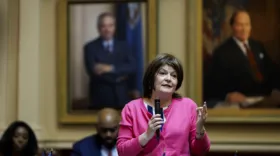
State Sen. Angelia Williams Graves (D–Norfolk), who introduced the legislation, is chair of that committee.
Graves said lawmakers are in a position to account for the generational harm done to families about 70 years ago by the “Massive Resistance” campaign, when some Virginia school districts closed their doors to students rather than follow the 1954 US Supreme Court decision mandating desegregation.
“There’s a cost to fixing it,” Graves said. “We didn’t do it, but we’re charged with fixing it, and this is our contribution to fixing it.”
Virginia residents who are descendants of the students who were locked out of school during Massive Resistance qualify for the award and can use it to attend approved colleges and universities in the commonwealth. This legislation would allow recipients to take those awards out of state.
The legislation has no fiscal impact because there’s ample money in the scholarship’s fund right now — more than $3 million, in addition to more than $2 million former Gov. Glenn Youngkin earmarked for his FY27–28 budget proposal.
Graves is carrying a budget amendment to invest even more in the fund — an additional $2.5 million annually. The goal, Graves said, is to keep putting additional state funds into the scholarship program to continue making right for past wrongs.
The Brown v. Board Scholarship was originally established in 2004 to award education funding to Virginia residents who were denied access to school during Massive Resistance. Their descendants became eligible for the award in 2023.
Marcia Walker has been advocating for the scholarship to be extended to include students like her 19-year-old daughter Morgan, a sophomore at Alabama State University.
VPM News previously reported that Walker’s father, John Smith, was upset to learn his granddaughter was denied the scholarship a few years ago. Smith was an elementary schooler in Prince Edward County in 1959, when county officials closed the schools for five years rather than comply with desegregation orders.
Morgan has borrowed over $10,000 in loans this school year. Walker said the scholarship is “money that she could be using in place of taking out student loans and being in debt.”
The proposed legislation would make students like Morgan eligible for up to $5,000 a year — compared to $10,000 a year for in-state students.
Graves told VPM News she’s not considering changing the $5,000 cap any time soon.
“We don’t have a registry of who’s where,” Graves said. “So we don’t know if we’re going to get 1,000 people [applying] or if we’re going to get 25 people.”
If the legislation passes, students who are eligible for the scholarship and plan to attend college in another state in fall 2028 could apply for the funds.
Del. Jackie Glass (D–Norfolk), another member of the scholarship committee, told VPM News that the scholarship has to evolve.
She said it doesn’t make sense for a kid to grow up in Virginia, be eligible for the scholarship their entire life, but become ineligible the moment they decide to go to college in another state – especially considering many Black students were forced to move to other states during Massive Resistance to continue their education.
“Why are we being punitive to our Virginians who are going off to school?” she asked.
Secretary of the Commonwealth Candi Mundon King, who was also on the committee when she was a state delegate, told VPM News in December that it wasn’t long ago that 16-year-old Barbara Johns organized strikes at her Farmville High School to force government leaders to recognize the suffering families faced because of separate and unequal schools.
“We need to do our job to repair the damage that was done to those families,” she said.
Copyright 2026 VPM