A debate over a tax break for data centers has put budget negotiations behind schedule, with the Virginia Senate pushing for its end — and the House of Delegates and Gov. Abigail Spanberger wanting to keep it.
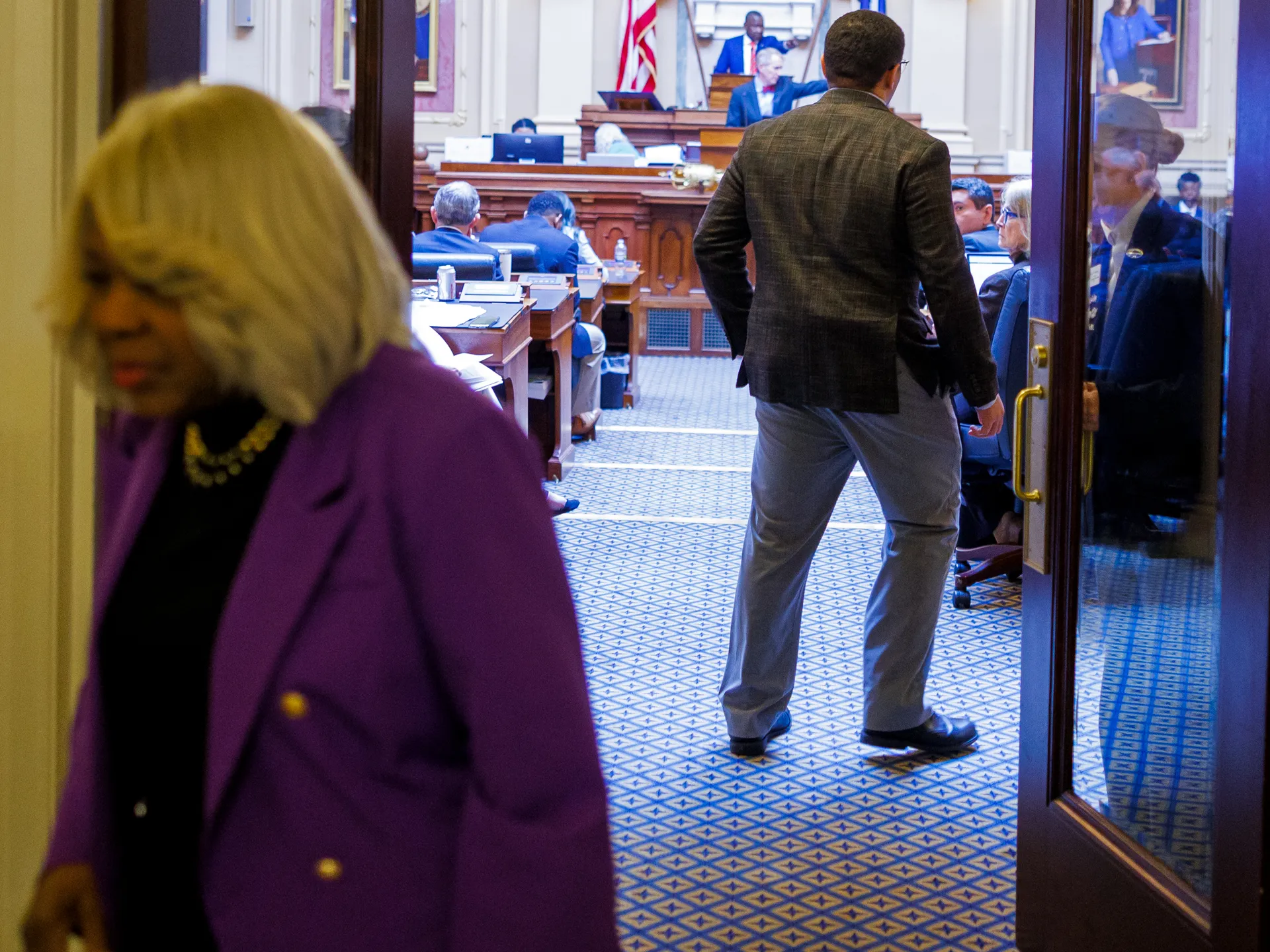
Thursday afternoon, lobbyists for big tech holed up in two of the Virginia State Capitol’s historic rooms, as lawmakers shuffled back and forth between them and the House and Senate chambers. Speaker of the House Don Scott (D–Portsmouth) told VPM News there would be no budget on Thursday when asked.
The 2026 legislative session is scheduled to end on Saturday, and lawmakers’ rules require 48 hours of consideration before a final vote on the budget.
But that requires an agreement — and granular negotiations — in the first place. Already, the Democrat-controlled House and Senate budgets differed greatly from the get-go, stemming from the Senate having about $1 billion more in funds otherwise tied up by Virginia’s Data Center Retail Sales & Use Tax Exemption.
“Unfortunately, as many of you have seen on social media, the other body has taken the position that a budget cannot be finalized, at least in their view, without eliminating the data center sales tax incentive,” House Appropriations Chair Luke Torian (D–Prince William) told lawmakers Thursday. “This is not a position the House can or should agree to.”

Republican former Gov. Glenn Youngkin’s introduced budget was $211 billion over two years.
As late as Tuesday, conferees had yet to meet to come to a compromise on the issues and others in the budget, according to Torian.
“I’m just waiting for Madam President to request a time to meet, and as soon as she requests the time to meet. Then we’ll we’ll have a conversation,” he said, referring to Senate President Pro Tempore Louise Lucas (D–Portsmouth), the chair of the chamber’s finance committee.
She fired back in a post on X: “I beg to differ with anyone who says that it’s on me to meet to discuss this budget because I delivered a budget that makes life affordable by ending a tax giveaway to big tech. The Governor and Chairman Torian have drawn a red line!”
The tax break, implemented in 2008 under Democratic Gov. Tim Kaine, saved the data center industry between $1.6 billion and $1.9 billion in taxes in fiscal year 2025, far more than its initial FY09 projections, when the Department of Taxation said it would cost $1.54 million — about $2.37 million in today’s dollars. (Virginia’s fiscal year runs July 1–June 30.)
In a letter to JLARC, Virginia Economic Development Partnership Chair Jason El-Koubi said the industry has generated “74,000 jobs, $5.5 billion in labor income, and $9.1 billion in GDP to Virginia’s economy annually.”
Representatives from the industry say the benefits of the tax break are worth the cost, citing that track record. A spokesperson from the Data Center Coalition pointed to a 2026 VEDP report, which said Virginia would lose out on $1.2 billion in tax dollars without the economic activity generated by data centers.
Opponents and critics of the tax perk say it’s a subsidy for the wealthiest corporations in the world, it has far outpaced initial estimates and that data centers will still be built in Virginia.
Photos in motion: Tap or scroll to see the composite
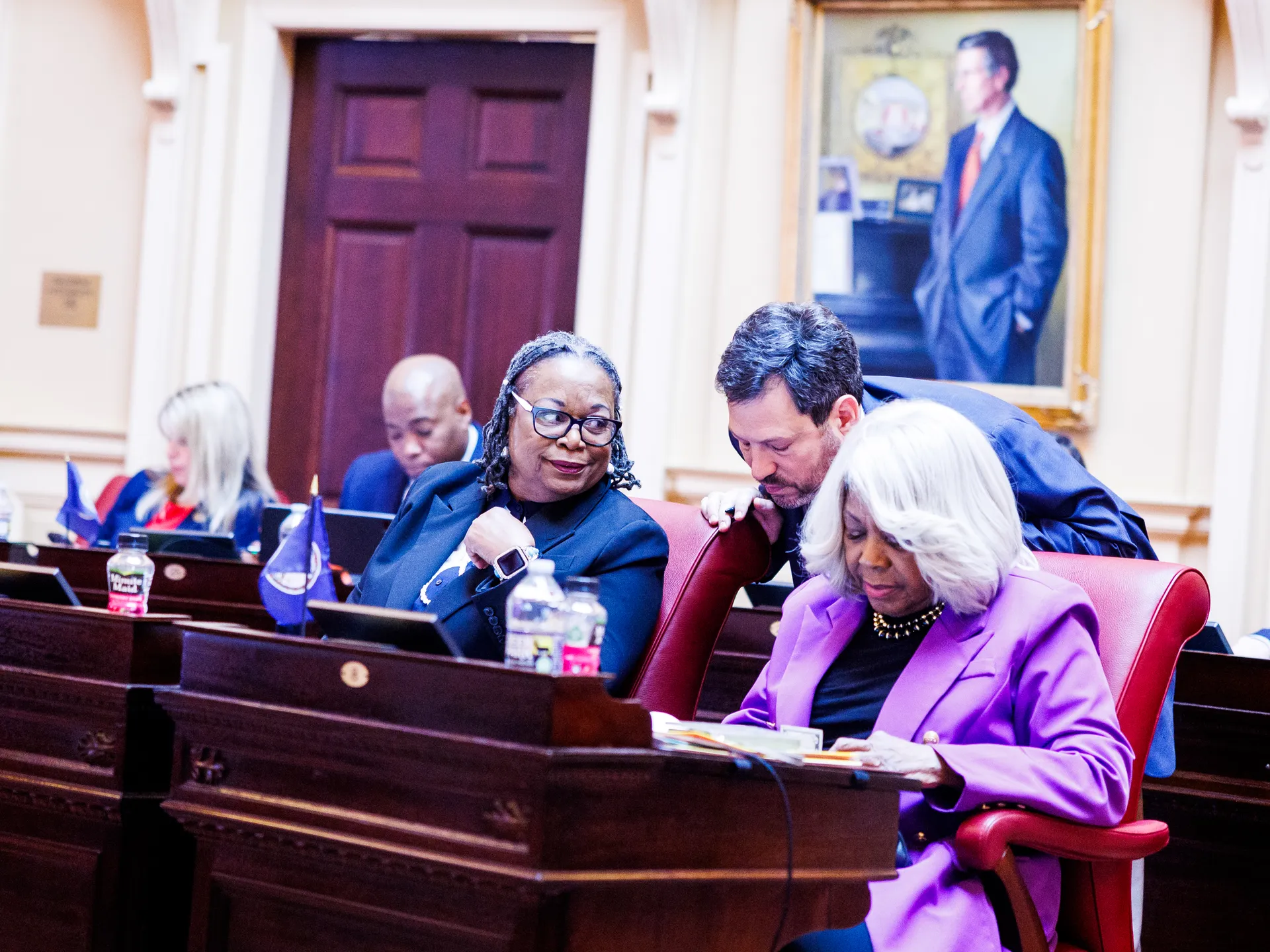
Senate President Pro Tempore Louise Lucas, D–Portsmouth, calls Majority Leader Scott Surovell, D–Fairfax, over to her desk on Tuesday, March 10, 2026 at the Virginia State Capitol in Richmond.
Photos by Shaban Athuman / VPM News
Difficult to track, predict
At the heart of the debate is whether ending the tax exemption would put data center–related jobs and non-exempt tax revenue from data centers, like local property and sales taxes, at risk. But evaluating it is difficult due to a lack of detailed public information on the subject.
Two reports from Virginia Tax and VEDP in 2024 and 2026, and a 2024 JLARC study, give some of the most detailed public information on the exemption — although the Virginia Tax–VEDP entries rely on the industry to self-report.
The 2026 report estimated that the data center industry generated $2.1 billion in total tax revenue in fiscal years 2024 and 2025, which ran from July 1, 2023 to June 30, 2025.
Potential future revenue, and the potential tax exemption, is difficult to predict too.
In fiscal years 2024 and 2025, companies reported investing $80.6 billion in data centers and claiming $3.2 billion in sales tax exemptions. In FY23, it was respectively $23.2 billion and $903 million. And in FY22, it was $13.8 billion and $673 million.
That translates to data center companies reported claiming about 4% of their total investment in sales taxes exemptions over the last few years, according to the VEDP reports.
Over Youngkin’s tenure, data center companies had announced (not contractually promised) they would invest about $113 billion in Virginia, again according to VEDP data. Some of that investment could have already occurred and been accounted for in the other VEDP reports.
New tax exemptions would likely apply to the new data centers’ purchases of computer equipment, as well as to Virginia’s existing data centers, which refresh the equipment that’s subject to the exemption. That occurs about every five to seven years, according to Terry Rephann, an economist at the University of Virginia’s Weldon Cooper Center.
Lucas, who supports ending the exemption early, has said she doubts data centers would abandon Virginia without the exemption.
The JLARC study said that 90% of data center companies would have not built their facilities in Virginia without the tax exemption. However, it’s uncertain whether that would mean 90% less investment in Virginia data centers moving forward.
Rephann said it’s likely that these days, the tax exemption makes the difference for fewer companies. He said subsequent work found it to be about 50%, and that the percentage has been declining over time.
An assessment of Georgia’s data center industry by the University of Georgia found that that state’s tax exemption attracted 30% of its data centers, after the state had previously assumed 90% of growth was due to tax incentives.
The reliability of power, labor force and other infrastructure weigh into site location as well, Rephann said.

What else to consider
The lack of data also makes it difficult to calculate labor costs related to the subsidy, said Anthony Elmo of Good Jobs First, a Washington, DC–based nonprofit that promotes government accountability in economic development.
“Virginia’s disclosure laws throw barriers in our way,” said Elmo. “Because Virginia does not report which companies get the exemption. That’s problem No. 1. You can’t make the claim that the subsidy per job is low or acceptable without knowing that information. Extrapolating from other data sources is not effective.”
In FY25, the data center industry reported adding 1,610 jobs and a reported tax benefit of $1.9 billion, or $1.2 million per new job. The industry reported 9,395 direct jobs from the industry, or roughly $200,000 per job.
“Lets say you’re a hyperscale center and you’re past your construction phase and have 50–100 employees — you know you’ll have to replace your servers,” said Elmo. “That double- or triple-dipping stacks up as time goes on, and you’re only sustaining the same 50–100 jobs.”
Direct and indirect jobs in the industry from July 1, 2024 through June 30, 2025 totaled 31,502 — $60,000 per job.
Charles Skelly, the business manager at two local International Brotherhood of Electrical Workers unions, said removing the exemption would “threaten the livelihoods of the skilled men and women who build and maintain the infrastructure that powers Virginia’s 21st century economy.”
Rephann said that lawmakers should make other considerations while considering the benefits of the exemption.
He said data centers are built “to deploy technological tools that aid businesses and households, make them more efficient, and are able to do new things. So it has an economy wide, lifting productivity impact.”
“Clearly there are these resource constraints and issues with power,” he said, pointing to local opposition, water, and noise. “But they’re all manageable problems too. So it’s just finding out how to keep everyone happy and make sure that the winners compensate the people that would lose out.”
Gov. Abigail Spanberger, who will need to sign off on the budget, signaled she wanted to preserve the tax exemption.
“Data centers should pay their fair share, and I think the Commonwealth of Virginia should also abide by contracts that we sign and [memorandums of understanding] we enter into,” she told reporters Wednesday. Torian also expressed the same sentiment.
Rephann said changing the incentive could put other economic incentives into question.
“Certainly, change the policies for the future recipients,” he said. “But, pulling them out when they’ve already been guaranteed creates a real, uncertain economic environment.”
It appears that the General Assembly, once again, will not complete its work on the budget within the confines of the regularly scheduled session. Legislators have come to compromises before, and the budget has different options.
Firms could be grandfathered in until 2035, or the exemption could be lowered. Spanberger has also floated a new “consumption” tax for data centers rather than ending the exemption completely.
Work on the budget needs to be completed by June 30 to avoid a shutdown of Virginia’s state government.
VPM News’ Shaban Athuman contributed reporting to this article.