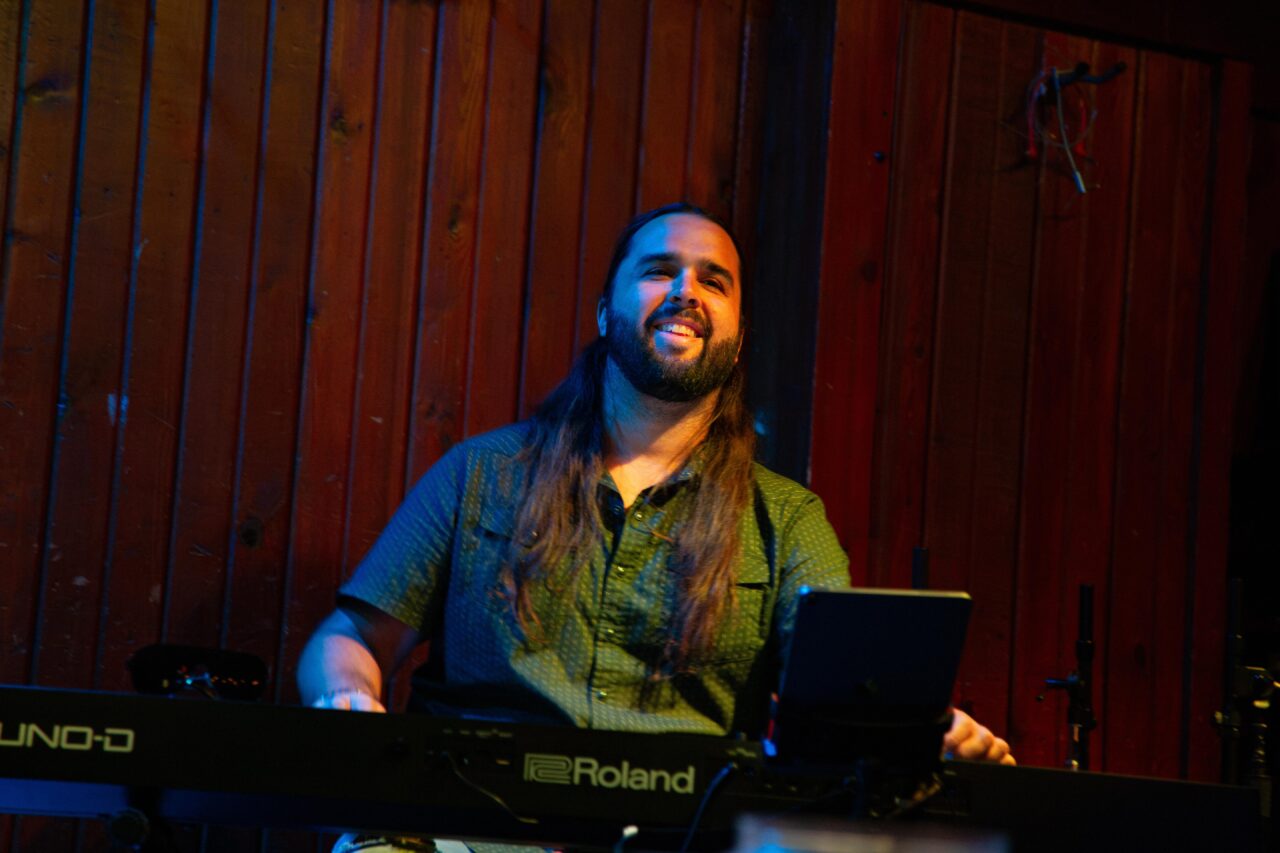
Musician Zack Morgan jokes that when he lost his corporate job in 2015, it was like being pushed off a cliff. For years, he said, he’d been playing both sides of the Austin coin: tech worker by day, funk keyboardist by night.
“Maybe this is my sign to try the full-time music thing,” Morgan recalled thinking. “Step one in that was: Get health insurance again.”
Austin, Texas bills itself as “the Live Music Capital of the World,” but it can be unaffordable for the artists who provide the city with its cultural cachet — and help drive its tourism revenue.
Morgan has supported himself by patching together gigs with a number of bands. To help pay for health insurance, he turned to a local nonprofit, the Health Alliance for Austin Musicians, or HAAM.
“That’s part of being able to make this whole thing work,” Morgan said.
HAAM subsidizes the monthly insurance premiums of local musicians who purchase plans through the Affordable Care Act marketplace.
To fund the roughly $4 million program, it works with Central Health, a public agency that provides healthcare resources for low-income residents of Austin and surrounding Travis County.
Many of the performing artists pay $0 toward monthly premiums.
After more than a decade, including through the coronavirus pandemic, the assistance program has become an established and reliable financial support for Austin’s musician community.

This year, after Congress failed to extend pandemic-era subsidies, premiums skyrocketed for many ACA plans. A recent report found that 5 million people nationwide had dropped the coverage.
HAAM helped blunt the impact for its members. It has emerged as a potential model for other cities hoping to make healthcare more affordable for key populations and industries.
A growing idea
Texas had the highest uninsured rate among states, with 19% of people age 64 and under uninsured as of 2024.
Even before the launch of the ACA marketplace in 2014, HAAM had spent a decade connecting musicians with free and low-cost care at clinics and hospitals in and around Austin.
But roughly 85% of HAAM members remained uninsured, leaving them exposed when traveling to gigs in other cities and states.
“When the Affordable Care Act came out and we knew it was here to stay, it really made sense for us to start getting our musicians fully insured,” said Rachel Blair, HAAM’s chief strategy officer.
Similar nonprofits in other U.S. cities with strong live music cultures, such as Seattle, New Orleans and Nashville, help musicians get medical care.
With the advent of the ACA, some of these organizations began helping musicians navigate the sometimes complex enrollment process for the online marketplaces, though they stopped short of pitching in on premiums.
But the team at HAAM recognized that without direct support to help pay premiums, many of their members would still struggle to retain coverage.
“When you think about the average HAAM member making about $30,000 a year, there’s no way that they would be able to spend a third of their income on healthcare,” Blair said.

)
The organization’s membership has grown by 77% to more than 3,300 people since HAAM began offering premium assistance, and more than 90% of members are now insured.
To help subsidize costs for members, HAAM partnered with Central Health, which is Travis County’s public hospital district — a type of health agency in Texas charged with using tax dollars to fund safety-net healthcare for poor residents.
Central Health also operates the nonprofit Sendero Health Plans, which offers marketplace insurance to Travis County residents.
To qualify, HAAM members must enroll in one of Sendero’s silver-level, or benchmark, plans. If their income is between one and two times the federal poverty level, Central Health pays the balance of their monthly premium after federal tax credits have been applied.
For members who fall above that income range, HAAM offers a more limited subsidy, covering 50% of their premium balances.
In 2017, HAAM helped set up a similar program in Denton, a college town north of Dallas that has served as a testing ground for successful musicians, from Meat Loaf to Norah Jones.
The Denton Music and Arts Collaborative works differently: It connects members with an independent insurance agent who helps them find the best health plan for their needs. The nonprofit then offers members a monthly subsidy of $100.
The subsidies are a way of keeping Denton’s culture of jazz and “weird art rock” alive, said the collaborative’s president, Jennifer Kapinos.
“More and more people were maybe graduating college and leaving and going to find better opportunities in other places,” Kapinos said.
“People who had lived here a long time suddenly were finding it harder and harder to afford to be here.”

In Austin, other sectors have been watching HAAM’s work. In 2025, Good Work Austin, a nonprofit that advocates for restaurant workers, launched a small pilot program with Central Health to help local food workers enroll in Sendero plans and cover their premiums.
Kit Abney Spelce, vice president of operations for Central Health, said partnering with an advocacy group focused on a particular workforce is key because simply announcing “free insurance for you” doesn’t mean people will sign up.
“We are very much dependent on our partner entity to go out and connect with the community, to have that relationship and that trust,” she said.
Navigating federal headwinds
Though insurance premium payments often increase year over year, the 2026 plan year was particularly expensive, increasing by 58% on average.
Citing medical and pharmacy costs, Sendero raised rates by an average of 16% for its enrollees.
At the same time, Congress allowed the pandemic-era enhanced premium tax credits to expire, reducing the federal subsidies that many marketplace customers relied on.
“Our premiums for our members went up 60% from one year to the next,” Blair said.
HAAM stepped up its fundraising into 2026, but it wasn’t enough to cover everyone who requested assistance.
They had to turn away hundreds of qualified people. Still, they were able to buffer existing members, said Spelce with Central Health.
“We’re going to make sure their monthly premium is paid every month,” she said.
A viable, if limited, assistance model
Beyond the eligible musicians they turned away in 2026, another population remains out of HAAM’s coverage reach for premium assistance: Austin’s poorest residents.
Under the ACA, the marketplace plans that HAAM helps subsidize are for low- and middle-income earners, but the people with the very lowest incomes — below 100% of the federal poverty level, set at about $15,000 in Texas — are supposed to be covered by expanded Medicaid.
But Texas is one of 10 states that chose not to expand Medicaid after the ACA became law, so many of the poorest Texans remain uncovered.
With no federal subsidies available for that group, HAAM and Central Health have tried to develop separate solutions for this subpopulation.
Central Health has its Medical Access Program, an alternative to health insurance that gives low-income, uninsured people access to a network of local care providers.
HAAM has also established relationships with primary care providers to serve its uninsured musician members — but Blair acknowledges that it’s not an equivalent benefit to what Medicaid expansion would offer.
“It’s not a very sustainable solution, especially when there’s a really good alternative,” Blair said.
This story comes from NPR’s health reporting partnership with KUT and KFF Health News.
Transcript:
JUANA SUMMERS, HOST:
Since the ’90s, Austin, Texas, has proudly billed itself as the live music capital of the world, but Austin is no longer the affordable college town that it was back then. Many musicians now struggle to make ends meet. As Olivia Aldridge at KUT in Austin explains, an advocacy group helps them get and pay for insurance, even as healthcare costs keep rising.
ZACK MORGAN: Yeah. What’s up, everybody? How are we doing?
(CHEERING)
OLIVIA ALDRIDGE, BYLINE: Zack Morgan is a funk keyboardist in Austin. These days, he’s pretty established. He plays with a bunch of bands around town. He’s 38 and married and thinking about having a kid. But to get started on this path, he needed a big push. That came in 2015 when he lost his job in tech.
MORGAN: I was like, OK, well, maybe this is my sign to try the full-time music thing. Step one, and that was, like, get health insurance again.
ALDRIDGE: Coming from the corporate world, it was intimidating to think about figuring out health benefits on his own. He found help from the nonprofit Health Alliance for Austin Musicians, or HAAM.
MORGAN: That’s part of being able to make this whole thing work, I think.
ALDRIDGE: HAAM subsidizes the monthly insurance premiums for thousands of musicians who buy plans through the Affordable Care Act marketplace. They partner with Central Health, a public agency that provides healthcare resources for low-income residents of Austin and surrounding Travis County. Together, they plan to spend about $4 million on the program this year. Rachel Blair is chief strategy officer for HAAM.
RACHEL BLAIR: When you think about the average HAAM member making about $30,000 a year, there’s no way that they would be able to spend a third of their income on healthcare.
ALDRIDGE: Here’s how it’s worked for the past decade. HAAM members enroll in one of the plans that Central Health offers on the marketplace, and if they fall within a certain income range, they’ll get a federal subsidy for part of the monthly premium. Central Health covers the rest. Musicians who don’t quite fit in the income criteria, maybe because they make a little more, can still get about half their premium costs covered directly by HAAM. Blair says musicians who are insured are healthier and they don’t have to worry as much about falling ill or getting in an accident while on the road.
BLAIR: That chronic stress erodes our health. It impacts creativity. I impacts a willingness to take a risk, to go out and be a creative entrepreneur, to be a musician, to put yourself out there in a very physical way.
ALDRIDGE: HAAM’s work has become a model for other cities that have live music scenes. Some of them, like New Orleans and Nashville, also have programs for getting musicians healthcare. In Texas, HAAM helped launch a similar program in Denton. That’s where the University of North Texas has its top-rated music and art schools. Roy Orbison, Norah Jones, Meat Loaf and others got their start in Denton.
JENNIFER KAPINOS: There’s a very long history of jazz, weird art rock. The visual arts community here is very strong.
ALDRIDGE: That’s Jennifer Kapinos, president of the Denton Music and Arts Collaborative. They want local musicians and artists to stick around.
KAPINOS: More and more people were maybe graduating college and leaving and going to find better opportunities other places.
ALDRIDGE: The Denton group offers a subsidy of a hundred dollars a month to help local musicians and artists buy insurance. Back in Austin, the restaurant industry is another important part of the local economy. Central Health just started another partnership like HAAM’s to help ensure waiters, cooks and other food workers. Kit Abney-Spelce with Central Health says they like to work with specific industries that already have networks they can tap.
KIT ABNEY-SPELCE: I think some people believe that, oh, if you just say it – like, hey, you know, free insurance for you – that people will just come, and that’s not always the case.
ALDRIDGE: The model does have gaps. In most states, the very lowest-income people are covered by Medicaid, not the marketplace plans. But Texas is 1 of 10 states that did not expand Medicaid, so those people can’t get coverage through either option. HAAM tries to help musicians in that situation get low-cost doctors appointments when they can.
And for people who do qualify, it’s gotten more expensive. Insurance rates are rising everywhere, and Congress decided to cut back on subsidies for marketplace plans in 2026. Rachel Blair says HAAM has had to turn people away. The percentage of HAAM members who are insured dropped from 95 to 91% this year.
BLAIR: While it is a decrease, we feel really proud of being able to stay as high as we are, and we’re working to get back as best we can.
ALDRIDGE: In September, HAAM will hold its yearly festival and fundraiser. Bands will play at grocery stores, parking lots, even on the steps of the Texas Capital, doing their part to raise enough money to help pay for their healthcare in 2027.
For NPR News, I’m Olivia Aldridge in Austin.
SUMMERS: This story comes from NPR’s partnership with KUT and KFF Health News.