Copyright © 2026 VPM, all rights reserved.
PBS is a 501(c)(3) not-for-profit organization.
VPM News Morning Edition
NEXT UP: 9:00 AM

Thanks to our sponsors – Become a Sponsor

Chrystia Freeland negotiated with Trump. Now she’s watching a trade war unfold

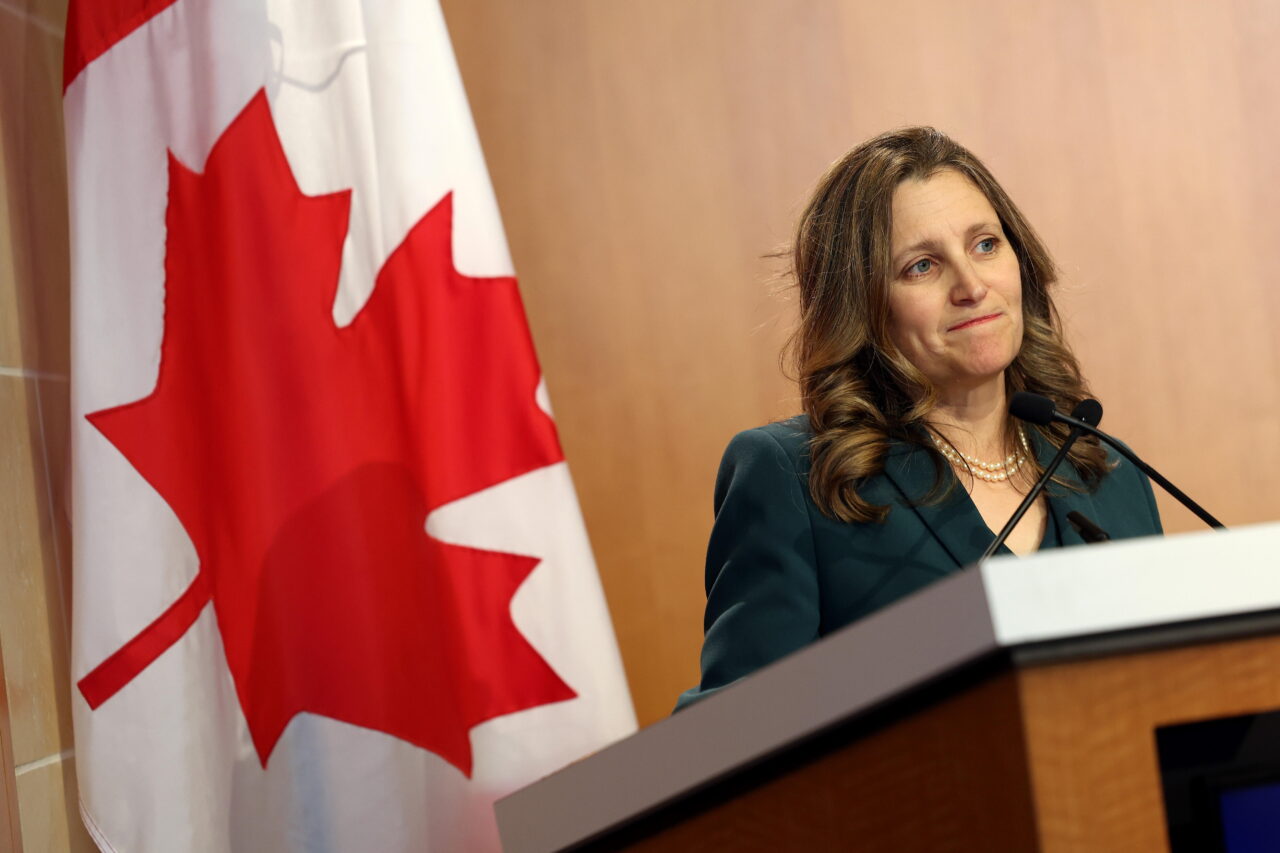
Former Canadian Finance Minister Chrystia Freeland speaks at the Peterson Institute for International Economics in Washington on April 12, 2023.
Kevin Dietsch / Getty Images
Former Canadian Finance Minister Chrystia Freeland speaks at the Peterson Institute for International Economics in Washington on April 12, 2023.

Canada’s latest tariffs on American goods took effect Tuesday. It’s another escalation in a trade war that is raising costs and testing a relationship that, until recently, was among the closest in the world.

Prime Minister Mark Carney’s government imposed tariffs of up to 50% on about $20 billion worth of U.S. goods in response to U.S. tariffs on Canadian products. The latest measures match U.S. tariffs dollar for dollar, though not product for product.

But in Canada, the fight has become about more than tariffs. Many Canadians say they feel betrayed by a longtime ally. President Trump has repeatedly suggested Canada should become the 51st state and has said he would use economic pressure, rather than military force, to make that happen. Canadians have cut back on travel to the United States and boycotted American goods as tensions have grown.

And the economic ties are hard to untangle. U.S. auto exports to Canada have fallen 22% since the trade dispute began. Canada is the largest customer for 26 U.S. states and a top-three customer for 45.

Chrystia Freeland understands the relationship from her time at the negotiating table. The former Canadian deputy prime minister and finance minister helped negotiate the U.S.-Mexico-Canada Agreement during Trump’s first term. Trump once called it “the best trade deal ever.”

Now, Freeland says, the U.S. risks pushing longtime allies away.

“If Americans are concerned about China in the world, which I am, the best way to act on China is with an alliance with America’s traditional allies,” Freeland told NPR’s Morning Edition. “But it has to start with stopping punching your friends in the face, which is what Washington is doing right now.”

Freeland also pushed back on the idea that Canada’s much smaller economy means it ultimately has to give in.

She recalled a small meeting during an earlier round of North American trade negotiations when, she said, she was told the United States was 10 times bigger than Canada and therefore “should get our way 10 times more than you.”

“That is not a way to have a partnership,” Freeland said, “and Canadians simply won’t stand for it.”

Listen to the full interview by clicking the blue play button above. Peter Armstrong contributed reporting from Toronto.

Steve Inskeep is a host of NPR's Morning Edition, as well as NPR's morning news podcast Up First.

Known for interviews with presidents and Congressional leaders, Inskeep has a passion for stories of the less famous: Pennsylvania truck drivers, Kentucky coal miners, U.S.-Mexico border detainees, Yemeni refugees, California firefighters, American soldiers.

Since joining Morning Edition in 2004, Inskeep has hosted the program from New Orleans, Detroit, San Francisco, Cairo, and Beijing; investigated Iraqi police in Baghdad; and received a Robert F. Kennedy Journalism Award for "The Price of African Oil," on conflict in Nigeria. He has taken listeners on a 2,428-mile journey along the U.S.-Mexico border, and 2,700 miles across North Africa. He is a repeat visitor to Iran and has covered wars in Syria and Yemen.

Inskeep says Morning Edition works to "slow down the news," making sense of fast-moving events. A prime example came during the 2008 Presidential campaign, when Inskeep and NPR's Michele Norris conducted "The York Project," groundbreaking conversations about race, which received an Alfred I. duPont-Columbia University Silver Baton for excellence.

Inskeep was hired by NPR in 1996. His first full-time assignment was the 1996 presidential primary in New Hampshire. He went on to cover the Pentagon, the Senate, and the 2000 presidential campaign of George W. Bush. After the Sept. 11 attacks, he covered the war in Afghanistan, turmoil in Pakistan, and the war in Iraq. In 2003, he received a National Headliner Award for investigating a military raid gone wrong in Afghanistan. He has twice been part of NPR News teams awarded the Alfred I. duPont-Columbia University Silver Baton for coverage of Iraq.

On days of bad news, Inskeep is inspired by the Langston Hughes book, Laughing to Keep From Crying. Of hosting Morning Edition during the 2008 financial crisis and Great Recession, he told Nuvo magazine when "the whole world seemed to be falling apart, it was especially important for me ... to be amused, even if I had to be cynically amused, about the things that were going wrong. Laughter is a sign that you're not defeated."

Inskeep is the author of Instant City: Life and Death in Karachi, a 2011 book on one of the world's great megacities. He is also author of Jacksonland, a history of President Andrew Jackson's long-running conflict with John Ross, a Cherokee chief who resisted the removal of Indians from the eastern United States in the 1830s.

He has been a guest on numerous TV programs including ABC's This Week, NBC's Meet the Press, MSNBC's Andrea Mitchell Reports, CNN's Inside Politics and the PBS Newshour. He has written for publications including The New York Times, Washington Post, the Wall Street Journal, and The Atlantic.

A native of Carmel, Indiana, Inskeep is a graduate of Morehead State University in Kentucky.

Related Stories