
VPM News photographer Shaban Athuman is back at the Virginia State Capitol for what promises to be another eventful General Assembly session.
Over the next two months, he will bring you regular updates from the Legislature — capturing everything from the state’s historic inaugurations to the small, human moments that lawmakers experience throughout.
Wednesday, April 15
In the lead-up to this year’s General Assembly session, I ran into a group of advocates that I had seen during Abigail Spanberger’s campaign for governor. The advocates were asking Spanberger to consider repealing Virginia’s longstanding “right-to-work” law, which prohibits union membership or payment of union dues from being a condition of employment.
The law has been in place since 1947 and has not been changed since 1973. Supporters say it keeps Virginia’s economy competitive and worry about forced unionization. Opponents say it undercuts labor’s bargaining power by letting workers reap the benefits of union membership without having to pay into the union.
In response, Spanberger said that she was looking at all options. But by the time she addressed a joint session of the General Assembly on the first Monday following her inauguration, she had made her choice.
“I will not repeal Virginia’s right-to-work status,“ she said.
She said her position was to ensure stability for the commonwealth’s business community, adding that “being pro-business and being pro-worker are not mutually exclusive.”
Following the governor’s speech, the advocates pivoted, asking for the right to collectively bargain public employees. Virginia’s ban on collective bargaining for government workers (except in localities, like Richmond, that have enacted ordinances to allow it) is a remnant of the Jim Crow era, when segregationist politicians enacted the ban in 1946 to prevent a group of Black employees at the University of Virginia’s hospital from pushing for better pay and working conditions.
After months of negotiations, advocates and lawmakers agreed to create a statewide Public Employee Relation Board, which would take over many of the roles held by the National Labor Relations Board — including overseeing the certification elections for would-be bargaining units of state or local government employees (though not home health workers or faculty at public colleges).
Janet Boston, a former frontline union member turned organizer, was watching from the gallery on the last day of the regular legislative session as the House of Delegates and Senate reached final agreements on many bills. After the House agreed to Del. Kathy Tran’s (D–Fairfax) conference report, Boston jumped to her feet in celebration, thinking it was nearly the end of the long fight for expanded collective bargaining.
But Spanberger proposed a substitute to the bill as part of her package of amendments and vetoes. The governor’s new proposal would not take effect until after her administration ends. It would also stagger eligibility for collective bargaining, starting with state-level employees and adding local bargaining units 18 months later.
“I think it’s important to lead by example,” Spanberger said a day after amending the bill. “So, moving state employees first once the PERB is up and running, allowing for state employees to go first in the process.”
–S.A.


Monday, March 9
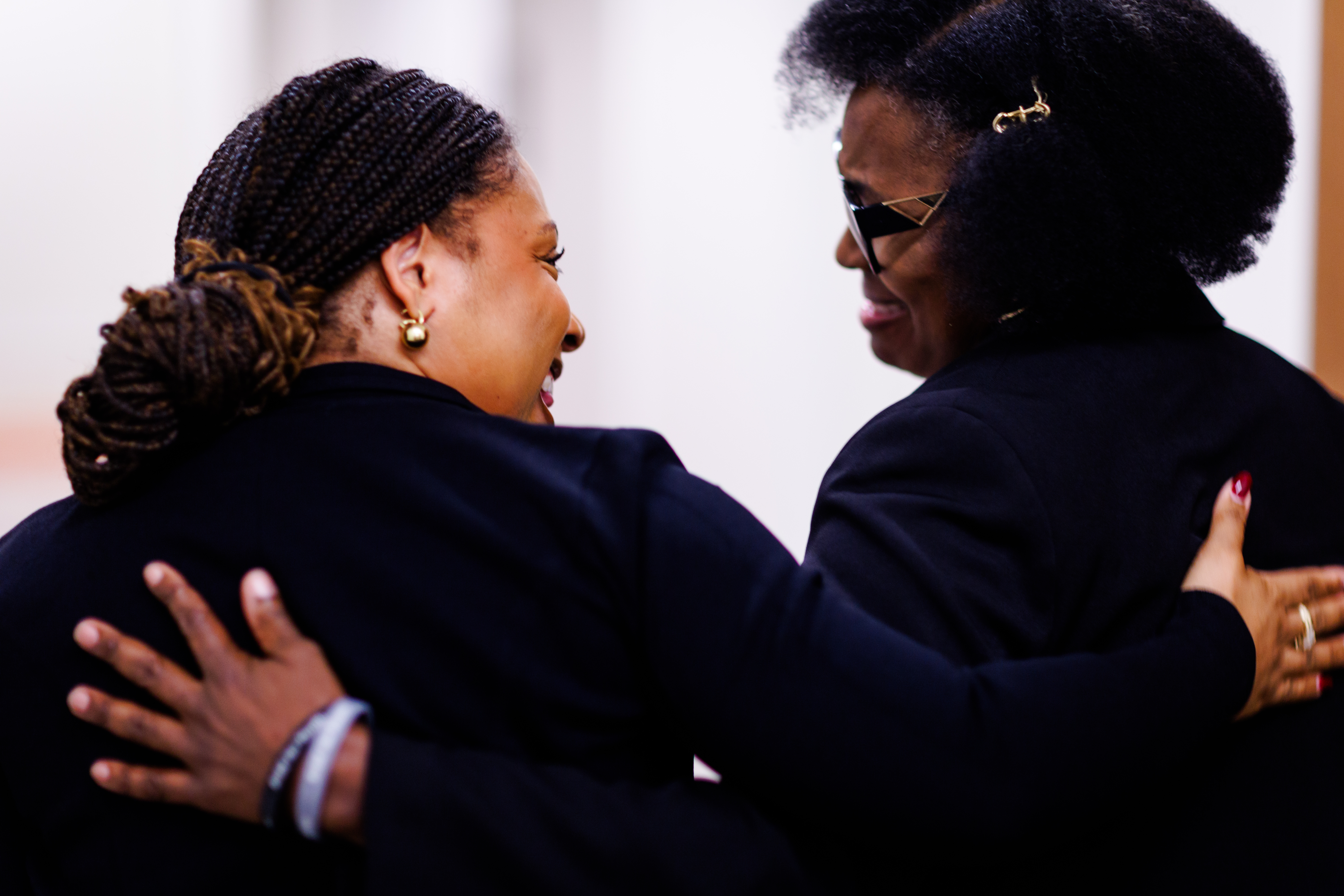
“We did it! Someone is gonna look after our kids!”
Those were the words of Del. Destiny LeVere Bolling (D–Henrico) as she embraced Valerie Slater, the executive director of RISE for Youth, a nonprofit “committed to dismantling the youth prison model and ensuring every space that impacts a young person’s life encourages growth and success.”

The Senate Finance and Appropriations Committee had just unanimously approved HB438, a bill LeVere Bolling introduced to create a diversion program that would keep certain delinquent youths out of the court system.

Later that day, the delegate said her joy came from the fact that the bill would help people like her foster son, who “fits into the category of a student that this could have helped because he got in trouble back in middle school.”
“He was able to turn his life around, and he’s doing really amazing things as a second-year college student that I’m very proud of,” LeVere Bolling said. “I know that not all communities have the power and the resources to be a community ‘village’ to help students like that.”
Thursday, Feb. 26
Things grew tense on the House floor last Thursday when Republican Dels. R. Lee Ware and Tom Garrett used moments of personal privilege to speak in opposition to SB636, which would remove Confederate statues from Capitol Square and store them until further legislative action.
Ware (R–Powhatan) rejected the notion that Confederate Gens. William “Extra Billy” Smith (who was governor in the 1840s) and “Stonewall” Jackson and Dr. Hunter Holmes McGuire were traitors against the United States. The longtime history teacher said that in the 1860s, most people considered their home state to be their country.
Instead of removing the statues of Jackson, McGuire and Smith, Ware added, Virginia should add a monument to “another great Virginian,” Booker T. Washington — a prominent Black educator after the war.
The Central Virginia delegate also said the sale of Black Africans into slavery in North America was only a small portion of the global slave trade throughout history, citing commentary from prominent historian Henry Louis Gates Jr. that society “must attribute responsibility and culpability where they truly belong: to white people and Black people on both sides of the Atlantic.”
Afterward, Del. Michelle Lopes Maldonado (D–Prince William) said she was “astounded” at Ware’s comments, “using soft words, equating what was pure inhumanity — murder, rape, pillage — in our history and using language about ‘both sides.’ There’s no ‘both sides.’”
She added: “There is also no equivocating statues in public places for people who looked at people like me and people who look like me as less than human.”
Garrett (R–Buckingham) disagreed.
“I wasn’t offended by the comments of the delegate of Powhatan,” he said. Garrett went on to equate attempts to reckon with historical racism in America with “a playbook in Marxism that says we pit one group of people against another group of people” and accuse those who want Confederate statues removed of wanting “to destroy America so they can consolidate power.”
He concluded his remarks: “We are great. We were great and we can be greater. But what we can’t do is destroy this special experiment — imperfect though it may be — that is America by telling our children that it is evil, when indeed it is both evil and good, and we together can make it even better.”
Several Democrats, including Dels. Michael Feggans (Virginia Beach), Marty Martinez (Loudoun), Atoosa Reaser (Loudoun) and Holly Seibold (Fairfax) turned their backs during Garrett’s comments. Del. Laura Jane Cohen (Fairfax) held Feggans’ hand tightly as they listened.


After the heated debate, both chambers passed their budgets. During floor debate, Sen. Danica Roem (D–Prince William) thanked Sen. L. Louise Lucas (D–Portsmouth) for adding an amendment that would end a billion-dollar tax exemption for data centers — a provision not in the House’s budget. Roem gave Lucas a fist bump after the budget passed.
Both chambers also moved amendments to give themselves a raise after the 2027 elections. The budget is expected to go into conference, meaning groups of legislators from each chamber will come together for negotiations to iron out any differences between the two proposals and deliver one final agreed-upon budget.


Wednesday, Feb. 25
One of the more lighthearted events of every General Assembly session is the Capitol Square Basketball Classic, where teams from various parts of the state government gather at the Siegel Center to raise money for VCU’s Massey Cancer Center. This year’s classic brought in $70,000 for the Massey Center.
In a repeat of recent results, Team Lobbyists took another beating from Team Governor Monday — though Gov. Abigail Spanberger was not there to demonstrate her hoop skills.
The main event, as usual, was the battle between the House and the Senate, MCed by Dels. Bonita Anthony (D–Norfolk) and Holly Seibold (D–Fairfax). Secretary of Finance Mark Sickles and Secretary of Natural and Historic Resources David Bulova, both former delegates, were on hand to watch the game along with their former House colleagues.
The game came down to the wire, with Surry County Supervisor Cameran Drew — Virginia’s youngest elected official (he’s 19) and a legislative aide to Del. Kimberly Pope Adams (D–Petersburg) — hitting a clutch shot to send it into overtime.
Unfortunately for the House, the delegates crumbled in the two-minute extra period, delivering a second straight victory to the Senate. It wasn’t all bad for the lower chamber, though; the House pages’ energy in cheering for their team was enough to claim the spirit award.


Friday, Feb. 20
Crossover week at the General Assembly is first and foremost a mad rush to move legislation from one chamber to the other. But this year, it was also a time to honor people — on occasions both joyous and somber.
Del. Elizabeth Bennett-Parker (D–Alexandria) delivered an emotional farewell address to her colleagues in the House of Delegates … before moving across the building to become Sen. Elizabeth Bennett-Parker (D–Alexandria). She took over the Senate seat vacated by Adam Ebbin, who left the Legislature to join Gov. Abigail Spanberger’s administration as a senior adviser at the Virginia Cannabis Control Authority.
Bennett-Parker took some time to share memories with her former House colleagues as she cleared her desk. The next day, after she was sworn into her new office, her daughter stole the show with her playful energy on the Senate floor.
The House also crowned Norfolk Democrat Phil Hernandez as its new oyster-eating champion, succeeding reigning champion Del. Shelly Simonds (D–Newport News), and honored US Circuit Judge J. Harvie Wilkinson III for his more than 40 years of service on the US Court of Appeals for the 4th Circuit.
Both chambers also said goodbye to dear colleagues and longtime friends. The House paid its respects to longtime Virginia Beach Del. Barry Knight, who died last Thursday. And Sen. Jennifer Boysko (D–Fairfax) honored her longtime friend Sincere Allah — a criminal justice reform advocate and community organizer who died earlier this month.


Monday, Feb. 16
As the halfway point of the session approaches, each chamber has to wrap up its business by Wednesday so that bills can cross over to the other chamber.
Emotions run high in the days leading up to crossover, with some legislators even crossing themselves before they present their bills in committee. Some of those prayers were answered, while others were left on the cutting room floor.
In the Senate Finance and Appropriations Committee, a bill that would bring a casino to Fairfax County — which failed in both 2024 and 2025 — was revived, sparking spirited debate within the county’s Senate delegation. Opponents of the casino voiced their concerns at a press conference the following day.
Bill debates have not been the only sources of emotion on Capitol Square.
In late January, legislators dressed in orange for Multiple Sclerosis Awareness Day. Del. Jeion Ward (D–Hampton), the chair of the House Labor and Commerce Committee, described her daily struggle with the disease, and colleagues offered hugs and words of encouragement.
And last week, Secretary of the Commonwealth Candi Mundon King, a former Democratic delegate from Prince William County, received a standing ovation at a meeting of the Sickle Cell Anemia Caucus. King’s 15-year-old daughter, Candis, died of sickle cell disease — a blood disorder that disproportionately affects Black people — in 2025
crossover


Tuesday, Feb. 3
The winter storm that passed through Central Virginia in late January has disrupted life for many families, with several school districts still yet to fully reopen more than a week later. State lawmakers and the people who interact with the General Assembly throughout the session were not immune to those effects, so many of them brought their children to Capitol Square with them.
On Tuesday, Jan. 27, a judge in Tazewell County Circuit Court ruled in favor of a group of Republican legislators who sued to block Democratic efforts to redraw Virginia’s congressional maps ahead of the 2026 federal midterm election. State Sen. Ryan McDougle (R–Hanover) was one of the plaintiffs in that lawsuit; his daughter, Reagan, helped run papers back and forth while her father read through the decision during a Senate Finance and Appropriations Committee meeting.
A day later, Dana Wiggins, director of the Center for Economic Justice and Consumer Advocacy at the Virginia Poverty Law Center, was supervising her 7-year-old son, Theo Rudney, as he passed the time with his new obsession: Prodigy Math, an online game that uses a fantasy world full of wizards and magic as an opportunity to practice math skills. Wiggins said she “wishes he was spending time away from screens, but at least he is playing a game that teaches him something good.”
In a nearby Senate committee room, Alison Powers, director of policy and education at the Virginia Indigent Defense Commission, kept track of bills as her kids worked on drawings and school work.
And as the week came to a close, freshman Del. Kacey Carnegie’s (D–Chesapeake) kids excitedly escorted their mother back from the Virginia State Capitol to her office in the General Assembly Building.
This week, with many school districts still closed, Del. Kelly Convirs-Fowler’s (D-Virginia Beach) daughter, Scarlett Fowler, joined her on the House floor and helped her cast her votes.


Monday, Jan. 26
The winter storm that swept across the US over the weekend didn’t shut down General Assembly activity altogether — but several meetings were canceled, leaving lawmakers with a fairly light agenda on a frigid Monday.
On his way from the General Assembly Building to the Virginia State Capitol, state Sen. Glen Sturtevant (R–Chesterfield) jammed his heel into the densely-packed, icy snow to find a grip, one of many tricks legislators used to navigate snow-covered Capitol Square.


Monday, Jan. 19
Abigail Spanberger, the commonwealth’s first woman governor, delivered her first address to a joint session of the Virginia General Assembly.
She was joined in the room by many other historic officeholders, including Lt. Gov. Ghazala Hashmi, the nation’s first Muslim-American woman to hold statewide office; Jay Jones, Virginia’s first Black attorney general; Sen. Louise Lucas (D–Portsmouth), the first woman to serve as Virginia Senate president pro tempore; and Del. Don Scott (D–Portsmouth), the first Black speaker of the House of Delegates.
Nearly all of the women in attendance wore white, as Spanberger did for her inauguration on Saturday, as a nod to the women’s suffrage movement.
After the over hour-long speech, which led with nearly three minutes of non-stop applause, Brianna Dougherty — daughter of freshman Chesterfield Del. Lindsey Dougherty (D–Chesterfield) — rushed towards the dais and hugged the governor.


Earlier in the day, Hashmi — a former state senator representing parts of Chesterfield County and the City of Richmond — presided over the Senate for the first time since taking her oath of office. Her successor, Sen. Mike Jones (D–Chesterfield), was introduced to the Senate.
Peter and Terry Ann Turck, seated in the Senate gallery, were recognized for their advocacy for gun safety reforms. Their son, Richmond theater actor Adam Turck, was shot and killed last summer when he intervened in a domestic dispute in Shockoe Bottom.


Saturday, Jan. 17
In the Virginia Stage Capitol’s rotunda, Jay Jones was waiting with his family. In the hands of his mother, Norfolk Judge Lyn Simmons, was the bible her grandfather used during World War II. His copy became the family’s bible, and the passage of time and living history of the people who used it is visible in the well-worn cover.
A little while later, Jay Jones took his oath as Virginia’s first Black attorney general on that bible held by his wife, Mavis, holding one of his children — and administered by his mother.
Shortly before taking her own historic oath, Abigail Spanberger approached her three daughters and kissed each of their heads while squeezing their arms tightly. As the daughters prepared to leave the incoming governor before Saturday’s ceremony, eldest daughter Claire returned the pressure — squeezing her mother’s hands tightly one more time.
Tears flowed down Claire Spanberger’s face right as her mother formally became Virginia’s first woman governor; after her oath, Gov. Abigail Spanberger kissed the side of Claire’s head.
Read more coverage of Saturday’s historic inauguration.


Friday, Jan. 16
It was a day of transitions at the Virginia State Capitol, with lawmakers and staff preparing for Saturday’s inaugural festivities.
The Senate voted to approve four constitutional amendments, setting the stage for Virginia voters to have the final say later this year. After they completed their business for the day, senators honored outgoing Lt. Gov. Winsome Earle-Sears — who has presided over the Senate for the last four years — for her many years of public service, including a $2,500 charity donation in her honor.
Earle-Sears also symbolically passed the Senate gavel to her successor as lieutenant governor, former state Sen. Ghazala Hashmi.