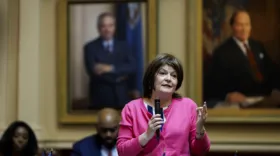
State Sen. Lashresce Aird (D–Petersburg) is carrying a bill that advocates hope could set a model for eliminating a source of PFAS, commonly known as “forever chemicals.”
Virginia’s environment is contaminated with these per- and polyfluoroalkyl substances. The chemical compounds have been used since the 1940s and are found in everything from rainproof clothing to non-stick cookware to car tires — and firefighting foam.
Studies show that the chemicals appear to have a range of health and environmental impacts: They may be responsible for decreased fertility, increased cancer risk and a reduced ability to fight infections. Once they find their way into the environment, they don’t break down or do so very slowly, hence the “forever” moniker.
The compounds can also make soil less productive for agriculture and wild plant life by repelling or inhibiting microbes, earthworms and other beneficial species, along with interfering with the reproduction of a wide range of critters in contaminated areas.
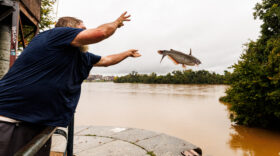
One such contaminated area is in the James River basin. The Virginia Department of Health issued a Do Not Eat order in Henrico County for creek chubsucker, chain pickerel and sunfish from White Oak Swamp Creek near Richmond International Airport downstream to the confluence of White Oak Swamp and the Chickahominy River in May 2025.
Another advisory against eating more than two meals per month of chain pickerel, largemouth bass and sunfish extends into Hanover, New Kent, James City and Charles City counties.
That’s due to contamination by perfluorooctane sulfonic acid (PFOS) discovered in those species from 2021 to 2023 — PFAS contamination is also found throughout that watershed.
State agencies suspect Richmond International Airport (RIC) and adjacent properties (military installations and the Richmond Firefighting Academy) could be contributors through past use of firefighting foam, though no source has been conclusively named.
In one surface water sample bordering the airport, the concentration of PFAS was recorded at 1,102.12 parts per trillion — the highest individual reading on the state’s PFAS dashboard.
A July 2020 Army National Guard report on possible sources was largely inconclusive, as PFAS releases on site were rarely tracked — “because PFAS were considered benign.” And in instances where PFAS use was confirmed, such as aircraft crashes in 1996, 2008 and 2012, an unknown amount of PFAS-containing foam was used.
A 2023 follow-up report on one area of interest — a flightline and fuel point used by the Virginia Air National Guard — similarly calls for further investigation, but states “the pathway for exposure to drinking water receptors from historical DoD activities at [the area of interest] is potentially complete.”
Airports are required by the Federal Aviation Administration to keep firefighting equipment on hand, including Aqueous Film Forming Foam. AFFF, particularly formulations released before 2000, can contain multiple types of PFAS including PFOS.
The airport has since stopped using AFFF in its trainings. It maintains fire extinguishers with the substance in case of emergency, per FAA regulations, but is also in the early stages of planning to transition away from the polluting mixture.
The FAA in 2023 published a military specification for fluorine-free foam, also known as F3, an alternative that contains small or no amounts of PFAS.
Aird’s bill simply requires the Capital Region Airport Commission to submit a plan to the General Assembly that would see Richmond International Airport transition to a PFAS-free alternative firefighting foam by 2030.
Jay Ford, Virginia policy manager with the Chesapeake Bay Foundation, told lawmakers during a January hearing on the bill that PFAS management should be a priority for lawmakers.
“We think this is a really thoughtful approach; we’re not mandating anything, we’re saying, ‘Tell us how you’re gonna do it,'” Ford said.
A spokesperson for Richmond’s commercial airport stressed that there is no guarantee the alternatives would be free of the “forever” compounds.
Aird said we no longer live in a PFAS-free society, but said she’s deeply concerned by the prevalence of the chemicals in food, water and the environment.
“I think any incremental step that we can take to lessen the amount of PFAS that’s being produced into materials that are likely to have entry into our water sources, we should take every deliberate step we can to try and rid ourselves of that,” Aird said.
There is also no guarantee that alternatives, including F3, are non-toxic — the Environmental Protection Agency found in a study comparing F3 foams with AFFF options that the PFAS-free alternatives were more acutely toxic to aquatic animals. But they have the advantage of breaking down more quickly in the environment, unlike “forever chemicals.”
Aird’s bill passed the House and Senate unanimously, with two senators voting against an amendment pushing the transition timeline back two years, to 2030.
It awaits action from Gov. Abigail Spanberger. She has until April 13 to sign, veto or amend the legislation.
Copyright 2026 VPM