One of the most wide-ranging pieces of utility legislation that passed the General Assembly this session may grow even further after amendments from Gov. Abigail Spanberger.
Del. Destiny LeVere Bolling’s (D–Henrico) HB1393 and state Sen. Louise Lucas’ (D–Portsmouth) SB253 cover electric line undergrounding, utility weatherization programs, data center grid costs, long-term fuel payments and more.
Spanberger made some changes to how the bills address those items — and has moved to retroactively limit Dominion Energy Virginia’s earnings in the current rate cycle.
The bills are similar, but not identical — LeVere Bolling’s includes a section ordering regulators at the State Corporation Commission to consider workforce protections and utilize a prevailing wage rate as part of its approval process for power plant construction.
Distribution line undergrounding
The General Assembly has allowed Dominion to underground the most outage-prone distribution lines on its system — the smaller electrical wires that carry electricity from substations to its final destination, such as homes and businesses — since 2014.
Existing law requires the SCC to approve certain projects that would cost less than $750,000 per mile on average, as long as they don’t increase overall rates too much. Any projects more expensive per mile would be subject to the commission’s scrutiny. Dominion estimated in 2024 that its average per-mile cost was $734,547.
The proposal to extend the program was controversial even before the General Assembly session began in January.
As a compromise, language was constructed by the state Commission on Electric Utility Regulation that would allow the per-mile cost of undergrounding projects to go up to $900,000 before facing SCC scrutiny, while the overall allowable impact on base rates was reduced slightly. Expanding the weatherization program, which helps the utility’s low-income customers reduce their monthly bills, was also part of the compromise.
Spanberger has moved to essentially flip the script. Rather than an automatic approval threshold, her proposals grant the SCC authority to deny projects under $900,000 per mile, while anything costlier would be automatically denied. And she requested to limit the overall allowable impact to base rates further than the CEUR compromise did.
“Undergrounding is very valuable for a whole host of reasons, but the most important thing for me as governor is that the full cost of that type of upgrade is not borne on the backs of individual ratepayers,” Spanberger said during a virtual press conference Tuesday.
Spanberger’s office did not respond to VPM News’ further questions about the undergrounding program or other aspects of her amendments prior to publication.
Ratepayer advocates are supportive of limiting the undergrounding program, arguing its benefits do not outweigh the costs for most customers on Dominion’s system. A typical customer using 1,000 kilowatt-hours per month would pay about $4.88 monthly to cover the program.
Supporters of the work say reducing outage frequency and time to restore power has wide-ranging economic and health benefits for Dominion’s customers.
Data center costs
Lucas caused a stir mid-session by adding language to SB253 that would allow the SCC to determine whether some specific data center-related costs would continue to be covered by smaller ratepayers. LeVere Bolling’s measure also took on the new language.

It addressed capacity market costs — basically, the price of doing business on the electricity market operated by PJM Interconnection. As data center demand has increased in PJM’s territory without enough new generation to match — and as some carbon-emitting power plants have been retired in an effort to slow the effects of climate change — market costs have reached historic levels.
The mid-session amendment also addressed financing for distribution infrastructure built specifically for data centers. Dominion starts recovering those costs from all of its customers before the data centers served by the new infrastructure start paying bills.
Lucas’ and LeVere Bolling’s bills would request the SCC to consider if those costs should fall on customers in the GS-5 rate class — a new designation for Dominion customers that have exceptionally high electricity demands, which includes data centers.
It’s estimated that shifting costs to GS-5 customers would save other ratepayers $5.52 on a 1,000 kWh monthly bill.
Spanberger amended the bills to remove specific language on capacity market and distribution financing costs, opting for watered down language ordering the SCC to ensure that GS-5 customers “are not being subsidized by other customers of the utility,” but not laying out a specific mechanism to achieve that.
Rate of return
Spanberger also added language that would likely reduce electric rates, but appeared to walk back a commitment by the Legislature to not interfere with the SCC’s authority to determine how much Dominion profits on its investments. The General Assembly regularly set Dominion’s rate of return, either at a specific percentage or within a range, prior to the utility’s 2025 rate case.
Under current state law, the commission reviews Dominion’s planned expenditures every two years and determines how much profit the utility will be authorized to make on its investments. Regulators also look at Dominion’s actual earnings over the previous rate period to determine if the company earned more or less than that authorized percentage profit.
In 2025, the commission set Dominion’s rate of return at 9.8%. Spanberger wants it to essentially revise that down to 9.3% when it conducts the 2027 rate review. If Dominion earned more than that, she wants the commission to order any excess earnings be credited back to ratepayers over the following two years.
It’s not clear exactly how much of a reimbursement that would result in. A spokesperson for the SCC said commission staff has not performed an analysis of the change.
Lawmakers reconvene next week
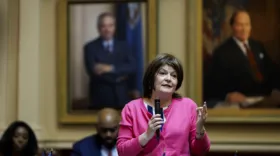
LeVere Bolling said in a written statement that she was still reviewing the governor’s amendments, but planned to oppose most of the changes Spanberger suggested. She said the bill that passed the Legislature represented months of work to come to an agreement — and that she was not given the opportunity to discuss the governor’s proposed changes before they were sent back to the statehouse.
“Many of the proposed amendments go beyond technical edits and instead make significant policy shifts, altering cost recovery structures, changing key thresholds, and revising how the State Corporation Commission evaluates utility investments and customer impacts,” LeVere Bolling wrote. “These changes materially impact the balance that the General Assembly worked to achieve.”
Aaron Ruby, a spokesperson for Dominion, made similar comments.
“We fully supported the legislation’s original goals of lowering costs for our customers, expanding energy assistance, and reducing outages. The amendments undermine these goals. We will remain engaged as the legislative process continues to preserve the original goals of the legislation,” Ruby wrote.
Because Spanberger offered amendments on HB1393 and SB253 — rather than full substitutes, which she proposed for many other bills — the Legislature has the option to approve some of the changes while rejecting others. She did not amend the section of the bills that expands Dominion’s weatherization program.
Lawmakers will reconvene on Wednesday, April 22, to consider the governor’s actions on their bills. If they choose to reject the proposed amendments, Spanberger will then have to decide whether to sign or veto the bills as originally passed.
Copyright 2026 VPM