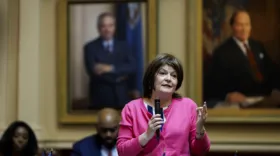
Del. Lee Carter (D-Manassas) cuts an unusual profile in the General Assembly. The Lyft-driving, Twitter-famous former Marine is also the legislature’s only self-described socialist. For the second year, he’s taking on a sacred cow in Virginia politics: the right-to-work law.
This time, with Democrats in charge of the legislature and a senior lawmaker also pushing changes to the law, business interests are taking notice. They’ve mobilized a public relations and lobbying campaign against the effort, with a flurry of op-eds, editorials, and media outreach.
Carter seems to relish the confrontation.
“I’m not surprised bosses don’t like it,” he said. “The whole point is to fight back against them.”
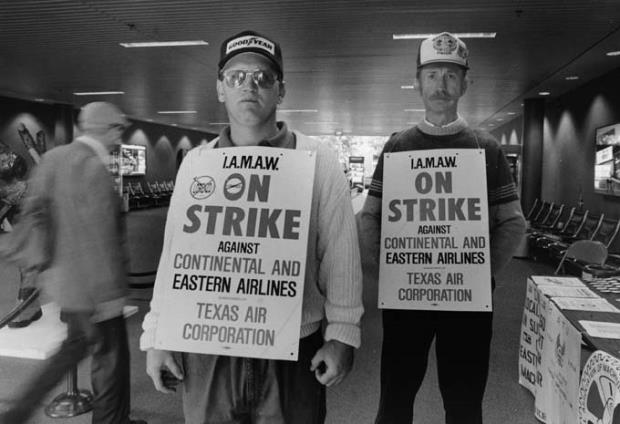
Virginia’s right-to-work law bans workplaces from requiring employees to join unions. Backers of the law say employees shouldn’t be forced to join a union or pay dues in a unionized workplace. Critics like Carter say it weakens unions by allowing non-unionized workers to benefit from collective bargaining.
The debate comes as lawmakers grapple with two 2019 scorecards: CNBC’s ranking of Virginia as the best state to do business and Oxfam’s ranking it the worst state for workers. Labor advocates connect the latter score in part to relatively weak unions; Virginia has one of the lowest rates of union membership in the country.
Virginia’s right-to-work law hasn’t faced a serious challenge in decades. But while Carter’s proposal may be a long shot this year — Gov. Ralph Northam has already suggested he would veto it — another proposal from Senate Majority Leader Dick Saslaw (D-Fairfax), the longest-serving member of the legislature, may have better odds.
“The business community for years has told me there’s no such thing as a free lunch,” Saslaw said. “And that’s what I believe.”
Saslaw surprised some allies in the business community when he filed his “ fair share” bill. It would allow unions to charge workers a fee for their bargaining in unionized workplaces. Unlike Carter’s legislation, it’s not a full repeal, and the fees couldn’t be used to pay for political activities.
Saslaw says workers wouldn’t end up paying much from their monthly paycheck.
“Their share of that will probably be about half an hour,” he said. “Okay? Nothing.”
Todd Haymore has a different perspective. He works in the offices of the law and government relations firm Hunton Andrews Kurth, at the top of a downtown office tower that feels more Manhattan than Richmond.
Each corridor of the 20th floor serves up slow-moving vistas of Richmond: the James River churning through last week’s rain, I-95 ferrying commuters home, cranes poking out of new construction sites.
Haymore sees signs everywhere of a thriving state economy.
“There’s plenty of unfilled jobs,” Haymore said. “We’ve got a 2.6 unemployment rate for two months in a row. The economy is booming.”
As Secretary of Commerce under former Governor Terry McAuliffe, Haymore crisscrossed the Commonwealth, inking projects that helped further McAuliffe’s reputation as an economic dealmaker.
“When I was recruiting business and industry to the state or talking to businesses that were looking to expand, right to work was one of the things that they care about deepest,” he said.
Now Haymore’s representing Virginians for Free Choice, a coalition of businesses, trade groups, and local chambers of commerce who are lobbying against any changes to right to work, including Saslaw’s bill.
“I think [repeal] would be very, very detrimental to Virginia standing as a pro-business pro-growth pro-employee state,” he said.
Carter and Haymore give conflicting information on how right-to-work affects incomes, job growth, and employee well-being.
Tom VanHeuvelen, a sociology professor at the University of Minnesota who has studied right to work, said existing research offers mixed answers. That’s in part because of the difficulty of isolating the effects of a policy that in many states has been in the books for decades.

“My hunch is that repealing right to work itself wouldn’t act as a light switch turning on or off some major economic change in Virginia’s economy,” he said.
But VanHeuvelen’s forthcoming paper in the American Journal of Sociology suggests the law did have a substantial upward effect on inequality in states with heavy union membership. And in times and places where unions have been powerful, there’s academic consensus that they’ve provided benefits to both members and non-members.
“Unions also have been important actors and getting sort of folks who are less likely to be politically involved and less likely to do things like vote,” VanHeuvelen said.
The researcher suspects that’s one reason why the business community has galvanized so forcefully against repeal: fears that it could embolden labor politically.
Unions were part of a broad coalition that helped Democrats take the legislature in November. But it’s not clear whether lawmakers will move on right-to-work. With Republicans united against any changes, the decision will likely come down to a few Democrats.
Their first votes may come in a Senate committee meeting on Monday.