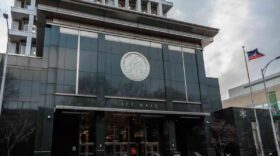
Three teenagers, including two brothers, will be released from Farmville Detention Center and Caroline Correction Center after a federal judge in Alexandria determined US Immigration and Customs Enforcement unlawfully denied them bond hearings.
The brothers, who are 18 and 19, were apprehended in late August in Newport News and have been awaiting deportation proceedings since that time. The third, Lopez Sarmiento, who is 19, was also apprehended in August outside his home in Washington, DC.
(Editor’s note: VPM News has removed a previous reference to Lopez Sarmiento’s first name to protect his safety.)
The court order is the result of Sarmiento et al. v Perry et al., an ongoing class action lawsuit filed by the ACLU of Virginia, Patrice Kopistansky and Cruz Law that argues ICE is illegally detaining immigrants with Special Immigrant Juvenile Status. If successful, the case could overturn ICE’s mandatory detention policy for youth in Virginia who’ve applied for or obtained SIJS.
Congress created SIJS in 1990 to provide a pathway to permanent residency for youth who entered the US as unaccompanied minors after being abandoned, abused or neglected, but a backlog has left immigrants from certain countries waiting years for a green card.
“SIJS was created because a child experiencing domestic abuse, sexual abuse, or other kinds of trauma needs a way to walk away from that — and, historically, the United States has offered this program,” said Monica Sarmiento, executive director of the Virginia Coalition for Immigrant Rights. “Now the Trump Administration is closing the door.” (Monica Sarmiento has no relation to Lopez Sarmiento.)
In 2022, then-President Joe Biden’s administration adopted a deferred action policy to shield people with SIJS status from deportation and allow them to apply for work permits. On June 6, 2025, US Citizenship and Immigration Services abandoned that policy.
Two of the three plaintiffs had received SIJS along with deferred action; the third had only applied for SIJS. The ACLU’s lawsuit says USCIS stripped their deferred action status without explanation and that the Department of Homeland Security appealed a judge’s decision to release them on bond.
The ACLU also confirmed that DHS revoked Lopez Sarmiento’s work authorizations. As a result, Lopez Sarmiento, who received a university scholarship but could not attend this fall because he was detained, will be unable to work legally after his release.
“These are young people just starting their lives, and they find themselves, apprehended off the street through this massive dragnet, like so many others in the DC and Virginia area,” ACLU attorney Sophia Gregg said of her clients. “They’re leaving their whole world behind.”
This experience is also consistent with recent DHS practice of detaining without bond anyone facing deportation proceedings. President Donald Trump’s administration argues that, whether someone has lived in the US “for 25 minutes or 25 years,” they remain an “applicant for admission” and must remain locked up while awaiting deportation.
This controversial legal interpretation, which extends to people with humanitarian protections like SIJS, has faced legal rebukes involving hundreds of individual cases since it was implemented in July, but class action challenges have made limited progress.
“They’re taking the position that all these individuals are legally still at the border and are not deserving of due process,” Gregg said of the practice. “But that just cannot be the case for people who entered as unaccompanied children and have all these protections around them.”
Without deferred action, many SIJS youth will not be able to apply for a work permit, drive legally or access the documentation needed to access health insurance. Jason Boyd, vice president for federal policy at Kids In Need of Defense, said the reversal exposes already vulnerable immigrant youth to new risks.
“Say you have a 17-year-old and they’re attending school, but they also face significant financial challenges,” Boyd said. “Without deferred action, as they wait years and years for a green card, they may not be able to lawfully find a job to help support themselves so that they can get the meals they need to have adequate nutrition. This leaves them in a hugely vulnerable state, and because of that, they are vulnerable to being preyed upon by labor abusers and traffickers who recognize, ‘Hey, this kid is desperate.’”
Jennifer Ward, foster care program manager at Commonwealth Catholic Charities, is already seeing the negative impact on SIJS youth. Her program aims to help foster care youth graduate from high school and find meaningful work.
“The hardest thing for me is telling kids that they have to wait to be able to move forward with their life,” she said, referencing her clients who can’t work legally. “These kids have goals, they have dreams. They don’t want to settle for the first minimum wage job they can get when they leave foster care — they want to be attorneys and doctors.”
The next step in Sarmiento et al. v Perry et al. will be for the judge to decide whether to approve the ACLU’s proposed class, which includes any immigrants denied a bond hearing in Virginia who have applied for or obtained SIJS.
VPM News reached out to ICE, the Department of Justice and DHS for comment on Nov. 5, but did not hear back by publication.