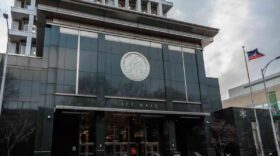
In a unanimous vote on Friday, the Virginia Commonwealth University Board of Visitors signed off on constructing a $3.6 million memorial to honor the lives of primarily African American people whose bodies were desecrated and discarded on campus over a century ago. Construction is expected to begin in summer 2027.
Stephen Davenport, VCU’s assistant vice president for social and economic development, said the remains will be reinterred respectfully inside the memorial, after having likely been stolen by medical staff for study in the 19th century.
He said the West African-inspired design elements are intended to “restore humanity and unity.” The memorial will be constructed between the Kontos Building and Egyptian Building, just steps away from where they were discarded.
“The remains were disrespected multiple times,” Davenport told VPM News.
In the mid-1800s, medical department faculty from then Hampden-Sydney College robbed graves from Richmond’s Shockoe Hill African Burying Ground. After cutting up the bodies for medical research, they were discarded in a nearby well.
When construction workers discovered the remains in the mid-1990s, the university didn’t take steps to honor their lives. Instead, university officials gave archaeologists one weekend to recover remains; those left behind were removed with a backhoe by construction workers or remain buried.
“We didn’t want to hide this history,” Davenport said. “Now, everybody going to this space – going to the Kontos Building or the Egyptian Building, both of which are still being used today – will have an opportunity to confront and reconcile that history.”
It wasn’t until the release of Shawn Utsey’s 2011 documentary “Until the Well Runs Dry,” that President Michael Rao’s administration learned of the bodies, and started a plan to honor their lives, Davenport said. Utsey, chair of the university’s African American studies department, told VPM News that during a meeting with Rao ahead of the premiere, Rao committed to doing something.
Following Utsey’s documentary, the university established a planning committee which later formed a family representative council with community members standing in place of biological descendants to help determine how to honor the remains.
“These are community volunteers who literally put a lot of effort and emotional effort into this work,” Davenport said. “They’re deeply connected to the remains.”
The effort became known as the East Marshall Street Well Project. The family council led a process to engage the community and develop a series of recommendations specific to the memorialization and interment of remains, as well as research. The first of these was to bring the remains back to Richmond, from the Smithsonian Institute, where they were being stored.
They also recommended using DNA to determine ancestry and the health conditions of the individuals.
Baneshwar Singh, an associate professor in VCU’s Department of Forensic Science, helped lead the recently-released DNA research. He said the process of studying the bones involved making a minor hole in order to extract the DNA.
“We did not cut the bone,” Singh said. “We did not want to disturb the bones.”
Singh said the group of researchers, which included about two dozen students, were able to learn a number of things about the people, including hair and eye color, age, sex and ancestry. He said most of the individuals had Central or West African ancestry.
“At least we know who these people were,” Singh said. “That’s the important part for the memorial.”
The family council also recommended a way to connect the individuals with living descendants, which he said was the only DNA-related recommendation that remains unfulfilled. Singh said they didn’t get enough volunteer DNA samples from the community in time, but said the DNA extracts remain in VCU’s possession and aren’t being destroyed in the event VCU decides to revisit the issue.
Singh said as technology continues to improve, it’s possible that someday researchers can learn more about the individuals than what they know now.
Carmen Foster, a VCU alumna and public historian, served as a member of the family representative council. Foster said the council was “very eager” to see the remains reinterred with dignity and respect.
“It is both an honor and a responsibility to represent both the remains and the community, and we take that responsibility with a sense of seriousness and purpose,” Foster told VPM News. “Our intention is to do the best that we can in service to those who are nameless.”
She said it’s possible linking the individuals with their descendants could be revisited in the future, but noted that it’s like “finding a needle in a haystack,” in part because many Richmonders migrated to the North because of Jim Crow-era segregation.
For now, Foster said the memorial is a recognition on VCU’s part about its role in “medical racism.”
She echoed others’ calls for VCU to do more to rebuild the trust of the Black community.
“Trust takes time, but I am feeling that people are open to what it means to rebuild trust,” Foster said.
“Building trust doesn’t come overnight. It doesn’t come with a memorial building. It comes with people. So it’s up to people to be committed to building trust together, and I think that this is one of many steps that are needed in this community.”
Utsey agrees this is only the first step towards restoring trust considering the university’s other past harms. In the 1960s, VCU took the heart of a Black man named Bruce Tucker without his family’s consent for Virginia’s first heart transplant.
“I’m satisfied to see that they have begun the process of restoring and rehabilitating their relationship with the Black community,” Utsey said. “This should be the beginning. There’s much more work to be done.”
He said VCU’s only recovered a fraction of the remains from the well and other areas nearby. And in order to take credit for having done the right thing, Utsey said it needs to respectfully recover the other remains and properly reinter them.
Davenport said no further excavation work is planned. He said any further excavation of the East Marshall Street Well would require “significant demolition” of the Kontos building and could jeopardize the “structural soundness” of the building.