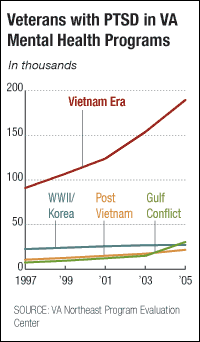
The number of Vietnam veterans seeking help for post-traumatic stress disorder has been steadily rising since the 1990s, and the rate has spiked since the United States prepared to invade Iraq in 2003.
Experts say a number of factors could be at play, including that America’s present is rekindling ideas of its past and the Iraq war is triggering Vietnam memories.
For Jim Hale, a Vietnam veteran who ran electrical generators on Phu Quoc Island for the U.S. military, the Iraq war is almost like “watching a rerun” of the Vietnam War.
Since 1987, Hale has lived off the grid with his wife, Deena, in the Ozarks, 10 miles from the nearest paved road. He said that for years he thought he was doing all right.
He’s always been a bad sleeper, and he tends to get nervous when he’s alone at night. But four years ago, Hale got pulled emotionally into helping two old war buddies whose feelings about Vietnam were resurfacing as the United States began laying the groundwork to invade Iraq. All the while, he said, he listened to the news about Iraq on his battery-powered radio.
Then Hale, too, found feelings of anger and betrayal creeping up on him. Deena pushed him to get help.
Vietnam Veterans and PTSD
In 2003, more than 153,600 Vietnam veterans sought treatment for PTSD. Some of those veterans were diagnosed years ago; some were new diagnoses.
There are plenty of theories about the reason for the spike: from aging veterans with more time on their hands, to veterans trying to game the system for government benefits. A number of experts, including those at the Department of Veterans Affairs, said Iraq has had a role in the numbers.
John Wilson is an expert on Vietnam veterans with PTSD. He’s convinced Iraq is a significant factor in the spike.
“It brings back to them their own experiences in Vietnam, and it brings back their pain and frustration since they were discharged three decades ago,” Wilson said.
Wilson thinks the parallels between Iraq and Vietnam figure into it. For example, neither war offers a front or safe place, and there is often little certainty when trying to identify the enemy in the field, he says.
Steve Harris, an Arkansas psychologist who works with the Department of Veterans Affairs, said veterans of both wars have seen and done things that they can’t accept.
“And that’s where the problems seem to lie,” Harris said.
Back of the Mind
Harris diagnosed Hale with PTSD two years ago. Hale said Iraq was the trigger that brought him in for treatment. Since his diagnosis, Hale has been going for counseling twice a month.
Hale said the counseling has helped him bring things from the back of his mind to a place where he can deal with them.
Like the time he remembered in late ’68 on Phu Quoc Island.
The military was shutting down the air base and turning it over to the Vietnamese. Hale said he was one of the last airmen left on the base.
Hale remembered what they thought was enemy fire. He remembered firing his M-16 into the jungle. And he remembered finding out it was civilians — not Viet Cong soldiers — he and his buddies had shot.
“And it was so bad, the air force flew in a C-130 Medevac,” Hale said.
He didn’t remember much else for all those years, until he’d told the story to Harris about 10 times.
Then the rest came back to him. Hale remembered he turned his head so that he didn’t have to watch the grisly scene. He said not being able to watch made him feel like a coward.
“I couldn’t look,” Hale said. “I told myself I’m here to guard, I’m not here to watch this happen. I’m going to turn around the face the dark. I don’t have to see it.”
Hale said he feels like he’s dealing with it now.
And Hale is not alone. At the local VA mental health clinic in Fayetteville, Ark., the parking lot is packed with old cars and small pick up trucks — many with bumper stickers indicating the driver is a Vietnam veteran.
Copyright 2023 NPR. To see more, visit https://www.npr.org. 9(MDM3NjYwMjA5MDE1MjA1MzQ1NDk1N2ZmZQ004) "Iraq War Stirs Memories for Vietnam Vets 2")