
I’m getting a backyard bird-feeding makeover.
Bill Thompson, the editor of Bird Watcher’s Digest who wrote the new book Identifying and Feeding Birds, recently came by my urban backyard in Washington, D.C., to make it more bird friendly.
“It’s the time of year most folks start feeding actively, ’cause we get a lot of the northern birds coming down for the winter, to what they feel is our milder climate,” Thompson says. “So it’s a great time to ramp up your feeder operation. I think that’s what we need to do here in your backyard.”
My backyard is actually less than 1/100 of an acre. I have one bird feeder there — a tube feeder, mounted on a pole. Thompson notices a dark coating of black gunk at the bottom.
“You wouldn’t want to eat something out there, right?” he says. “We often forget that, really, bird feeding, we’re doing it for us. We’re not responsible for the birds’ utter survival. So we need to do it the right way, and the right way is to really give your feeders a regular cleaning.”
That means a good scrubbing every few weeks to get rid of mold and dirt: You don’t want to make the birds sick.
As we chat, two red-tailed hawks circle high above, cruising for a squirrel. And they should have easy pickings: This is prime squirrel country.
“It’s really hard to squirrel-proof a bird feeder because squirrels are like The Flying Wallendas of the mammal kingdom,” Thompson says.
We do have a baffle on our feeder pole to keep the squirrels away. We’ve got gray ones, black ones, hungry, aggressive urban ones.
“I mean, literally, I’ve seen them practically giving each other boosts up,” Thompson says. “And one will knock the feeder and flip some seed out, and then they’ll switch places.”
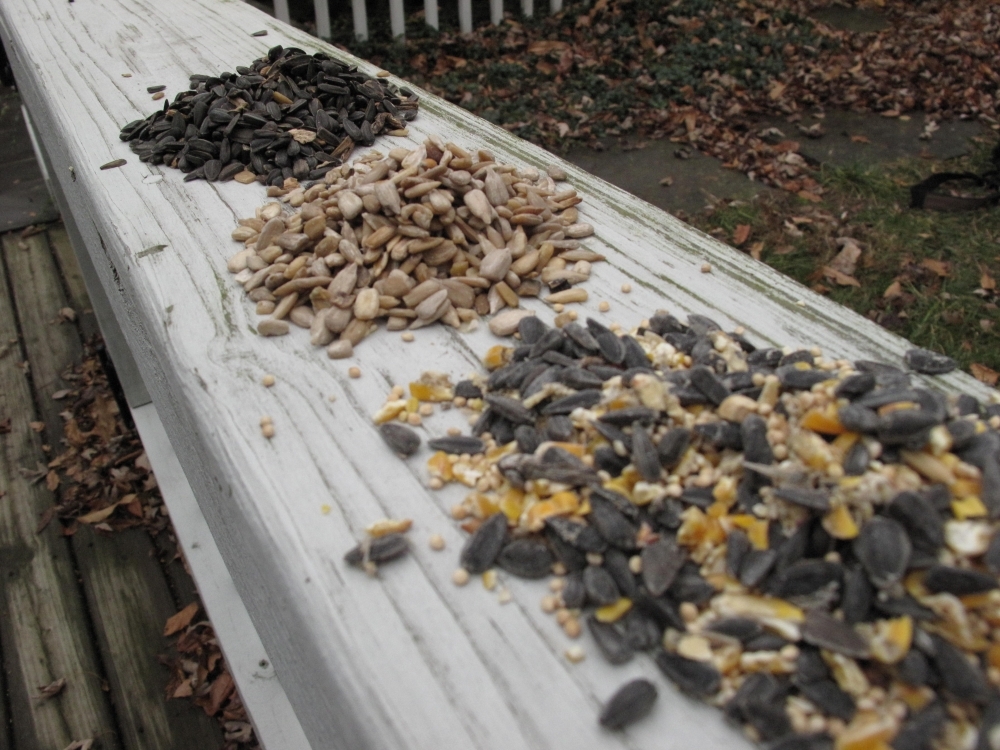
Thompson pours the seed into the feeder: It’s mostly black oil sunflower seed. It has a thin shell, with lots of nutmeat inside. And he’s brought a smorgasbord of other bird treats.
He pours peanuts into a wire mesh tube feeder.
“Peanuts are a great high-energy, high-fat food for the winter,” he says.
He’s also brought a mix of tiny thistle and Nyjer seeds, which he pours into a long mesh sock.
“This’ll be the favorite food and feeder for the gold finches and pine siskins. It’s a huge year for pine siskins. We’ve had 20 at our feeders already,” he says. “They’re very rowdy and noisy at the feeders. So if you see a bird that’s the disruptive kid in the class at the feeders, that’s gonna be a pine siskin.”
He scatters some mixed seed, cracked corn and millet for the ground feeders.
Up on the railing of our deck, Thompson sprinkles a crumbly concoction he’s mixed up: suet dough made from lard, peanut butter, cornmeal, flour and quick oats.
“This is super high-energy food for birds in winter. They love it,” he says.
Here are some more bird-friendly suggestions from Thompson: First, don’t overtidy your yard.
Also, ditch the lawn-care company if you’re trying to protect birds.
“If they’re down in your beautifully dew-covered and also chemically treated lawn grabbing an insect and taking it back to the featherless nestlings to feed them, sometimes those chemicals can transfer right to the young and they can’t handle it,” he says. “It can be pretty toxic.”
One last thing: Keep Fluffy indoors.
“Cats kill millions if not billions of birds every year. Cats are this superpredator that we’ve put in artificially in our backyards,” he says. “And they roam around and create havoc.”
We don’t want havoc. We want birds.
The sad truth is that it took less than two hours for the squirrels to rip the thistle feeder out of the tree and gnaw a hole in the sack. It took two days for them to knock the peanut feeder off its hook. They chewed the green plastic base beyond recognition. But we have had a steady flurry of bird visitors: chickadees, juncos, titmice, cardinals, song sparrows — and my favorite, Carolina wrens.
I’m still waiting for the pine siskins that Thompson promised.
Copyright 2023 NPR. To see more, visit https://www.npr.org. 9(MDM3NjYwMjA5MDE1MjA1MzQ1NDk1N2ZmZQ004) "Bird Feeding Tips For The Urban Yard 2")
