
Back in the olden days – maybe five years ago in Moscow time – the Russian word for barbershop was rather quaint: parikmakherskaya, or literally, “wig shop.”
While women could tend to their coiffures in ubiquitous salony krasoty, beauty salons, men had to content themselves with surly babushkas delivering awkward, cookie-cutter haircuts in spartan halls.
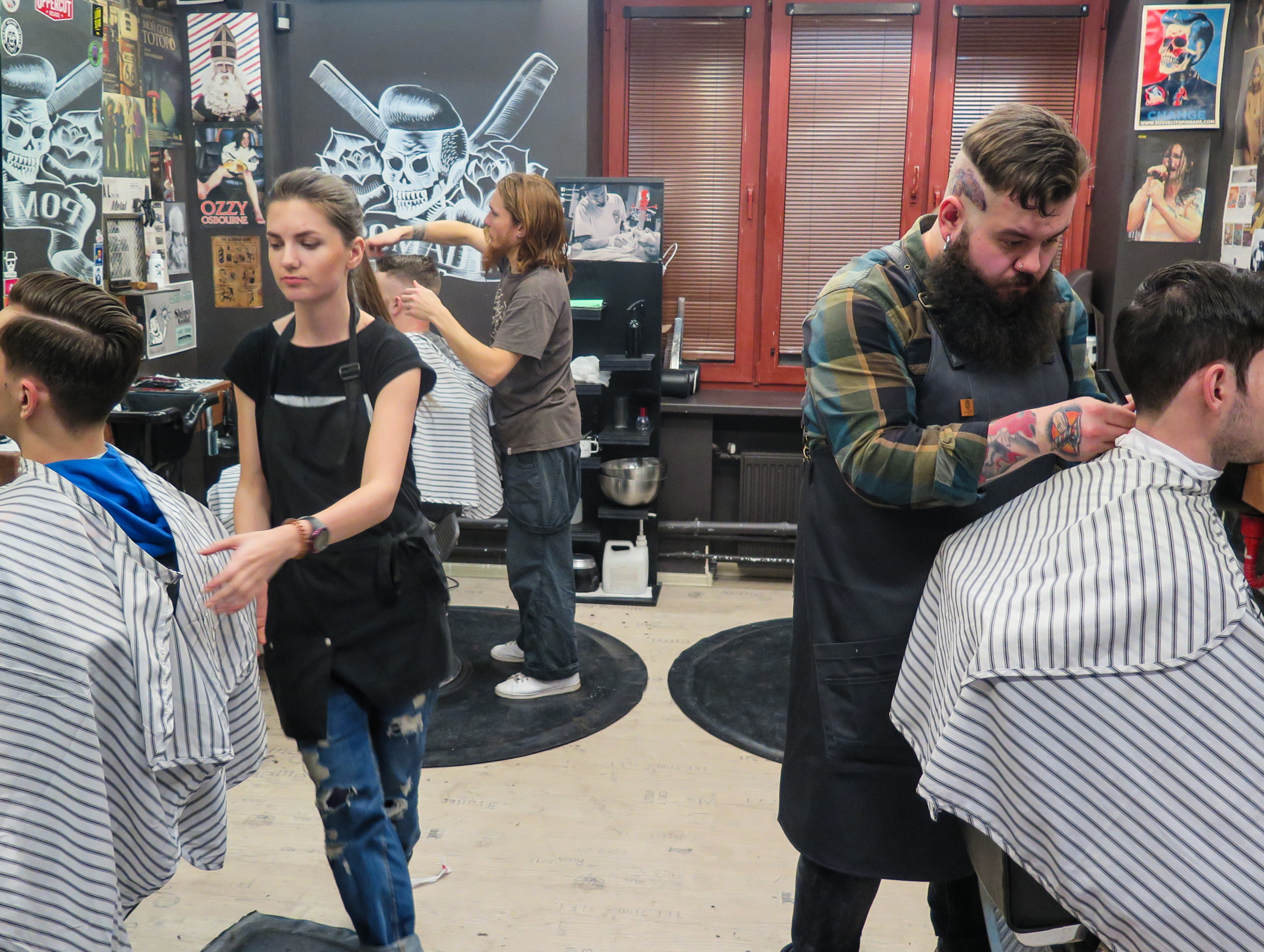
Today, the Russian capital is experiencing a boom in American-style barbershops, where bearded, tattooed hairdressers style their all-male customers with the latest shadow fades and pompadours to the sounds of hard rock and screeching espresso machines.
“If you go to a regular parikmakherskaya, you tell them how you want your hair cut but it never turns out right,” said Maxim Kuzin, a young engineer waiting his turn in Pomades, one of half-a-dozen barbershops on a single block in downtown Moscow. “Here, the technique is completely different. I like the result.”
One of the newest words in the Russian language — the English word barbershop — exudes sophistication and hipness.
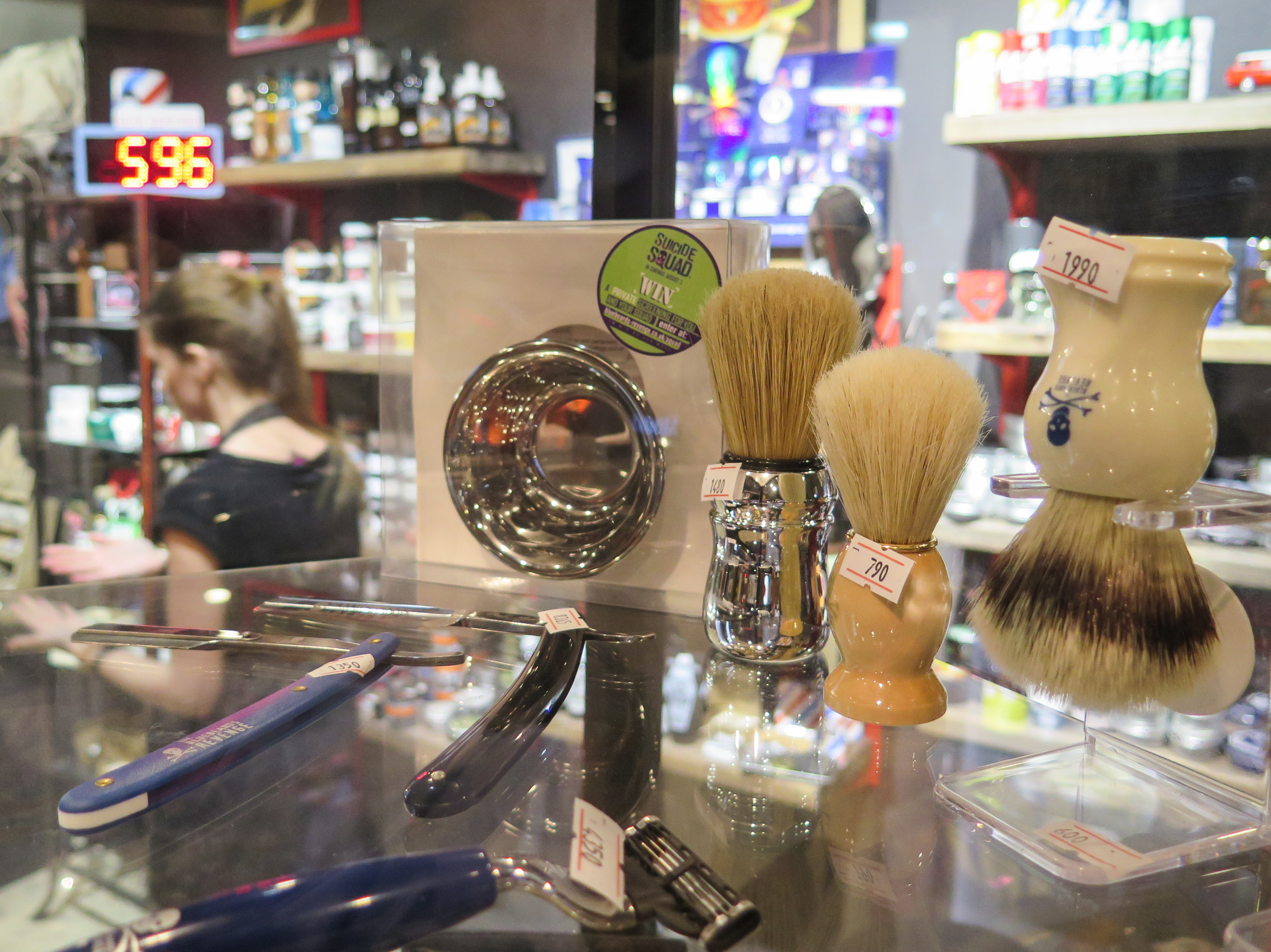
In Pomades, the shelves up front are full of the gels, waxes and oils that modern men use to coif themselves. There’s a coffee bar, an old-school arcade video game, and in the back, five barber chairs. A haircut costs the equivalent of $17.
Three-and-a-half years ago, Roman Bagadayev, 31, and his partner, Yevgeniya Tolmachyova, 29, started Pomades as an online shop for men’s grooming products. That turned into a brick-and-mortar store, which then morphed into their first barbershop.
“Moscow pushes people to do something,” said Tolmachyova. “Everything here is very fast: people, traffic, business. So we’re expanding. Now we have three barbershops.”
From its look and vibe, Pomades wouldn’t be out of place in Brooklyn or downtown San Francisco.
Despite chilly U.S.-Russian relations, Bagadayev says there’s no contradiction, since all his customers have grown up on American movies, listen to American music and wear American clothing brands.
“All Russians love American culture, actually,” said Tolmachyova. “It’s all about image. It’s prestigious to have something from Western culture. It doesn’t matter what it is: any brands, what you wear, what you eat.”
Muscovites are known for their trendiness — and it never takes very long for what’s cool in New York or London to show up on the streets of the Russian capital.
From Moscow, fashions then filter to the rest of Russia and the former Soviet Union. Tolmachyova says she has had business inquiries from as far away as Kyrgyzstan.
“This boom is quite narrow,” said Stanislav Vazhenin, a client who studied in England and now works in a venture capital firm in Moscow. “Where I’m from – northwestern Russia – there are no barbershops.”
The fact that barbershops are now in vogue in Moscow is also a reflection of what could be called the emancipation of the Russian male.
Until recently, Russian society took a narrow view of masculinity. Real men weren’t supposed to worry about what they looked like, as over-attention to hair or skincare might raise suspicions.
“In Russia, people are homophobic a bit,” said Tolmachyova. “A Russian man starts taking care of his appearance – it’s sometimes not socially approved.”
Now young people who never knew the conformism of the Soviet Union are developing their own styles.

With his bushy beard, nose ring and multiple tattoos, Pomades’ head barber, Artemy Zolotarevsky, would never have fit in back in those days. Even now, his look turns heads.
“Here in Moscow, it’s still not very typical for people to wear head tattoos and piercing and beards,” he said. “When people see me, some are amazed, some give me mean looks. And so I think I’m a bit of an outlaw.”
But he’s also a committed barber. The tattoo on his right hand depicts a barber’s pole crossed over electric clippers.
Copyright 2023 NPR. To see more, visit https://www.npr.org.