Churches across America have managed to get around bans on public gathering by moving their worship services online, but technology provides only partial solutions.
In addition to presiding at services, religious leaders are expected to provide counseling, lead prayer groups and minister personally to people with special needs. For many, that aspect of their work has never been more important, or more difficult, at a time when communities are struggling to contain the coronavirus.
“A ‘high-five’ from across the room isn’t quite the same thing,” says Kathie Amidei, a pastoral associate at St. Anthony on the Lake Catholic Church outside Milwaukee, Wis. “If we are to be a conduit of God’s love, we have to figure out how to do that without the ways we’ve always done it.”
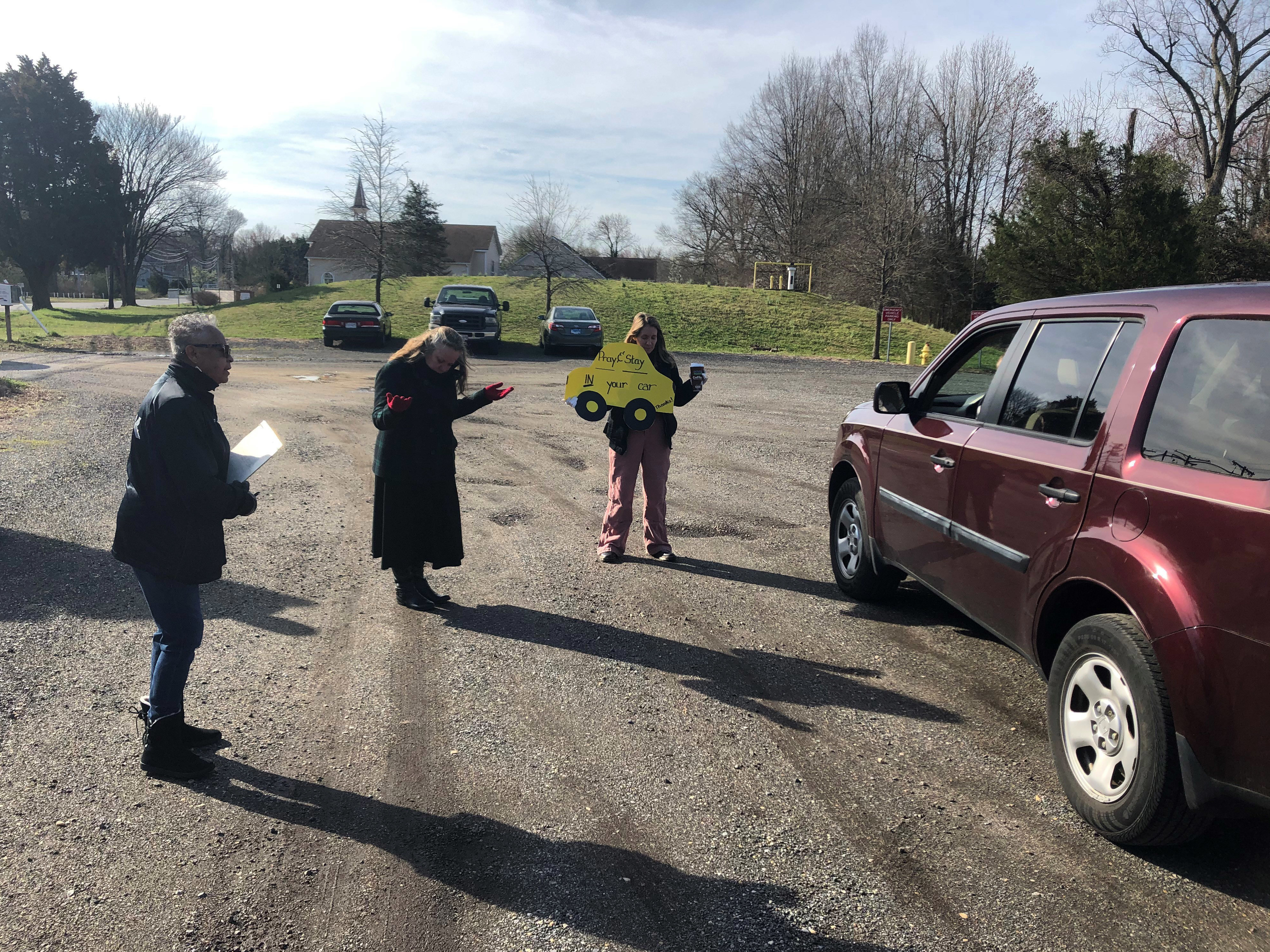
Some creativity is required. Faith Wilkerson, the pastor at Centenary United Methodist Church in Shady Side, Md., has been hosting a “drive-thru” opportunity each Sunday morning. Anyone with a prayer request or a desire for a blessing is invited to pull into the church parking lot. Wilkerson, assisted by lay volunteers, chats briefly at carside with the visitors and then prays with them, all the while staying at an appropriate distance.
“We just approach the car and say, ‘Welcome to our drive-thru church. Can we take your order?’ ” Wilkerson says. The idea came to her while sitting in a drive-thru line at Starbucks. “I got to thinking,” she says. “People can’t go in to Starbucks, and we can’t go in to church. Why don’t we just do a drive-thru church?”
Other ministers are doing the best they can to maintain personal contact with their members, even at some personal risk to their own health. Peter Marty, senior pastor at St. Paul Lutheran Church in Davenport, Iowa, has continued to visit church members in the hospital even under coronavirus conditions.
“Obviously, I wouldn’t visit someone on the respiratory floor,” Marty says, “and I don protective gear when that’s the protocol. I check in with the nursing staff before entering a room and stand six feet away from the patient. When I see the difference in the faces of people I visit, I’m so glad I went.”
In many denominations, ministers have to get training in “pastoral care” in order to be ordained, but the guidance is now changing.
“Go old school,” suggests Chanequa Walker-Barnes, who teaches pastoral care and counseling in the McAfee School of Theology at Mercer University in Atlanta. “Burn a CD or a DVD with your message and have somebody deliver it to the homes of your seniors and shut-ins.” She delivered the advice in a YouTube presentation she titled “Pastoring in a Pandemic.”
Under the circumstances, telephone contact is gaining new importance, even among younger pastors accustomed to other ways of connecting.
Eileen Campbell-Reed, currently teaching pastoral care and theology at Union Theological Seminary, says it has suddenly become more important to teach young seminary students about telephone etiquette.
“That is not something they have considered,” she says. “Younger people, straight from college and entering the seminary, planning to be pastors or ministers, are not thinking about pastoral care by phone.”
At the same time, new social media options such as Zoom are certainly relevant. At St. Lydia’s in Brooklyn, New York, known as the “Dinner Church,” members until recently had been gathering weekly to worship and cook together communally. With New York now partially shut down, the gathering has gone virtual. The members can still see each other via the Zoom platform and converse from their own homes.
The group worship begins with members lighting a candle alongside their computers and breaking bread together in a short communion rite, followed by a supper, with members sharing their experiences.
Funerals are also being live-streamed. After the death of his father in Chicago, Sunil Shroff wanted his father’s friends and relatives to join in the celebration of his life. He hired a company, All Pro Audio Visual, to set up a live video feed of the Hindu ceremony, with opportunities for people to share their thoughts.
“Thank you very much again for your messages,” Shroff said, speaking into a camera. “Please continue to give us messages, because we’re recording it, and we’re seeing it. We can’t hear you, but you can hear us, and we hear you by the messages you’re typing on the chat. Om Shanti.”
The various options pastors and other faith leaders are pursuing don’t work as well in some denominations as in others, however. Catholics in particular, face challenges others don’t have to consider.
“We’re a gathering people,” says Amidei, the pastoral associate at St. Anthony’s on the Lake outside Milwaukee. “The first thing we do in a crisis is to physically come together, whether to pray or worship or celebrate a sacrament. I always say, sacraments are the church’s sign language. And now we can’t use that sign language. We can’t take that baby and hug them and say, ‘You’re ours, and we’re going to take care of you.’ We can’t anoint the sick, to help give them strength and let them know they’re not alone.”
The Eucharist, the communion rite, is especially complicated for Catholics. Unlike many Christian denominations, the Catholic church requires a priest to officiate at the sacrament, and that usually means being physically present.
Hospital or hospice visits are also challenging. Diocesan authorities have prescribed strict protocols for priests to follow. The Chicago archdiocese, for example, bars priests from visiting a health care facility if they are over 60 or have chronic illnesses. Those who do visit patients are to wear gloves, which are to be burned or buried after the visit.
Copyright 2024 NPR