

“Largely white, affluent, older.”
That’s Jacob Padrón’s description of the traditional audience for Long Wharf Theatre in New Haven, Conn., where he’s artistic director. But that profile applies to other established regional theaters as well. “That was the demographic, that continues to be the demographic, but that’s changing,” he said.
Long Wharf is one of three theaters that’s received a $1 million grant from the Mellon Foundation. The other two are Portland Center Stage in Portland, Ore., and Actors Theatre of Louisville in Louisville, Ky. All three are trying to reach new audiences in different ways — but that’s not why they’re getting these grants, said Stephanie Ybarra, program officer for arts and culture at the Mellon Foundation.
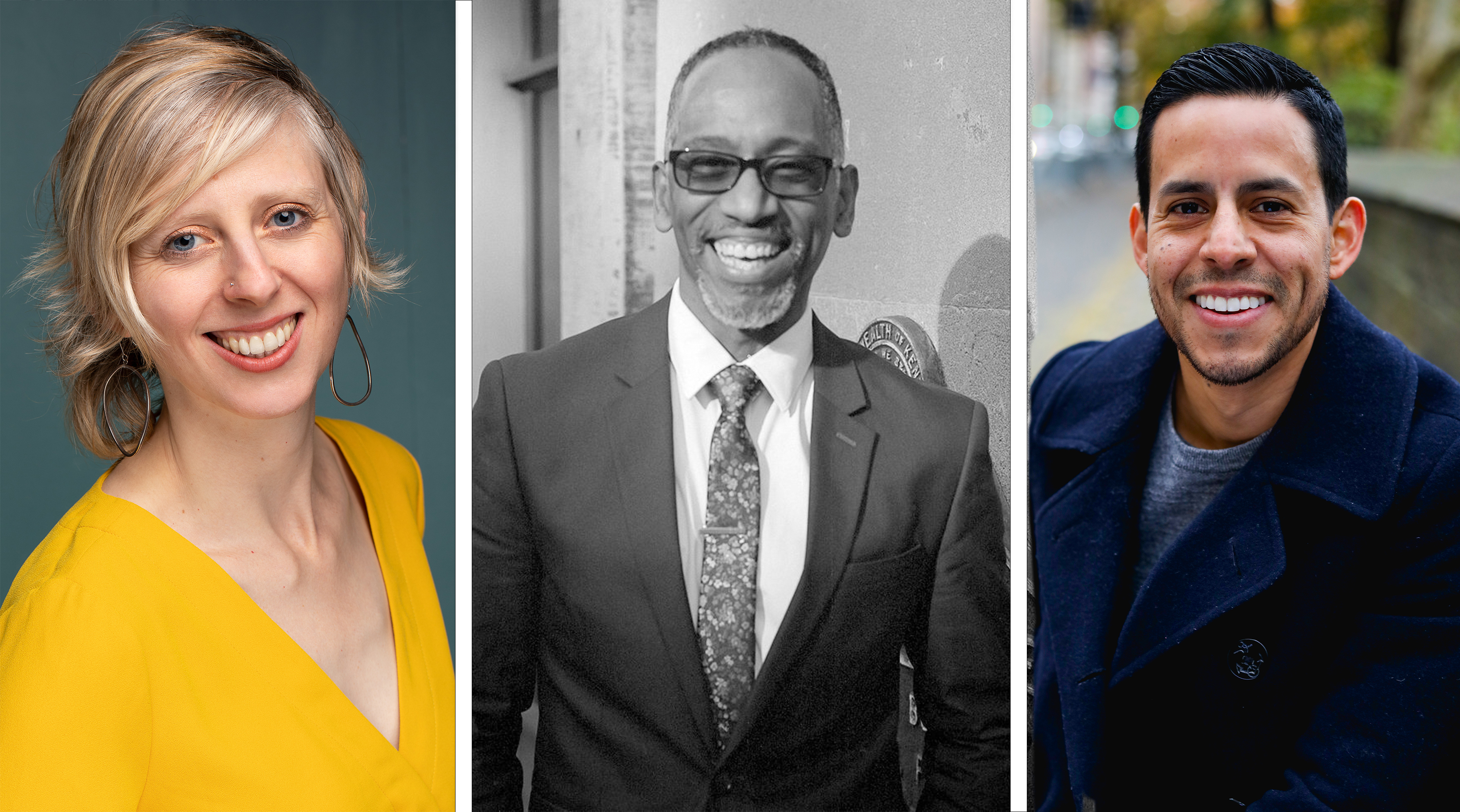
Ybarra said the grant is for the people running them: Padrón in New Haven, Robert Barry Fleming in Louisville and Marissa Wolf in Portland. She said all three have proven track records “in the ways that they advocate for their theaters, their communities, and the ways that they use their platforms for local artists and the national conversation.”
For theater to thrive, Ybarra said, individual theaters must have a “wholesale reimagining of the relationship . . . to their immediate communities.” And she believes these leaders understand that.
‘Wholesale reimagining’ takes courageous leadership
The state of regional theaters is a mixed bag, due to the lingering effects of the pandemic, inflation, and changing audience behavior. Some theaters are thriving. Others are holding steady or struggling. A report on the state of the industry in 2022 from Theatre Communications Group focused on the need of theaters to innovate.
And that’s something these three theaters, spread across the country, have in common.
Portland Center Stage is a new play powerhouse; they’ve developed 29 world premieres and focus on bringing diverse perspectives to the stage. Artistic director Marissa Wolf said the new funds are essential – not only supporting transformational change, but “inspiring long-term investment from our whole community.”
Long Wharf recently left its home of nearly 60 years, saving the company about $500,000 a year, said Padrón. Now that the theater is itinerant, he said, “the entire city is now our stage.”
As examples, he pointed to a recent production of Arthur Miller’s A View From The Bridge in a boathouse and the theater’s work with artist Lady Dane Figueroa Edidi, who curates the Long Wharf’s virtual Black Trans Women At The Center: An Evening of Short Plays. Lady Dane is scheduled to perform in person at the New Haven Pride Center in November.
Actors Theatre has also been going through a transition. For years, it was home to the Humana Festival of New American Plays, a prestigious event that brought top talent from New York and around the world, but didn’t necessarily serve local, diverse audiences. That festival is gone.
Instead, Actors Theatre is focused on programs that Fleming said support “health and wellness, social equity and art and how those things intersect.”
He said by telling new kinds of stories, including ones focused on the local South Asian diaspora, are in Spanish, or are “rural stories of Appalachia versus urban stories,” new audiences have grown almost 40 percent.
This story was edited by Jennifer Vanasco.
Copyright 2024 NPR. To see more, visit https://www.npr.org. 9(MDM3NjYwMjA5MDE1MjA1MzQ1NDk1N2ZmZQ004) "As theaters scramble to reach new audiences, three get $1 million each 2")
