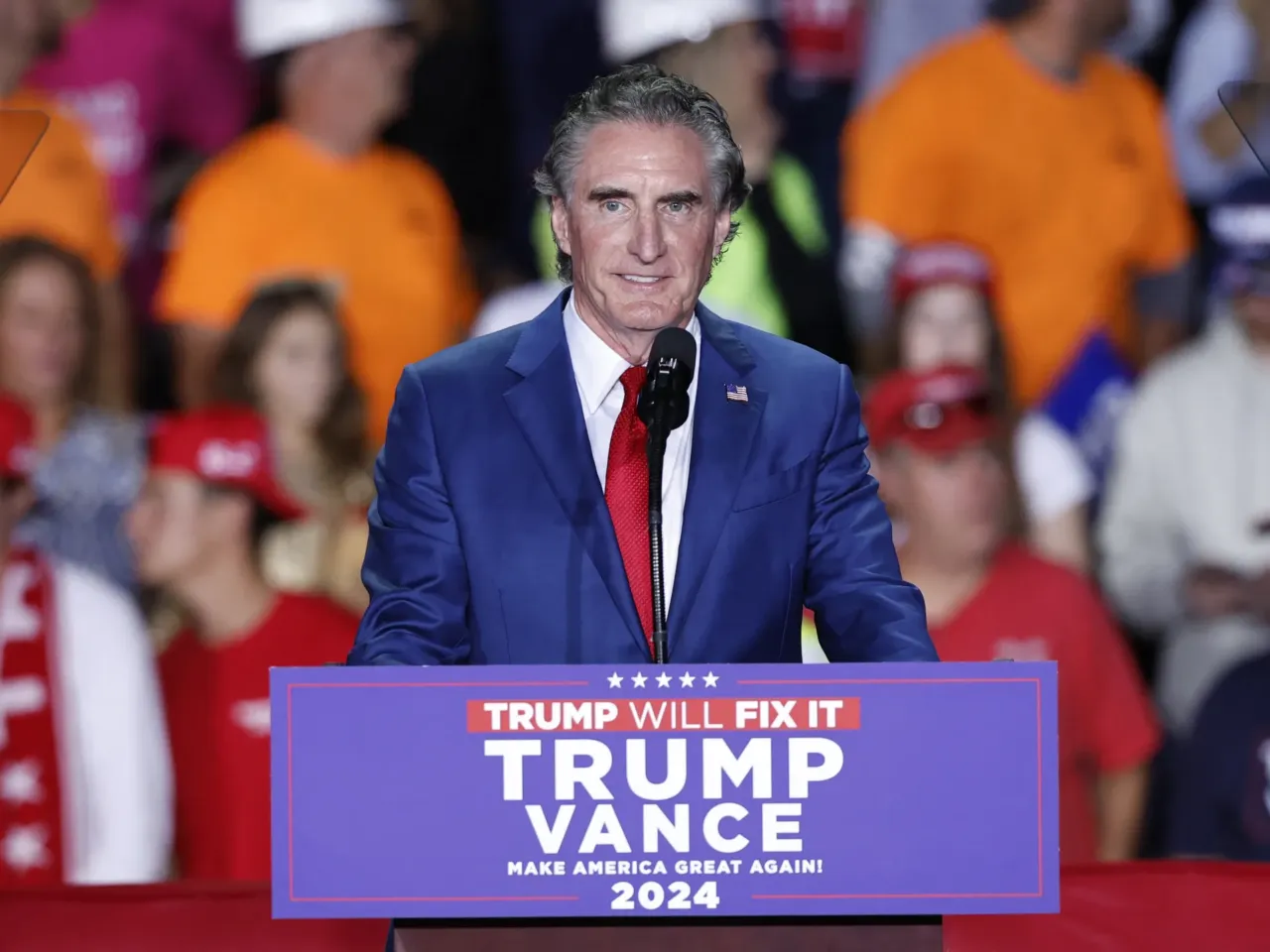
President-elect Donald Trump says he will nominate North Dakota Gov. Doug Burgum to be secretary of the Department of the Interior.
“He’s going to head the Department of Interior, and it’s going to be fantastic,” Trump said in a speech during an America First Policy Institute dinner at his Mar-a-Lago resort. He said there will be a formal announcement on Friday.
“We’re going to do things with energy and with land interior that is going to be incredible,” Trump said.
Trump also wants Burgum to lead a newly formed National Energy Council that will oversee all U.S. regulatory and permitting agencies with an eye toward fast-tracking everything from oil and gas drilling to renewable projects. Burgum is also expected to sit on Trump’s powerful National Security Council.
If confirmed as Interior Secretary, Burgum would play a key role in pushing Trump’s agenda to increase oil, gas and coal production on public lands.
Interior is a sprawling department responsible for managing 20% of U.S. surface land, as well as federally owned mineral rights. This gives Interior control over nearly a quarter of all energy development in America, on- and off-shore.
Burgum is known as a big booster of oil and gas drilling, though his state’s boom has mostly occurred on private land such as the Bakken oil field. Historically, Interior secretaries have generally come from Western states with large tracts of federal public land, while North Dakota is only about 4% federally owned.
The Trump administration is expected to reverse President Biden’s focus on conservation and renewable energy policy enacted by current Interior Secretary Deb Haaland, the nation’s first Indigenous Cabinet member.
Haaland also has been implementing a controversial and first of its kind rule that will allow public land to be leased for conservation, not just drilling.
“In this era of this really terrible climate crisis, those are considerations that need to be made when we’re managing our public lands,” Haaland told NPR last month.
Interior is also in charge of U.S. national parks, monuments and wildlife refuges. It also oversees relations with 574 federally recognized Native American tribes, including Alaska Natives, Hawaii Natives and affiliated Island Communities.
Burgum was elected governor in 2016 on a campaign focused on anti-establishment politics. Before that, he led a software company that he sold to Microsoft for $1.1 billion in stock in the early 2000s.
Leveraging his other entrepreneurial success in his real estate development firm and software venture capital group, Burgum ran a largely self-funded campaign in the 2024 Republican presidential primary and focused on energy and taxes before dropping out of the race last December. He then became a vocal supporter of Trump and hosted fundraising events for him while being shortlisted for the Republican vice presidential nomination.
Restoring and expanding fossil fuel energy development should be priority one at Interior in the coming Trump term, former Interior official William Perry Pendley wrote in Project 2025, a blueprint for the new administration published by the Heritage Foundation.
Emissions from burning and extracting fossil fuels from public lands and waters account for about a quarter of U.S. carbon dioxide emissions, according to the U.S. Geological Survey.
Trump’s previous Interior secretaries became embroiled in ethics scandals. He dismissed Ryan Zinke, a Republican congressman from Montana, after 21 months as Zinke was facing multiple ethics investigations. An investigation by Interior’s inspector general found Zinke had misused his position to advance a development project in his Montana hometown.
Trump then elevated former oil industry lobbyist and Deputy Interior Secretary David Bernhardt to the top of the agency. Nine months after his appointment, the Government Accountability Office found Bernhardt had twice violated the law at Interior when he directed the National Park Service to use park entrance fees for maintenance to keep parks open during the 2019 government shutdown.
In a press release Friday announcing both the planned Interior and Energy Council posts for Gov. Burgum, Trump took a swipe at the outgoing Biden administration and its climate goals which he says stifled drilling in the country. But last year under Biden, federal data show the U.S. actually produced more crude oil than any other country ever.
Copyright 2024 NPR