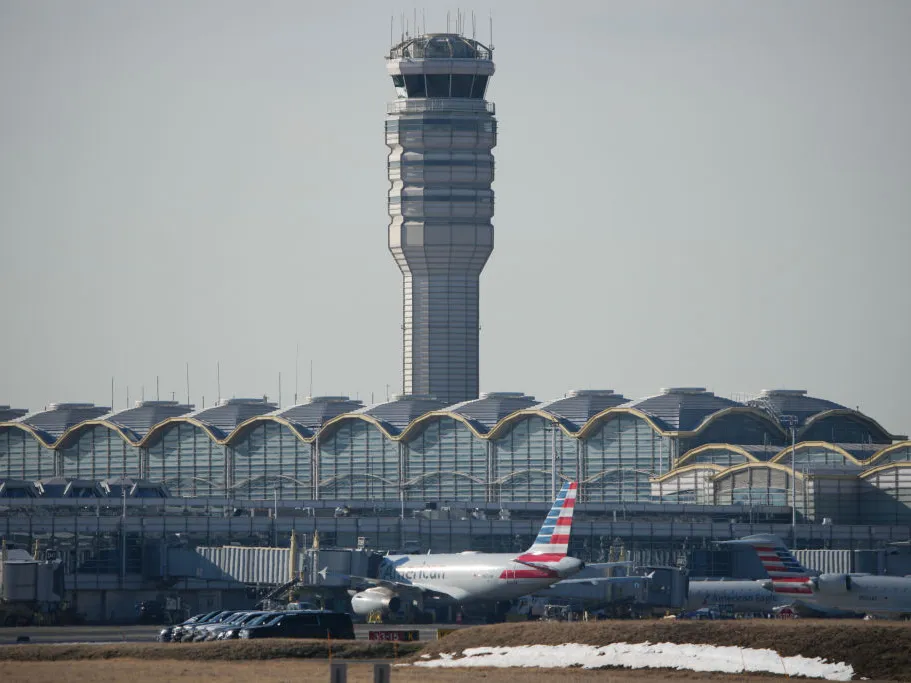
When pilots report near-midair collisions around Reagan National Airport, there’s often a military aircraft involved, an NPR analysis of Federal Aviation Administration data shows.
A midair crash like Wednesday’s deadly collision near Washington, D.C., is extremely rare. To help keep it that way, the FAA encourages pilots and flight crews to report incidents where such tragedies almost happen – what’s known as a “near midair collision,” or NMAC.
The agency’s database of those reports contains 30 records of NMAC reports at Reagan National since 1987. Of those, at least 10 involved military aircraft, and at least seven included military helicopters.
Nationally, only 23 percent of NMAC reports involved military aircraft, according to the FAA data.
With the relatively high concentration of military flights around Reagan, aviation experts say they aren’t surprised to see more of them involved in near-midair collisions.
“There are helicopter routes that traverse the airspace around Metropolitan Washington, D.C., designed for mainly use by military helicopters that are flying in and out of the various bases,” says Mike McCormick, a former FAA director of safety and operations for the nation’s air traffic control towers.
“That would increase the likelihood that there would be in fact near-midair collisions that would be reported,” says McCormick, now an associate professor at Embry Riddle Aeronautical University in Daytona Beach, Fla.
The FAA’s database of near-collisions includes more than 8,700 reports from airports around the country. Pilots report the incidents themselves, based on a judgment that there was a collision hazard between two or more aircraft that were flying too close – generally less than 500 feet.
In the case of Wednesday’s crash, in which an American Airlines regional jet collided with a U.S. Army Black Hawk helicopter, McCormick says there was “a confluence of factors” that may have contributed to the incident.
The crew of the jet, he says, was in the midst of a routine but complex flight operation needed to land on an alternate runway.
“They had no opportunity to look out their windows for other aircraft. They were focused on the airport and the runway that they were lining up on. So that prevented at least one element in the system from taking place – for the American aircraft to see and avoid the Black Hawk helicopter.”
And the crew of the helicopter, he says, “probably had difficulty seeing the American aircraft, because of its orientation landing on runway 33. There were a lot of lights in the background and at low altitude, and the location of aircraft at nighttime can be confusing to find.”
McCormick says he doesn’t believe there are systemic problems with how military and civilian flight operations interact in the crowded airspace around the nation’s capital. But, he says that doesn’t mean that there aren’t some changes coming.
“I feel very confident that although the (National Transportation Safety Board) investigation is going to take some time, I know the FAA is already looking at this in a parallel investigation – to see if there’s anything they can do in the near term or immediately to mitigate the risk of an event like this.”
While the U.S. air traffic system is among the world’s safest, McCormick says, “It is still shocking when a tragedy like this occurs and it needs to be studied.”
NPR’s Nick McMillan contributed to this story.
Copyright 2025 NPR