Copyright © 2026 VPM, all rights reserved.
PBS is a 501(c)(3) not-for-profit organization.
VPM News Morning Edition
NEXT UP: 9:00 AM

Thanks to our sponsors – Become a Sponsor

The time NPR’s Sylvia Poggioli came face-to-face with Pope Francis

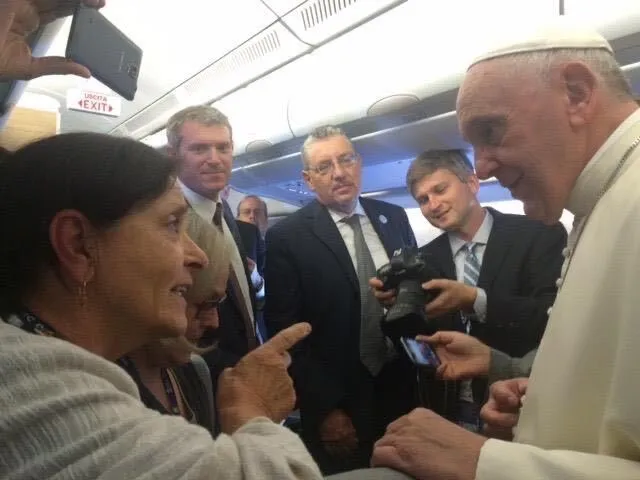
Then-NPR correspondent Sylvia Poggioli speaks with Pope Francis on a flight from Rome to Havana, on Sept. 19, 2015.
Philip Pullella
Then-NPR correspondent Sylvia Poggioli speaks with Pope Francis on a flight from Rome to Havana, on Sept. 19, 2015.

Reporting for NPR from Rome, I covered the last three popes.

My first encounter with Pope John Paul II was in 1983, when I was a budding radio reporter. It was a ceremonial event welcoming journalists. When he walked by me, I pulled out my microphone, broke the no-question protocol and asked, “When will you visit Russia?” — then still the Soviet Union. The Polish-born pope replied cryptically in Latin and moved quickly on. I was unable to decipher his meaning.

I had much better luck with Pope Francis. In 2015, I was among the Vatican reporters onboard the plane for a papal visit to Cuba and the United States. Shortly after takeoff, Pope Francis came back to the plane’s economy section to greet members of the traveling media individually. Several reporters had photos of family members and asked the pope to bless them. Some others raised arcane theological subjects. I had no idea what I was going to say until he came to me.

After stuttering a few niceties, and as he was about to go on to the next reporter, I blurted out, “You know, you and I have something in common.” That grabbed his attention. I went on, “both our parents were Italians, and both were anti-fascists. Mine left Italy for the U.S. and yours went to Argentina.”

His eyes locked on mine, and I realized he was a very intense listener.

He then told me a story I don’t believe had been publicized before then. When his grandparents and their only son Mario decided to leave Italy in the 1920s, they bought tickets for passage on a ship to Argentina. But for some reason they were unable to go on that trip.

A few months later, Francis told me, the Principessa Mafalda ocean liner that they were ticketed to travel on sank off the coast of Brazil in October 1927, killing hundreds.

The family emigrated to Argentina a year and a half later.

It’s no surprise that throughout his 12-year papacy, Francis spoke out forcefully on behalf of immigrants, refugees and the dispossessed. He was one of their offspring.

Copyright 2025 NPR

Sylvia Poggioli is senior European correspondent for NPR's International Desk covering political, economic, and cultural news in Italy, the Vatican, Western Europe, and the Balkans. Poggioli's on-air reporting and analysis have encompassed the fall of communism in Eastern Europe, the turbulent civil war in the former Yugoslavia, and how immigration has transformed European societies.

Since joining NPR's foreign desk in 1982, Poggioli has traveled extensively for reporting assignments. These include going to Norway to cover the aftermath of the brutal attacks by a right-wing extremist; to Greece, Spain, and Portugal reporting on the eurozone crisis; and the Balkans where the last wanted war criminals have been arrested.

In addition, Poggioli has traveled to France, Germany, United Kingdom, The Netherlands, Belgium, Austria, Sweden, and Denmark to produce in-depth reports on immigration, racism, Islam, and the rise of the right in Europe.

She has also travelled with Pope Francis on several of his foreign trips, including visits to Cuba, the United States, Congo, Uganda, Central African Republic, Myanmar, and Bangladesh.

Throughout her career Poggioli has been recognized for her work with distinctions including the WBUR Foreign Correspondent Award, the Welles Hangen Award for Distinguished Journalism, a George Foster Peabody, National Women's Political Caucus/Radcliffe College Exceptional Merit Media Awards, the Edward Weintal Journalism Prize, and the Silver Angel Excellence in the Media Award. Poggioli was part of the NPR team that won the 2000 Overseas Press Club Award for coverage of the war in Kosovo. In 2009, she received the Maria Grazia Cutulli Award for foreign reporting.

In 2000, Poggioli received an honorary Doctor of Humane Letters from Brandeis University. In 2006, she received an honorary degree from the University of Massachusetts Boston together with Barack Obama.

Prior to this honor, Poggioli was elected a Fellow of the American Academy of Arts and Sciences "for her distinctive, cultivated and authoritative reports on 'ethnic cleansing' in Bosnia." In 1990, Poggioli spent an academic year at Harvard University as a research fellow at Harvard University's Center for Press, Politics, and Public Policy at the Kennedy School of Government.

From 1971 to 1986, Poggioli served as an editor on the English-language desk for the Ansa News Agency in Italy. She worked at the Festival of Two Worlds in Spoleto, Italy. She was actively involved with women's film and theater groups.

The daughter of Italian anti-fascists who were forced to flee Italy under Mussolini, Poggioli was born in Providence, Rhode Island, and grew up in Cambridge, Massachusetts. She graduated from Harvard College with a bachelor's degree in romance languages and literature. She later studied in Italy under a Fulbright Scholarship.

Related Stories