
Copyright © 2026 VPM, all rights reserved.
PBS is a 501(c)(3) not-for-profit organization.
VPM News Morning Edition
NEXT UP: 9:00 AM

Thanks to our sponsors – Become a Sponsor

After Texas flood, former camper reflects on Camp Mystic’s traditions and loss

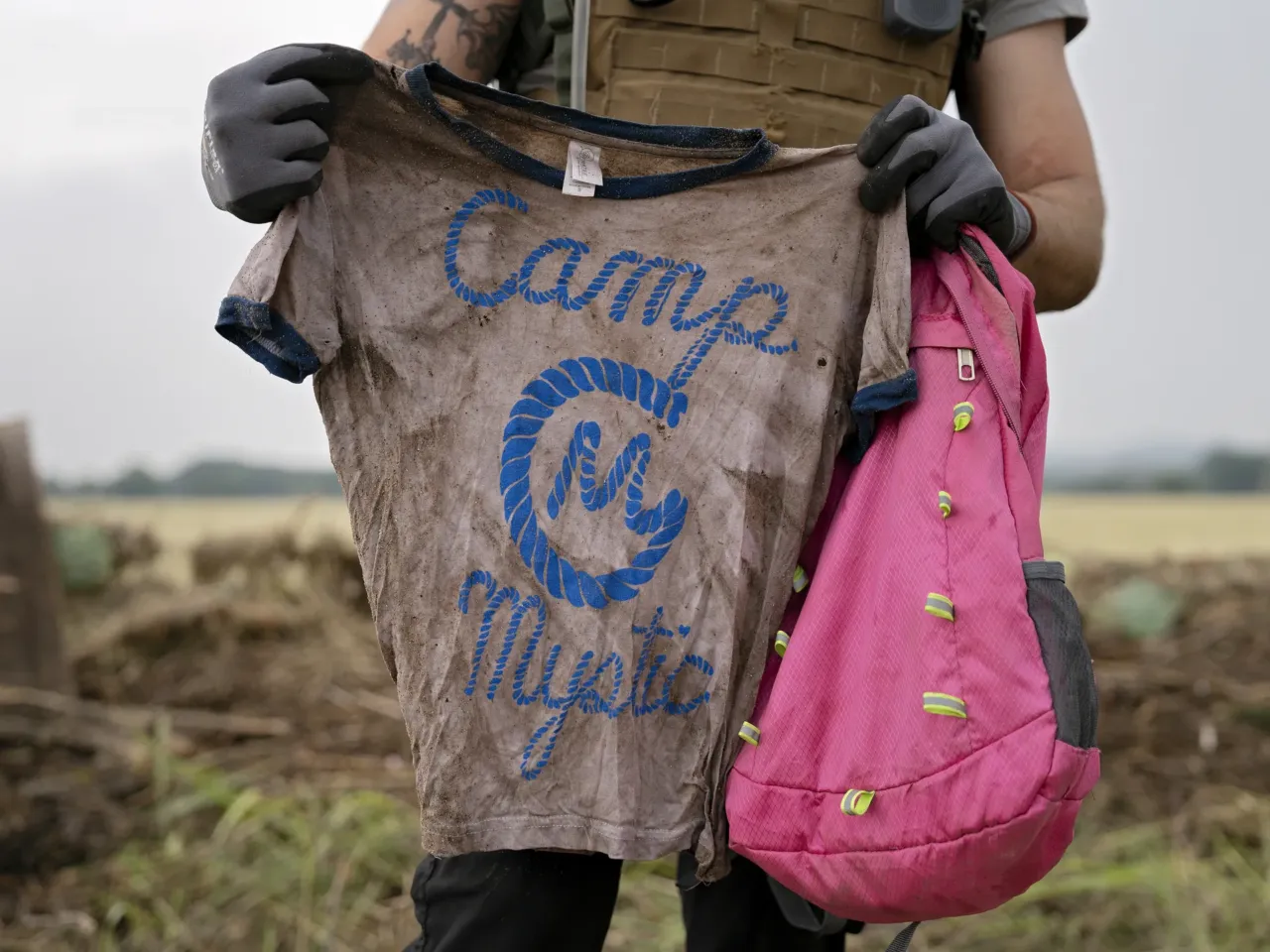
A search and rescue volunteer holds a T-shirt and backpack with the words Camp Mystic on them in Comfort, Texas on July 6, 2025. The volunteer found the belongings yesterday along the Guadalupe River near Ingram, Texas.
Danielle Villasana for The Washington Post / via Getty Images
A search and rescue volunteer holds a T-shirt and backpack with the words Camp Mystic on them in Comfort, Texas on July 6, 2025. The volunteer found the belongings yesterday along the Guadalupe River near Ingram, Texas.

Updated July 07, 2025 at 13:39 PM ET

For Lauren Garcia, Camp Mystic, nestled on the banks of the Guadalupe River in Texas Hill Country, was a little slice of heaven. A place where she could disconnect from the outside world.

Established in 1926, the private Christian summer camp became a tradition for generations of women in the state. Campers, who wrapped up their second year in school, participated in activities like horseback riding, canoe races and archery. But now, the historic campgrounds have become a site of mourning.

In a statement released by Camp Mystic officials, 27 campers and counselors were confirmed dead in the flash flood that ripped through central Texas. Camp director Richard ‘Dick’ Eastland was among the dead. Rescue and recovery efforts are still ongoing along the Guadalupe River.

Garcia, who attended Camp Mystic for a decade, first as a camper and then as a counselor, says the loss is deeply personal.

“My heart is broken,” Garcia said in an interview with NPR’s Michel Martin. “We are leaning on each other, on our love, and the love that we shared at the camp.”

This interview has been lightly edited for length and clarity. 

Interview Highlights 

Michel Martin: I understand your mom and her sisters all went and your sisters all went. What made it so special for all of you?

Lauren Garcia: Oh, we loved it. It was a home to some of the most meaningful and lifelong friendships I’ve had. It’s like a little slice of heaven there every summer to come back and see the familiar faces and fresh ones. I couldn’t wait.

Martin: What are some of your favorite memories?

Garcia: I don’t know where to start. It’s rooted in tradition and ritual. Sundays were some of my favorites. We would all make our way down to the cool Guadalupe Waterfront for our Sunday devotionals. You could hear everyone’s charm bracelets would jingle as we’d all sing together. We would learn lessons from the camp owners themselves, Tweedy and [Richard] Dick Eastland. They owned the camp, but it felt more like a family affair. They knew everyone’s names and they would teach us things like how to be kind to one another. They would hand out these things called fuzzies to other little campers. We’d pass them to each other, just to recognize how to give love to one another… It was so special that their family was involved in everything from walking on the campgrounds and teaching us fishing. Their sons and daughters were program directors, head chef, head nurses. They ran the events and they made the most amazing food.

Martin: We’ve heard about so many famous and not famous people who sent their daughters there. Laura Bush, the former first lady, was a counselor there. Why do you think it has had such a hold on so many people through so many generations?

Garcia: It’s hard to put into words unless you are or have a mystic girl. No amount of anecdotes could allow me to explain now how this place has been cracked open for the world to see. It was like a little bubble in a safe haven. No matter what was going on in your home life or your school life, you would come back each year and expect some of the same rituals and traditions. I think that’s what girls like myself depended on. It brought calm and ease and it was just beautiful there.

Martin: I can only imagine what you’re feeling knowing about what happened at the flood. What kinds of conversations are you having with other former campers? What are you talking about?

Garcia: My heart is broken. It was devastating for so many families. I can’t even put that into words. I think this community needs each other. We are leaning on each other, on our faith and the love that we shared for this camp. That’s what Camp Mystic taught us — to lean on each other. Physically, we’re seeing people help out with recovery efforts and organizing massive donation drives. And for this unimaginable sorrow, we’re staying connected through prayer and service. That’s always what camp has been about.

This interview was edited for digital by Majd Al-Waheidi.

Copyright 2025 NPR

Michel Martin is the weekend host of All Things Considered and host of the Consider This Saturday podcast, where she draws on her deep reporting and interviewing experience to dig in to the week's news. Outside the studio, she has also hosted "Michel Martin: Going There," an ambitious live event series in collaboration with Member Stations.

Martin came to NPR in 2006 and launched Tell Me More, a one-hour daily NPR news and talk show that aired on NPR stations nationwide from 2007-2014 and dipped into thousands of important conversations taking place in the corridors of power, but also in houses of worship, and barber shops and beauty shops, at PTA meetings, town halls, and at the kitchen table.

She has spent more than 25 years as a journalist — first in print with major newspapers and then in television. Tell Me More marked her debut as a full-time public radio show host. Martin says, "What makes public radio special is that it's got both intimacy and reach all at once. For the cost of a phone call, I can take you around the world. But I'm right there with you in your car, in your living room or kitchen or office, in your iPod. Radio itself is an incredible tool and when you combine that with the global resources of NPR plus the commitment to quality, responsibility and civility, it's an unbeatable combination."

Martin has also served as contributor and substitute host for NPR newsmagazines and talk shows, including Talk of the Nation and News & Notes.

Martin joined NPR from ABC News, where she worked since 1992. She served as correspondent for Nightline from 1996 to 2006, reporting on such subjects as the congressional budget battles, the U.S. embassy bombings in Africa, racial profiling and the aftermath of Hurricane Katrina. At ABC, she also contributed to numerous programs and specials, including the network's award-winning coverage of Sept. 11, a documentary on the Anita Hill-Clarence Thomas controversy, a critically acclaimed AIDS special and reports for the ongoing series "America in Black and White." Martin reported for the ABC newsmagazine Day One, winning an Emmy for her coverage of the international campaign to ban the use of landmines, and was a regular panelist on This Week with George Stephanopoulos. She also hosted the 13-episode series Life 360, an innovative program partnership between Oregon Public Broadcasting and Nightline incorporating documentary film, performance and personal narrative; it aired on public television stations across the country.

Before joining ABC, Martin covered state and local politics for the Washington Post and national politics and policy at the Wall Street Journal, where she was White House correspondent. She has also been a regular panelist on the PBS series Washington Week and a contributor to NOW with Bill Moyers.

Martin has been honored by numerous organizations, including the Candace Award for Communications from The National Coalition of 100 Black Women, the Joan Barone Award for Excellence in Washington-based National Affairs/Public Policy Broadcasting from the Radio and Television Correspondents' Association and a 2002 Silver Gavel Award, given by the American Bar Association. Along with her Emmy award, she received three additional Emmy nominations, including one with WNYC's Robert Krulwich, at the time an ABC contributor as well, for an ABC News program examining children's racial attitudes. In 2019, Martin was elected into the American Academy of Arts and Sciences for outstanding achievement in journalism. She is the 2021 recipient of PMJA's 2021 Leo C. Lee Award.

A native of Brooklyn, N.Y., Martin graduated cum laude from Radcliffe College at Harvard University in 1980 and earned a Master of Arts from the Wesley Theological Seminary in 2016.

Related Stories