Copyright © 2026 VPM, all rights reserved.
PBS is a 501(c)(3) not-for-profit organization.
VPM News Morning Edition
NEXT UP: 9:00 AM

Thanks to our sponsors – Become a Sponsor

Israeli Prime Minister Benjamin Netanyahu to meet President Trump Monday

MICHEL MARTIN, HOST:

President Trump says there could be a ceasefire deal in Gaza this week, with some hostages in Gaza going free.

(SOUNDBITE OF ARCHIVED RECORDING)

PRESIDENT DONALD TRUMP: I think there’s a good chance we have a deal with Hamas during the week, during the coming week, pertaining to quite a few of the hostages, yeah.

LEILA FADEL, HOST:

That’s what Trump will be discussing this evening with Israeli Prime Minister Benjamin Netanyahu in the White House. It will be their first meeting since the U.S. joined Israel in attacking Iran’s nuclear sites two weeks ago.

MARTIN: NPR’s Daniel Estrin has been following all this from Tel Aviv. Daniel, good morning.

DANIEL ESTRIN, BYLINE: Good morning, Michel.

MARTIN: So how close is a ceasefire deal in Gaza, based on your reporting?

ESTRIN: We are not expecting a ceasefire deal to be announced today. It could take a few more days or longer. Israel and Hamas just began talks in Doha, Qatar, yesterday. And mediators in the region tell us that the Israeli and Hamas delegations are on different floors of the same hotel in Doha, and mediators are shuttling between them. But remember, Netanyahu just landed today in Washington. A person who was briefed on the matter, who was not authorized to speak publicly, told me that Netanyahu is expected to meet Trump’s Mideast envoy, Steve Witkoff, and Secretary of State Marco Rubio to talk over the details of what a Gaza deal would look like before Netanyahu meets Trump for dinner.

MARTIN: Can you just give us a sense of what a ceasefire deal might look like? I mean, is it temporary? Would it actually lead to the end of the war in Gaza?

ESTRIN: We saw a recent draft of the deal that is being negotiated. It starts with a 60-day ceasefire. During that time, Hamas would release 10 out of the 20 living hostages it still holds. Israel would release Palestinian prisoners. And starting on day 1 of the ceasefire, the two sides would begin discussing the terms of a final end of the war. Now, Netanyahu’s latest mantra is that there will be no more Hamas in Gaza. So we are expecting discussions between the U.S. and Israel this week in Washington about what that would look like. Does that mean expelling the few remaining senior Hamas militants from Gaza? What would it look like for Hamas to lay down its arms? Who would replace Hamas in governing Gaza? Those are the issues that need to be discussed.

MARTIN: So it was just two weeks ago that the U.S. joined Israel’s attacks on Iran’s nuclear facilities, and now Trump is looking for a ceasefire deal in Gaza. Is this all connected, Daniel? Is there a bigger strategy at play here?

ESTRIN: I think it is all connected, Michel. We spoke to a person briefed on the matter, who was not authorized to speak about it publicly, who said that Netanyahu and Trump will be discussing what kind of diplomatic deal Israel would want to see with Iran, what would want the U.S. to forge with Iran over the future of its nuclear program. You know, Trump did attack Iran’s nuclear sites with bombs that Israel does not possess. That is something Netanyahu had long wanted, and now Netanyahu knows what Trump wants. Trump wants an end to the Gaza war. Trump promised his voters when he was running for election that he would end wars. He wants to be the president to end the Gaza war so that he can broker diplomatic ties between Israel and other Arab or Muslim countries.

But that puts Netanyahu in a tough spot. His far-right political partners in government do not want the war to end. But for Netanyahu, ending the war and freeing the hostages from Gaza is a kind of image of victory that could help Netanyahu. He is eyeing a potential new election here in Israel.

MARTIN: That is NPR’s Daniel Estrin in Tel Aviv. Daniel, thank you.

ESTRIN: You’re welcome. Transcript provided by NPR, Copyright NPR.

NPR transcripts are created on a rush deadline by an NPR contractor. This text may not be in its final form and may be updated or revised in the future. Accuracy and availability may vary. The authoritative record of NPR’s programming is the audio record.

Tags

Michel Martin is the weekend host of All Things Considered and host of the Consider This Saturday podcast, where she draws on her deep reporting and interviewing experience to dig in to the week's news. Outside the studio, she has also hosted "Michel Martin: Going There," an ambitious live event series in collaboration with Member Stations.

Martin came to NPR in 2006 and launched Tell Me More, a one-hour daily NPR news and talk show that aired on NPR stations nationwide from 2007-2014 and dipped into thousands of important conversations taking place in the corridors of power, but also in houses of worship, and barber shops and beauty shops, at PTA meetings, town halls, and at the kitchen table.

She has spent more than 25 years as a journalist — first in print with major newspapers and then in television. Tell Me More marked her debut as a full-time public radio show host. Martin says, "What makes public radio special is that it's got both intimacy and reach all at once. For the cost of a phone call, I can take you around the world. But I'm right there with you in your car, in your living room or kitchen or office, in your iPod. Radio itself is an incredible tool and when you combine that with the global resources of NPR plus the commitment to quality, responsibility and civility, it's an unbeatable combination."

Martin has also served as contributor and substitute host for NPR newsmagazines and talk shows, including Talk of the Nation and News & Notes.

Martin joined NPR from ABC News, where she worked since 1992. She served as correspondent for Nightline from 1996 to 2006, reporting on such subjects as the congressional budget battles, the U.S. embassy bombings in Africa, racial profiling and the aftermath of Hurricane Katrina. At ABC, she also contributed to numerous programs and specials, including the network's award-winning coverage of Sept. 11, a documentary on the Anita Hill-Clarence Thomas controversy, a critically acclaimed AIDS special and reports for the ongoing series "America in Black and White." Martin reported for the ABC newsmagazine Day One, winning an Emmy for her coverage of the international campaign to ban the use of landmines, and was a regular panelist on This Week with George Stephanopoulos. She also hosted the 13-episode series Life 360, an innovative program partnership between Oregon Public Broadcasting and Nightline incorporating documentary film, performance and personal narrative; it aired on public television stations across the country.

Before joining ABC, Martin covered state and local politics for the Washington Post and national politics and policy at the Wall Street Journal, where she was White House correspondent. She has also been a regular panelist on the PBS series Washington Week and a contributor to NOW with Bill Moyers.

Martin has been honored by numerous organizations, including the Candace Award for Communications from The National Coalition of 100 Black Women, the Joan Barone Award for Excellence in Washington-based National Affairs/Public Policy Broadcasting from the Radio and Television Correspondents' Association and a 2002 Silver Gavel Award, given by the American Bar Association. Along with her Emmy award, she received three additional Emmy nominations, including one with WNYC's Robert Krulwich, at the time an ABC contributor as well, for an ABC News program examining children's racial attitudes. In 2019, Martin was elected into the American Academy of Arts and Sciences for outstanding achievement in journalism. She is the 2021 recipient of PMJA's 2021 Leo C. Lee Award.

A native of Brooklyn, N.Y., Martin graduated cum laude from Radcliffe College at Harvard University in 1980 and earned a Master of Arts from the Wesley Theological Seminary in 2016.

Israeli Prime Minister Benjamin Netanyahu to meet President Trump Monday

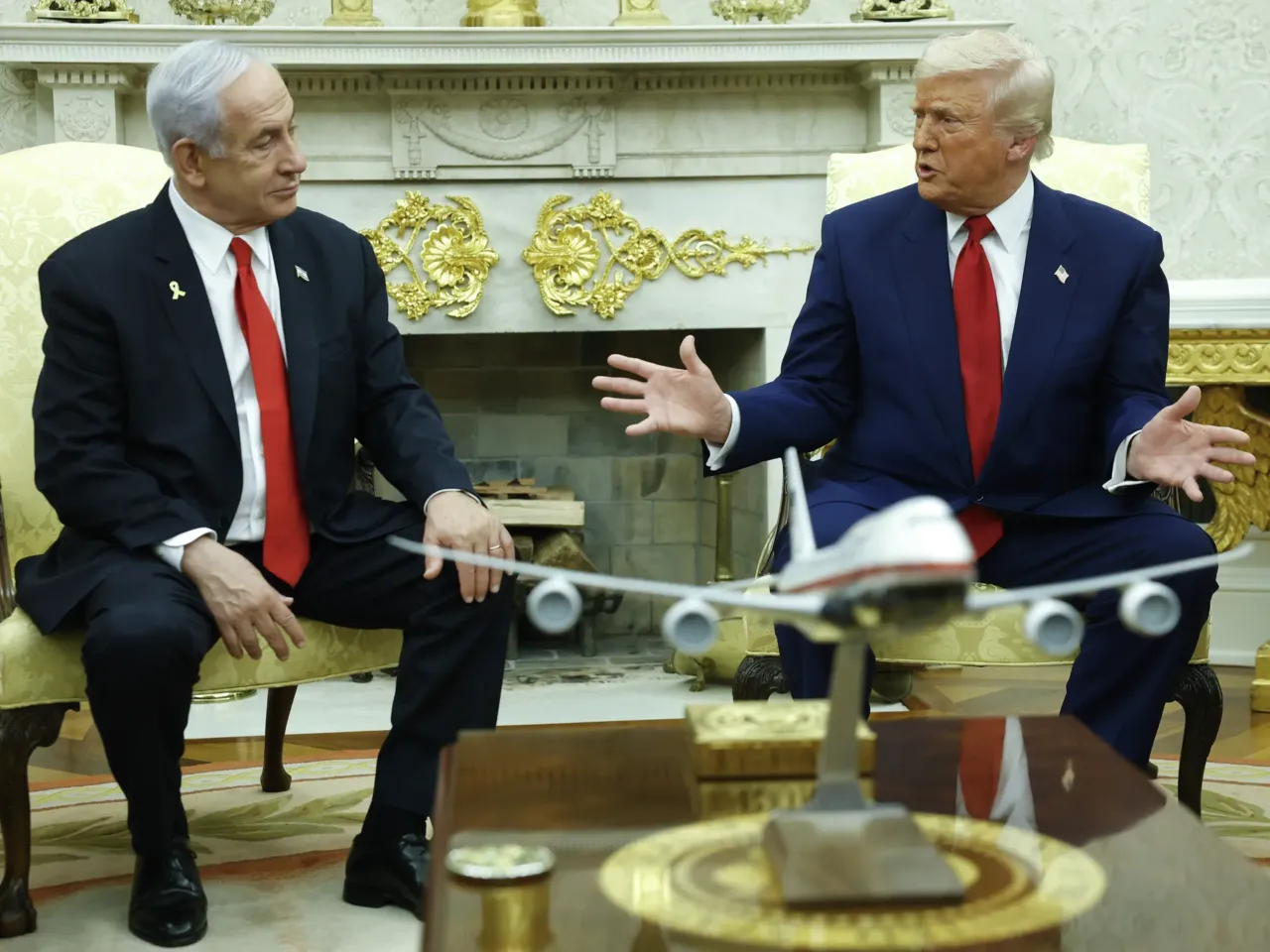
President Donald Trump speaks alongside Israeli Prime Minister Benjamin Netanyahu during a meeting in the Oval Office of the White House on April 7, 2025, in Washington, D.C. Netanyahu and Trump are to meet again on Monday.
Kevin Dietsch / Getty Images North America
President Donald Trump speaks alongside Israeli Prime Minister Benjamin Netanyahu during a meeting in the Oval Office of the White House on April 7, 2025, in Washington, D.C. Netanyahu and Trump are to meet again on Monday.

WASHINGTON — Israel Prime Minister Benjamin Netanyahu is due to meet with President Trump on Monday, when they may announce a ceasefire deal for Gaza.

It will be Netanyahu’s first visit to the White House since the two leaders collaborated in an attack on Iran’s nuclear facilities last month.

In the wake of the 12-day war that Israel fought against Iran, the main focus between the two leaders was expected to be how to wind down Israel’s war with Hamas in Gaza that began close to two years ago. Netanyahu told reporters Sunday that there was an opportunity to forge new diplomatic ties with additional unspecified countries. Israel is reportedly seeking a security pact with its longtime enemy Syria.

Trump said last week on his social media site that Israel has agreed to a 60-day ceasefire in Gaza, and warned Hamas they had better accept it. Hamas this weekend voiced an initial positive response to the latest framework but said it needed to work out details before accepting.

Hamas triggered the current war when it attacked Israeli communities bordering the Gaza Strip in October 2023, killing around 1,200 people and taking around 250 hostage. More than 56,000 Palestinians have been killed in Israel air strikes since then, the majority of them women and children, according to Gaza health officials, and Gaza’s towns have been left in ruins.

A new ceasefire plan

According to the ceasefire proposal, Hamas would release eight living hostages at the start of the 60-day ceasefire, and two more hostages on the 50th day of the ceasefire. Israel would release Palestinian prisoners.

Israeli negotiators headed to Qatar Sunday for ceasefire talks with Hamas. But as with previous talks that have ended in stalemate, there are still major obstacles to overcome: the main one being Hamas’ insistence that the talks lead to a permanent end to the war, a demand Israel has rejected. Israel has again said that Hamas is seeking “unacceptable” changes to the latest ceasefire proposal.

The deal resembles a similar one proposed by Israel and the U.S. earlier this year. Israel and Hamas had agreed on a ceasefire that took effect just as Trump came into office in January, and lasted until Israel renewed attacks in Gaza in March, and stopped all aid from entering the besieged coastal enclave. Food deliveries only resumed in late May under tight Israeli control in a system that the U.N. — which used to run aid deliveries — has called “death traps” for Palestinians trying to access the handout sites.

But Netanyahu has said Israel’s accomplishments in weakening Iran — a country that backed anti-Israeli militant groups across the region, such as Hamas in Gaza and Hezbollah in Lebanon — have opened opportunities to release the 50 remaining living and dead hostages still in captivity in Gaza.

Adding to the Israeli public pressure to end the war is the large number of soldiers, 20, killed in Gaza in the past month alone.

The ceasefire talks have been mediated by Qatar, the U.S. and Egypt. An official from the region who was briefed on the talks but not authorized to speak publicly to the media told NPR that the Israeli delegation in Doha was a largely technical team and included Gal Hirsch, the government’s official responsible for hostage affairs; Ophir Falk, Netanyahu’s personal representative; and officers from the Shin Bet, Israel’s internal security agency, and Mossad, its overseas intelligence agency.

The delegation was to discuss Hamas’s response to the latest proposal, hoping to reach a formula that reduces its demands, the official said.

A changing Middle East

The war in Gaza began on Oct. 7, 2023, when Hamas-led militants launched a surprise attack on Israel that caught the country off guard, and triggered a cascade of regional events that have transformed the Middle East.

On Oct. 8, Hezbollah, the powerful Iranian-back militant group in Lebanon, started firing missiles into Israel in solidarity with Hamas, triggering a months-long exchange of rockets and airstrikes across their shared border.

Last fall, Israel launched a devastating attack on Hezbollah that wiped out most of its leadership. Shortly after that, Israeli airstrikes on Iranian weapons shipments to Hezbollah across neighboring Syria — at the time, a key ally of Iran — weakened the dictatorship of President Bashar al-Assad, who was overthrown last December by rebels.

In June, Netanyahu launched an air war against Iran to destroy its nuclear program, which he said was aimed at building an atomic bomb, something Iran denied. Trump ordered a strike by U.S. strategic bombers on sites that Israeli bombs were unable to destroy, a major boost for Netanyahu.

Despite Israel’s success in decimating Iran’s allies and damaging its nuclear program, the massive death toll in Gaza has led to increasing diplomatic isolation for Israel, including widespread anti-Israeli protests in Europe and the U.S., and charges of genocide brought by South Africa in the International Court of Justice, something Israel vehemently denies.

Copyright 2025 NPR

James Hider is NPR's Middle East editor.

Hider has worked for years in the Middle East, first as the deputy bureau chief for AFP news agency in Jerusalem during the height of the second Palestinian Intifada, then covering the US-British invasion of Iraq and the subsequent civil war there for The Times of London. In 2011, he covered the Arab Spring uprisings, first from Tahrir Square in Egypt, then from the front lines in the Libyan civil war. He has reported from almost all the countries in the region, including Yemen and Syria.

Hider also has covered conflict in the Balkans, Afghanistan and the Caucasus, and later served as Latin America editor for The Times.

He is the author and co-author of award-winning books on the Middle East, the oppression of the Uyghurs in China and the international disaster recovery industry. He currently lives in Washington, D.C., and writes science-fiction novels for fun.

Related Stories
Related Stories