Updated August 20, 2025 at 17:00 PM ET
As President Trump’s federal takeover of law enforcement in the nation’s capital enters its second week, three Republican-led states have committed to sending hundreds more National Guard troops to patrol the streets of Washington, D.C. to crackdown on crime.
The National Guard deployment in Washington could be a glimpse into what President Trump has stated he intends to do in other major cities across the U.S. — with Trump, during a press conference last week, naming New York City, Los Angeles and Baltimore as potential future targets of federal expansion.
But despite the president’s claims regarding the prevalence of crime in these cities, Baltimore stands out as an outlier. So far this year, the city has seen 84 homicides — that’s the fewest recorded homicides in over 50 years. In comparison, the first seven months of 2024 had 111 homicides.
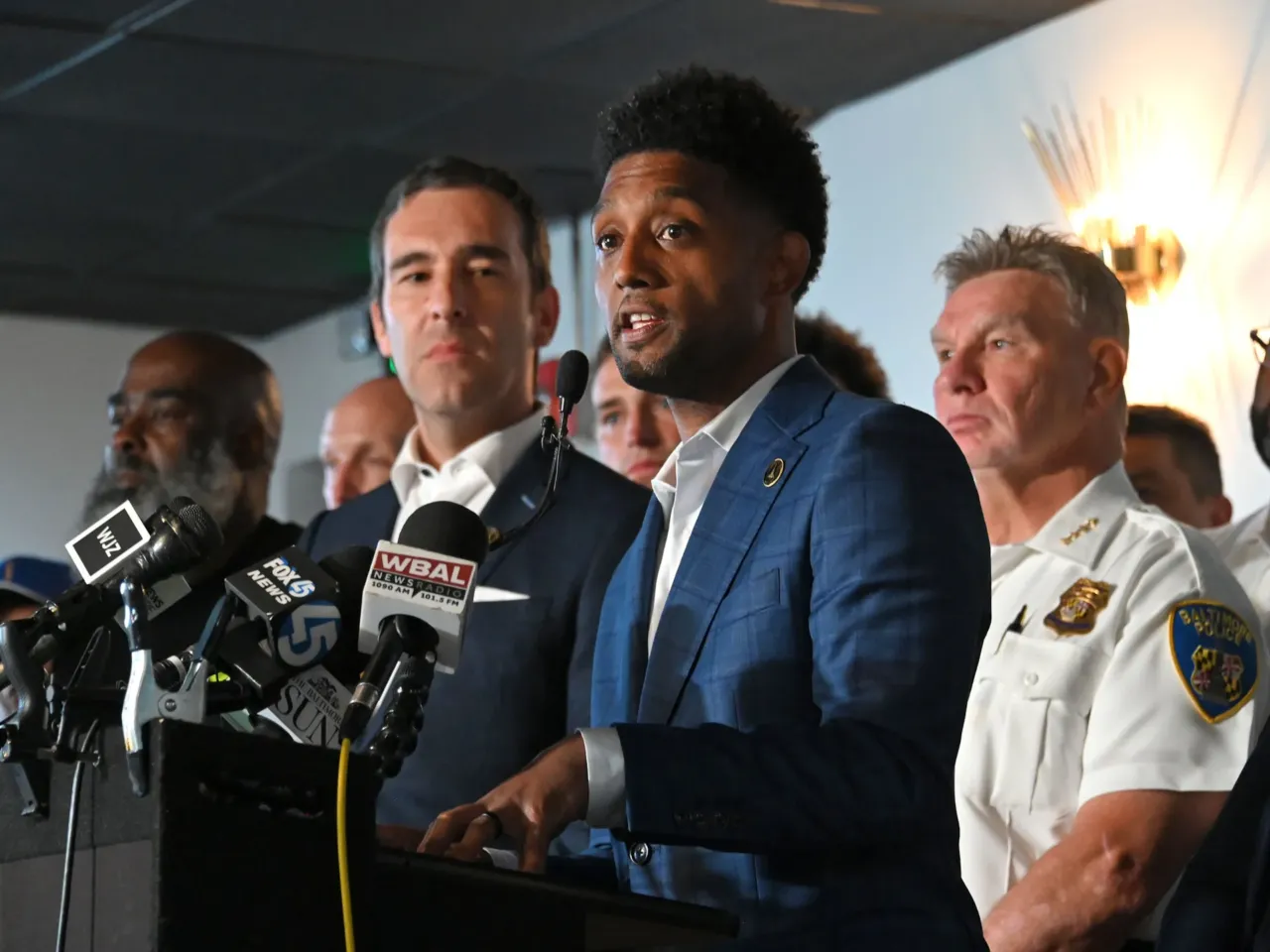
Speaking to Morning Edition, Baltimore Mayor Brandon Scott says what’s worked for Baltimore is looking at crime in the city holistically.
During his conversation with NPR’s Michel Martin, Scott talked about how federal funding helped the city approach crime in a different way — and his reaction to the amount of federal agents patrolling the streets of D.C.
This interview has been edited for length and clarity.
Interview Highlights
Michel Martin: I want to start by going back in time a little bit to 2015. Homicides spiked in Baltimore to levels that hadn’t been seen since the 1990s. That was the year that Freddie Gray died in police custody. There were demonstrations. You were on the council at the time. What do you think was driving the violence back then?
Baltimore Mayor Brandon Scott: We know what causes it, right? When you have, here in Baltimore, the birthplace of redlining, purposeful disinvestment into neighborhoods over generations and generations. And at the same time, deindustrialization. And then you, of course, have the influx of drugs into the communities. You just have a melting pot of disaster.
Martin: Back in 2015, there were some like 344 homicides. And then they started dropping that, and then there was a COVID spike.
Scott: No, not for us. They did not drop. That’s the difference here. In Baltimore, we didn’t have a COVID spike. It literally started to fall off a cliff, starting with September of 2022.
Martin: What do you think were some of the factors that led to that significant drop?
Scott: Well, September is when we fully implemented our comprehensive violence prevention plan. So, when you look deep into that plan it is multifaceted. We have the group violence reduction strategy, which is a focused deterrence model, where we actually go to those who are most likely to be the victim or perpetrator of gun violence. They get a letter directly from me. We knock on their door and say ‘We know who you are. We know what you do. Change your life. We’ll help you do it. But if you don’t, we’re going to remove you via law enforcement’. Those who have taken us up on change in their life – over 90% of them have not re-injured, revictimized or recidivated in crime.
Martin: So if people say, yes, I am ready. What happens then?
Scott: We actually have case managers. They work with these people every day to make sure that they’re getting the things that they need. I’ll give you some examples. There was a young man who told our folks when they knocked on the door that this was the first time he had been involved in that life since he was 12, that anyone told him he could do any different. There are people who are now working for the city, at the public works, and at the convention center. Folks who have changed their life around because they’re getting all of their support from the community portion of the group violence reduction strategy.
Martin: What big of a difference do you think the federal money paid in this?
Scott: When you look at how we were able to really grow our community violence intervention ecosystem at such a rapid pace is because we used 50 million of APRA (the American Rescue Plan Act) to do so. We have local money into it, obviously, state money, philanthropic money and the federal money. That helped us to really rapidly deploy all of these resources.
Martin: You say there’s never one cause of this kind of a situation and there’s not one solution. But if you had to isolate one or two things, what do you think it would be?
Scott: I can’t. It’s all of it. It is the community violence intervention. It is that our police officers are making a gun arrest and taking 2500 guns off the streets. It is that they are taking these violent organizations down and handing them over to our attorney general, our state’s attorney, who are prosecuting folks. It is the record investments that we’ve made into recreation, parks and schools. It’s all of it.
Martin: So as you’re watching the approach the president is taking in Washington, D.C., putting the D.C. police under federal control, putting 800 National Guardsmen on the streets, what’s going through your mind?
Scott: It’s the wrong approach. We know that doesn’t work. You’re taking federal ATF agents, DEA agents, all these folks off of their actual job to stop guns from being trafficked into cities to just do patrol. That’s not what they do. If the president wanted to help, he could be sending them to the borders to stop the drugs from getting into the country in the first place. He could be helping by eliminating things like Glocks, which is an AR-15 access to average Americans in ghost guns. That’s what he could be doing.
Treye Green edited the digital version.
Copyright 2025 NPR