Copyright © 2026 VPM, all rights reserved.
PBS is a 501(c)(3) not-for-profit organization.
VPM News Morning Edition
NEXT UP: 9:00 AM

Thanks to our sponsors – Become a Sponsor

Ken Burns shares 3 thoughts on upcoming ‘American Revolution’ series

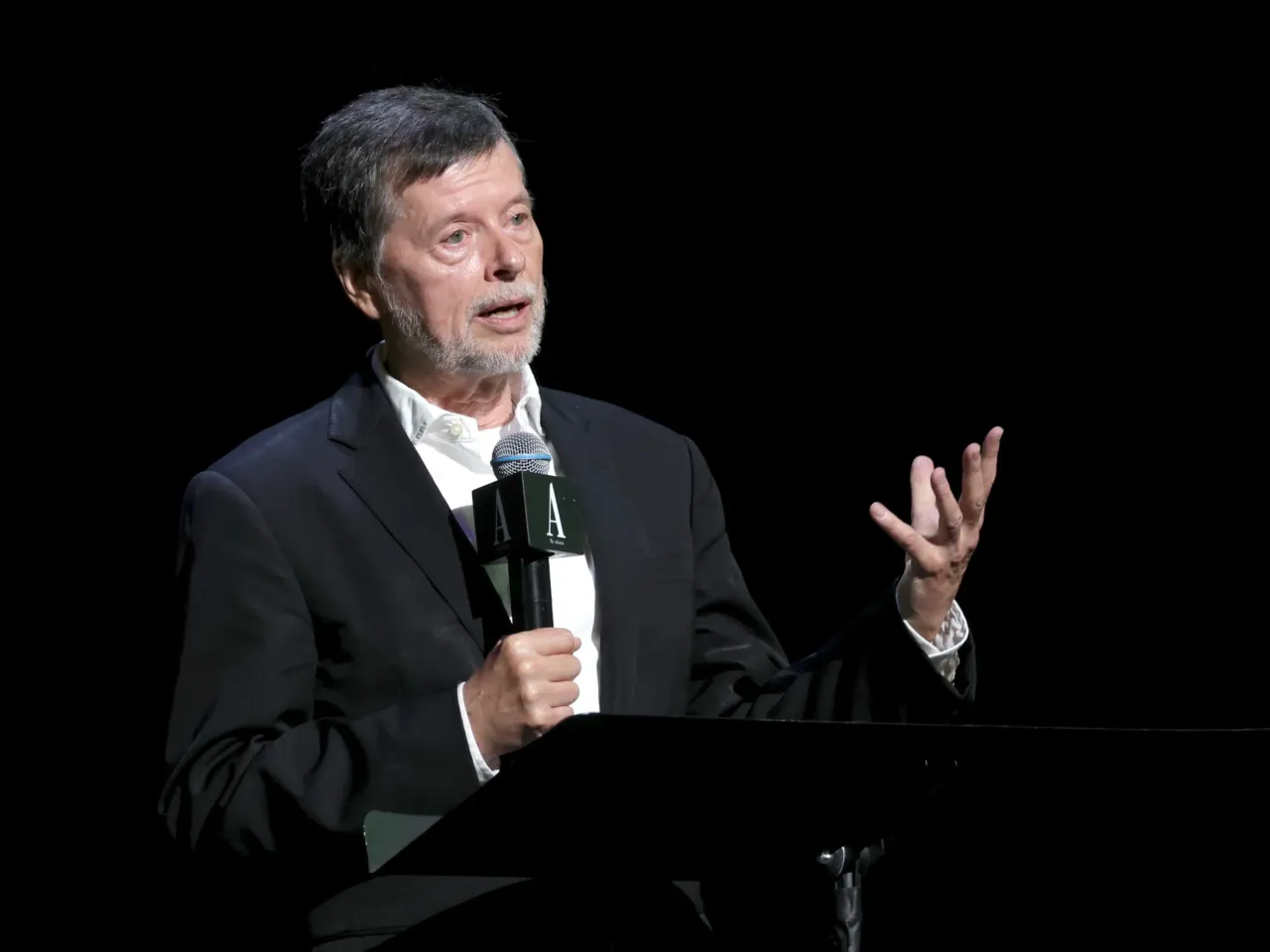
Ken Burns speaks onstage during the New York premiere of PBS' The American Revolution during the 2025 Atlantic Festival on September 18 in New York City.
Michael Loccisano / Getty Images
Ken Burns speaks onstage during the New York premiere of PBS' The American Revolution during the 2025 Atlantic Festival on September 18 in New York City.

Updated November 14, 2025 at 13:57 PM ET

Filmmaker Ken Burns has examined some of the most defining moments of American history.

He’s delved into the Civil War, dissected America’s response to the Holocaust and chronicled the evolution of jazz music.

For his latest project, Burns turns his lens toward The American Revolution — an event he has called the most significant since the birth of Christ.

Speaking to Morning Edition, Burns said he wanted to “wake people up” to the fact that “for most of human history, most people had been subjects under authoritarian rule and that what happened in the eastern seaboard of North America created citizens — this new thing with responsibilities.”

The six-part series — 10 years in the making — tells the story of how the American Revolution unfolded through the accounts of political and military leaders, Native soldiers, free and enslaved African soldiers and many more who played roles on both sides of the war.

The first episode of The American Revolution airs on PBS Sunday, Nov. 16. The series was co-directed by Burns, David Schmidt and Sarah Botstein.

Burns discussed his project and what he learned during its making with NPR’s Michel Martin. Below are some of his thoughts:

The Founding Fathers thought of future Americans as they envisioned a country

The Founding Fathers, Burns said, spoke of “unborn millions” who would be influenced by the creation of the country and the concept of citizenship.

When Thomas Jefferson spoke of the pursuit of happiness, Burns said this was not about the pursuit of material things but about lifelong learning in a marketplace of ideas.

“If you led a life of lifelong learning, you would be virtuous. You would earn the right of citizenship, one of the highest honors that could be bestowed on anyone,” Burns said.

The brutality of the revolution makes it that much more significant

The American Revolution explores just how violent the fighting was during the war.

Burns said that without newsreels or photographs, current understanding of the fighting is “limited to the romanticized paintings.” Conversations about the revolution, he added, focus on big moments like the Continental Congress and Constitutional Convention.

“We think that if we acknowledge the violence … that somehow it will diminish those big ideas,” Burns said. “In fact I think that those big ideas are even more inspiring when you understand that they come out of a revolution that is bloody, just guerrilla warfare at times and unbelievably brutal, a revolution that is also a civil war.”

Division is a constant in U.S. history

“When you look at the revolution, we were really divided then, really divided,” Burns said. “People were killing their neighbors.”

He noted how hundreds of thousands died during the Civil War and how various bombings took place in the U.S. during the Vietnam War era.

“I think we forget that. And [in] almost every period that I’ve focused on, you find enormous differences between people,” Burns said.

Burns said The American Revolution series serves as a reminder of why America’s experiment with democracy is so special.

The Founding Fathers “talked about you and me. They talked about the unborn millions,” Burns said. “We’ve got an obligation to listen to what they were offering, to understand what they thought was important … and then try to hand that off to our posterity and maybe the blips that we are so focused on, the navels that we constantly gaze at, won’t seem as important.”

The digital version of this story was edited by Majd Al-Waheidi. The radio version was produced by Phil Harrell.

Copyright 2025 NPR

Michel Martin is the weekend host of All Things Considered and host of the Consider This Saturday podcast, where she draws on her deep reporting and interviewing experience to dig in to the week's news. Outside the studio, she has also hosted "Michel Martin: Going There," an ambitious live event series in collaboration with Member Stations.

Martin came to NPR in 2006 and launched Tell Me More, a one-hour daily NPR news and talk show that aired on NPR stations nationwide from 2007-2014 and dipped into thousands of important conversations taking place in the corridors of power, but also in houses of worship, and barber shops and beauty shops, at PTA meetings, town halls, and at the kitchen table.

She has spent more than 25 years as a journalist — first in print with major newspapers and then in television. Tell Me More marked her debut as a full-time public radio show host. Martin says, "What makes public radio special is that it's got both intimacy and reach all at once. For the cost of a phone call, I can take you around the world. But I'm right there with you in your car, in your living room or kitchen or office, in your iPod. Radio itself is an incredible tool and when you combine that with the global resources of NPR plus the commitment to quality, responsibility and civility, it's an unbeatable combination."

Martin has also served as contributor and substitute host for NPR newsmagazines and talk shows, including Talk of the Nation and News & Notes.

Martin joined NPR from ABC News, where she worked since 1992. She served as correspondent for Nightline from 1996 to 2006, reporting on such subjects as the congressional budget battles, the U.S. embassy bombings in Africa, racial profiling and the aftermath of Hurricane Katrina. At ABC, she also contributed to numerous programs and specials, including the network's award-winning coverage of Sept. 11, a documentary on the Anita Hill-Clarence Thomas controversy, a critically acclaimed AIDS special and reports for the ongoing series "America in Black and White." Martin reported for the ABC newsmagazine Day One, winning an Emmy for her coverage of the international campaign to ban the use of landmines, and was a regular panelist on This Week with George Stephanopoulos. She also hosted the 13-episode series Life 360, an innovative program partnership between Oregon Public Broadcasting and Nightline incorporating documentary film, performance and personal narrative; it aired on public television stations across the country.

Before joining ABC, Martin covered state and local politics for the Washington Post and national politics and policy at the Wall Street Journal, where she was White House correspondent. She has also been a regular panelist on the PBS series Washington Week and a contributor to NOW with Bill Moyers.

Martin has been honored by numerous organizations, including the Candace Award for Communications from The National Coalition of 100 Black Women, the Joan Barone Award for Excellence in Washington-based National Affairs/Public Policy Broadcasting from the Radio and Television Correspondents' Association and a 2002 Silver Gavel Award, given by the American Bar Association. Along with her Emmy award, she received three additional Emmy nominations, including one with WNYC's Robert Krulwich, at the time an ABC contributor as well, for an ABC News program examining children's racial attitudes. In 2019, Martin was elected into the American Academy of Arts and Sciences for outstanding achievement in journalism. She is the 2021 recipient of PMJA's 2021 Leo C. Lee Award.

A native of Brooklyn, N.Y., Martin graduated cum laude from Radcliffe College at Harvard University in 1980 and earned a Master of Arts from the Wesley Theological Seminary in 2016.

Related Stories