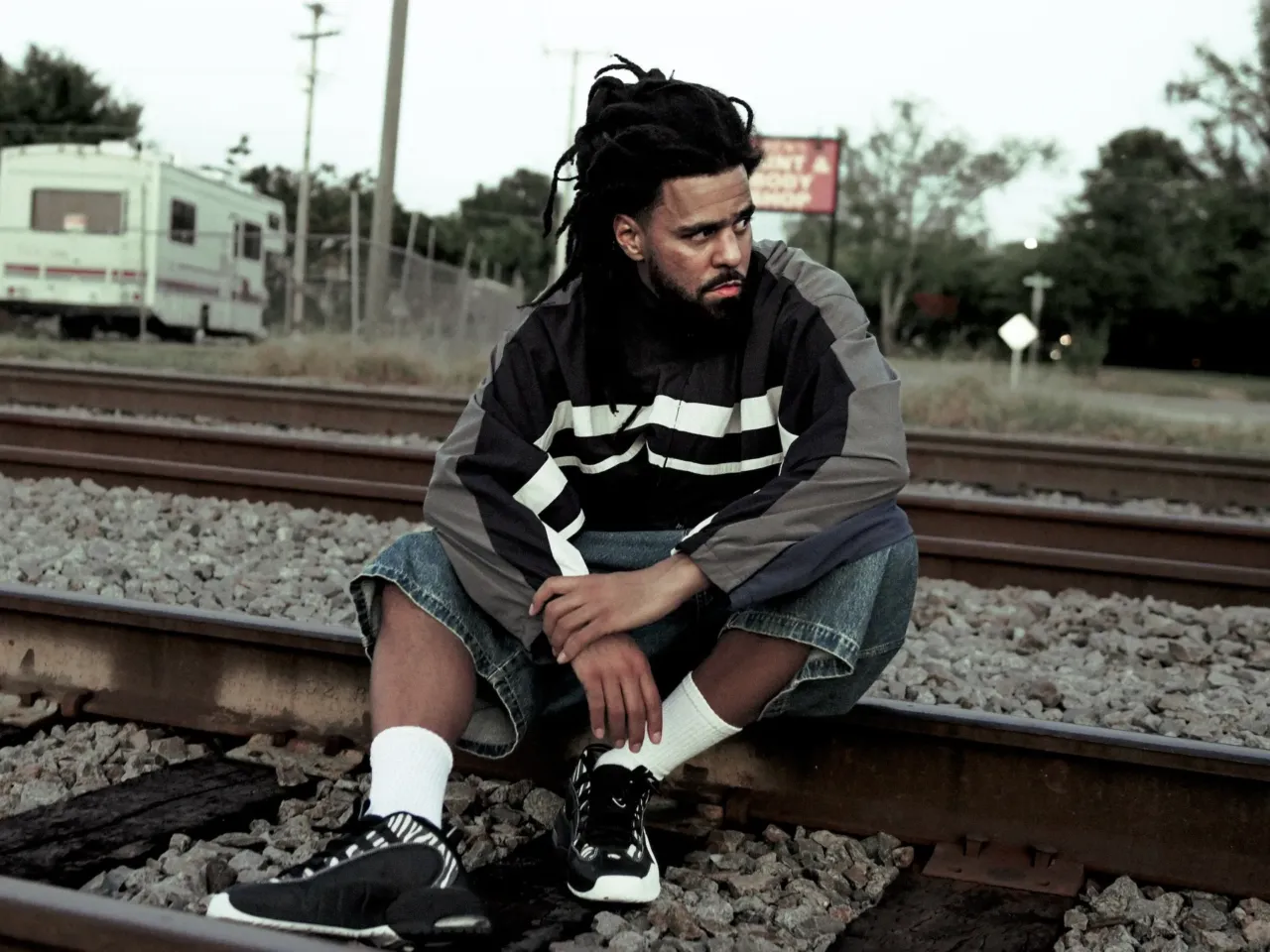
If you believe in the many-worlds interpretation of quantum physics, we inhabit multiple realities at the same time. Our past and future selves mixing and mingling with the present in imperceptible ways. Muddying our memories with our visions. Making it impossible to distinguish intention from impact. We are a multitudinous freaking mess.
J. Cole was in the midst of his Jesus year — age 33 — the first time he hinted at The Fall-Off. Planning for retirement in advance is the wisest of moves for most working professionals; announcing it prematurely in rap reeks of desperation. For the last decade, Cole’s milked it to infinity. With fans hanging on to his every verse like it’s his next-to-last. But it was never the end he was focused on, it was the endgame. Because a decade-long retirement party is only a punchline without an illustrious legacy to leave behind.
The (marketing) plan seemed to be going perfectly. Until his prediction became prophecy. J. Cole’s self-inflicted fall-off, from Big Three contender to odd-man out, became so literal that he seemed destined for cautionary-tale status: Here lies the MC who entered a three-way battle with one foot in — and the other foot in his mouth. He deleted “7 Minute Drill” from streaming, calling the diss track directed at Kendrick Lamar the “lamest s*** I did in my f***ing life.”
Through it all, Cole had the foresight, or hindsight, to know he hadn’t yet become the man he’d one day proclaim to be. Nearly a decade in the making, The Fall-Off finds Cole straddling universes: He’s an old man, a new man and everyman all at once. Rap’s wayward wonder is still consumed to death with writing and revising his personal memoirs. But his self-mythologizing is also sacrificial. Cole’s rethinking his relationship with rap’s codes of masculinity, even if deconstructing them means destroying himself in the process: “This a suicide note / Come here look what I wrote,” as he rhymes on “Bunce Road Blues.” “I’m bout to kill myself / F*** J. Cole / I don’t even want this role / Wanna rebuild myself.”
The Fall-Off is a double album meant to symbolize dual realities in his timeline. Nearly a decade in the making, the parallel storylines that unfold — on Disc 29 and Disc 39 — represent Cole’s state of mind at either age and stage of his career. Both sides cast him as the journeyman who found success after leaving his hometown, only to return and face new epiphanies that make him question what it was all worth. Now, in the thick of midlife, he’s evaluating his self-worth by reflecting on the legacy he’ll leave. It’s less concept album than epic conceit, the kind that would’ve made Joseph Campbell a diehard convert. But before he can journey through internal conflict (Disc 29) and arrive at internal peace (Disc 39), the hero has the job of convincing himself how redemptive his love for home and hip-hop can really be.
His sense of pride is inextricably tied to a sense of place. Though boombap is his blood type, he’s hellbent on showing he’s loyal to the Southern soil. He reestablishes that out the gate with a soundtrack heavy on samples and interpolations that allude to his sacrosanct stomping ground. The prodigal rapper returns to his home state with James Taylor crooning “Carolina On My Mind” on “29 Intro.” Later, when Future pops up on “Bunce Road Blues,” riffing on Usher’s classic “Nice & Slow,” it’s a soft nod to the Atlanta rise a young Cole once aspired to. A snatch of the Bangladesh-produced beat from Ludacris’ first hit “What’s Your Fantasy.” A sprinkling of Three Six Mafia’s DNA via Willie Hutch. An OutKast homage dedicated to the mutual come-up of “yo mama and yo cousin, too.” They all sound at home here, even when Cole openly struggles with being back in the Ville.
Of course, Cole’s cultural encoding has never been restricted by locality. Whether he’s dropping sonic references to T.I. and Boosie or extending his hip-hop homage to include the likes of DMX (on “Life Sentence”) and Nas (on “SAFETY”) , it’s an earnest if flawed attempt at personifying a unified hip-hop identity that’s nearly non-existent now. The dissolution of that identity comes to a head on a remake of hip-hop’s everyman classic that puts Cole’s existential crisis on full blast. “I Love Her Again” picks up where Common’s “I Used To Love H.E.R.” left off. Repeating the original’s patriarchal premise — by personifying hip-hop as a “b****” because so many men have had their way with “her” — feels even more cringe in 2026 than it was 30-odd years ago. For a genre built on so much male dominance and misogyny, nothing could be more unjust than making women the metaphor for the rap game’s treachery. At the very least, Cole does close the loop on Com’s classic by reconciling his open relationship as his problem. Not hip-hop’s. The only thing worse is when he attempts to repair homophobic slights by telling a story about how a homeboy he and his bros used to call the f-word is now dying of AIDS. It’s meant to express regret but does so by inflicting the same injury.
Even when I don’t love Cole’s creative choices, I respect how he pushes his folk to make better life choices. Like he does on “Two Six,” when he raps, “Rolls Royce please don’t sell these rappers no more Cullinans / They unoriginal and plus I know they don’t be budgetin’.” In his hands, aspirational hip-hop is not defined by one’s ability to splurge half a milli on a luxury SUV. That’s further evidenced by the low-budget promo tour he commenced with the album release — taking his high-mileage Honda Civic on the road to sell CDs out the trunk. Performative? Maybe. But it ain’t stuntin’ if the car note’s paid.
The best moments come when he reflects on the hardening of his own heart with a soft touch. You can hear it as he raps to his younger self on “The Villest.” Or on “What If,” when he roleplays Pac and Big squashing the beef before it turns deadly. Posing these hypotheticals is about more than assuming greatness. He’s trying to get hip-hop to imaginate a new reality. So the future doesn’t have to repeat the past.
The climax comes on “Quik Stop,” a swelling lyrical narrative reenacting a fan encounter at a local gas station, over a Cole-sung sample of Devin the Dude’s “Just Tryin’ Ta Live” that ends with Cole realizing he served his highest purpose when he stopped fueling any self-serving desires to be the greatest. “This life is more than just rap / More than the b****es you scrape / More than the riches you stack / See, it’s the difference you make,” he raps.
Ultimately, the perennial Middle Child is the middleman pulled between hip-hop’s ideological extremes: art vs. sport, conscious vs. commercial, Kendrick vs. Drake. He navigates that morass with his whole heart. But the album isn’t without its chest thumping. Cole is proud of himself. Very proud. To have taken a path less traveled, out of Fayetteville and most especially in rap. Backing out of that beef was just the dress-rehearsal. It’s almost as if he’d gotten ahead of himself, working on this proposed final testament years in advance of its release. He knew in his heart he hadn’t yet lived up to the man he wanted to be, needed to be, for The Fall-Off to ring true. So when the test hit him in real time, backpedalling was his only way forward. It may not be the best album of his career, but it’s the best version of himself.
Copyright 2026 NPR