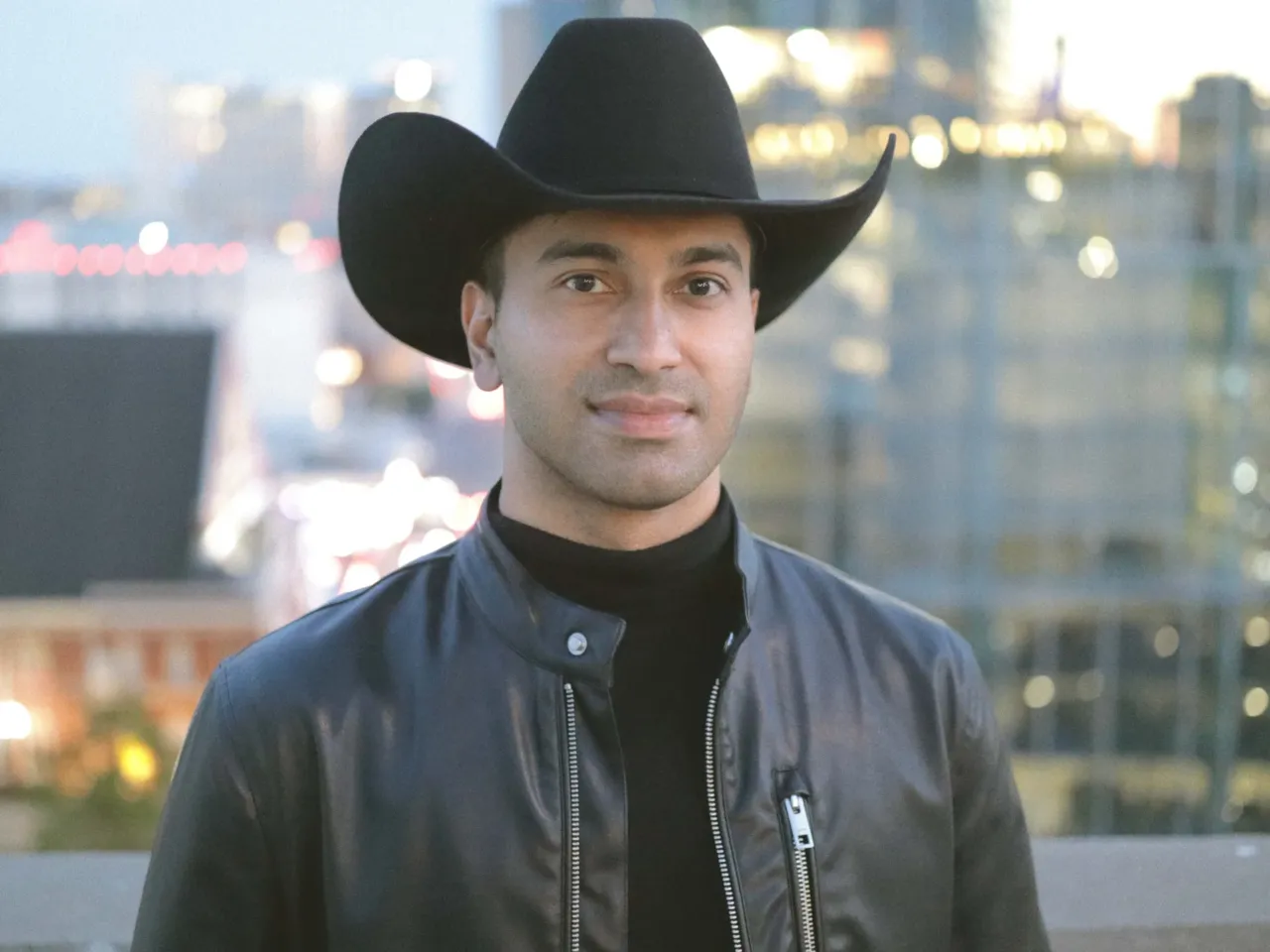
When the singer-songwriter Mo Sabri was growing up in East Tennessee, his Pakistani immigrant parents loved playing the swirling, rhythmic sounds of qawwali, Sufi Muslim devotional music.
They also loved playing country classics by Kenny Rogers and Dolly Parton. After all, Johnson City, Sabri’s hometown, is a 30-minute drive from Bristol, Tenn., known as the birthplace of country music.
Those musical influences would have a profound effect on Sabri. Today, he is a country music artist in Nashville who proudly identifies as a Pakistani American and a Muslim — and creates music drawing from those worlds. On his YouTube channel, you’ll find original country songs like “Married in a Barn” but also a cover of the qawwali “Tajdar e Haram.”
And he’s making music history. On May 31, this Muslim country singer will play with the Nashville Symphony. They will perform an orchestral rendition of his new album, Tennessee Desi, a unique fusion of Appalachian country sounds and qawwali, which comes from the Arabic word qaul, meaning “to speak.”
“This is a really big deal,” says Charles Alexander, a digital strategist of Malaysian Indian descent who has worked in Nashville’s music industry for 16 years. “It speaks volumes in terms of diversity and representation in the types of music that has germinated in Tennessee.”
As for Sabri, his upcoming show is a homecoming. “In a way, it’s a reflection of who I am as a first-generation American, who’s half-country, half-desi,” he says. “Desi” refers to those from the South Asian diaspora.
“I feel most free writing country music”
Although country, which descended from Black music, is associated with a white conservative audience, it felt like the natural choice for Sabri as a musical artist. In Johnson City, his life resembled the lyrics of the country music songs he listened to.
“There was a lot of sitting on your porch and watching the sunset, driving down the road in your truck with the windows down,” he says.
Sabri was also drawn to country because of its pursuit of the truth, he says. “I feel most free writing country music. It’s almost punk rock — that I can talk about being Muslim in the place that most people think I shouldn’t or can’t.”
“More similar than different”
Sabri says he started delving into qawwali around the start of the pandemic as a way to get closer to his parents and his culture. “Since I’ve never lived [in Pakistan], it felt like a way to stay in touch with my heritage,” he says.
And, he notes, he may be distantly related to the Sabri Brothers, the famous qawwali duo from Pakistan. “So I felt a responsibility to eventually try to honor the genre,” he says.
Qawwali, which hails from India and Pakistan, is a musical performance of Sufi Muslim poetry — think Rumi and Hafez — infusing singing, handclaps and drumbeats to bring listeners to ecstatic heights.
At home and at gatherings with the few South Asian families in Johnson City, the music “would always get people dancing and clapping,” Sabri recalls.
Tennessee Desi includes a cover of the bluegrass song “Rocky Top,” an ode to the hills of Tennessee, and a qawwali called “Allah Hoo,” which tells Islam’s creation story. In preparing for the concert, Sabri found that the two genres were “more similar than different,” he says.
“Country is a folk music of Appalachia, and qawwali is a folk music of South Asia,” he says. Religion is also a big theme in both genres.
One challenge in blending the two genres was that “qawwali doesn’t necessarily follow a Western scale, which has 12 notes,” he says. “In Eastern music, there are microtones in between.”
There are techniques to “artistically mimic the microtonal aspect” like the slide guitar, common in country and blues music, Sabri says. “You have a piece of metal placed on the string [of the guitar], and now the note is no longer exact.”
Music that bridges divides
So what do Americans think of Sabri’s fusion of country and qawwali music? Last year, he played a show in Indiana and tested out an early version of Tennessee Desi set onstage.
“There were people from all political sides, country folks and Desi aunties in the audience, and they were all enjoying it in different ways,” he says. “It’s a testament to the fact that there are people in the South who enjoy the fusion, and there are South Asians who love country music.”
Sabri has a few listeners from South Asia as well. On his YouTube, commenters from the region have praised his cover of the qawwali “Tajdar e Haram.”
“Well you made my day with those beautiful words you spoke in English, never knew those verses could be taken to such heights by the wonder of translation,” writes one user.
“Enchanting,” writes another.
Some users, however, have criticized his pronunciation. “Good effort,” writes another user. “You need to acquire a little more control over your language. I am sure with the passage of time you will be a household name.”
Sabri acknowledges that his Urdu could be better. While he can understand the language fluently, “I’m a little slow when it comes to speaking,” he says.
“From the mountains of Pakistan to the mountains of East Tennessee”
Sabri has never been to Pakistan, but if he does go, he says he’d “love to visit where my parents grew up, near Rawalpindi.”
His dad immigrated to the United States in the ’70s and his mom in the ’80s. “My parents came from the mountains of Pakistan, and they settled in the mountains of East Tennessee,” he says. “They wanted me and my siblings to have the opportunities they never had — and find success.”
That he will be blending the music from his parents’ home country and the music from the region he grew up — on such a prominent stage — is a full-circle moment for Sabri.
He feels it will be for his parents, too. “Me performing at the Symphony,” he says, “is their American dream come true.”
Copyright 2026 NPR