Wine comes in at the mouth
And love comes in at the eye;
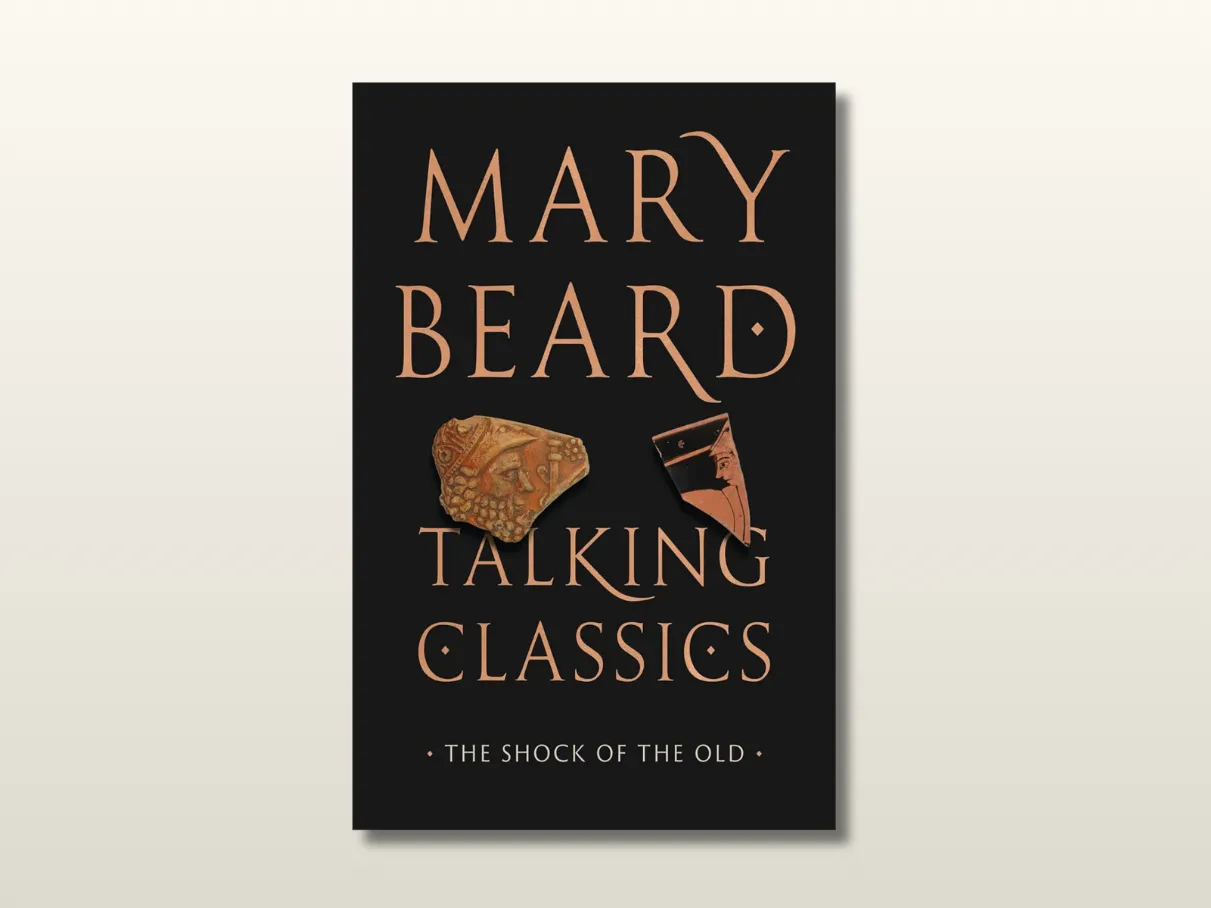
That’s a line from a Yeats’ poem, appropriately entitled “A Drinking Song.” Love did indeed come “in at the eye” for the distinguished classics scholar Mary Beard. In her new book called, Talking Classics, Beard, who grew up middle class in an English village, recalls being taken as a child by her mother for her first visit to London in 1960.
They wandered through The British Museum and stopped to see the mummies. Beard, however, became curious about a display case featuring everyday objects, including a 4,000-year-old piece of bread.
Beard’s mother tried to lift her up for a closer look but, as Beard confesses in the droll way that has endeared her to millions of readers and television audiences, the attempt failed because “I was a heavy and wriggly child.”
Along came a kindly curator who drew keys out of his pocket, unlocked the case, and held the ancient piece of bread in front of little Mary’s eyes. As Beard says, that experience was what the ancient Greeks would have called a moment of thauma, meaning “wonder” or “wonderment.” I don’t think it’s fanciful to say that Beard has spent her life unlocking the deep past and encouraging thauma in the rest of us.
Most of Talking Classics is drawn from four lectures Beard gave at the University of Chicago in 2023. If the word “lectures” makes you want to head for an exit door, you don’t know Beard’s style. This is a public intellectual who uses terms like “slime-bag” to describe Medea’s husband and who advises everyone to “dial down the pious reverence” when considering the ancient world.
Beard also has little love for the exclusionary side of studying the classics or for those conservative traditionalists she dubs “the column crowd,” who want to erect classical architecture in contemporary cities because of “the authority” it appears to exude. One of the many hard questions Beard considers in this book is whether classical architecture and statuary are irredeemably tainted by the uses to which they’ve been put by, say, Mussolini or today’s far-right racist groups. Beard reminds us that there’s also radical “disruptive” power in the classics. Among the revolutionaries she names with “more than a foothold in classics” are Karl Marx, Nelson Mandela, Eldridge Cleaver and Bobby Seale.
The overarching question about the ancient world that structures Beard’s slim little book — and her life’s work — is one that she says “was very nearly drummed out of me when I was a student: what on earth was it like to be there?”
I’d say it’s also the question that powers the geyser of contemporary reimaginings of the ancient world, among them, novels like The Song of Achilles and Circe, both by Madeline Miller, as well as the forthcoming Christopher Nolan film The Odyssey. As much as she treasures connection with the deep past, Beard cautions us that the classical world is also;
unthinkingly alien, sometimes almost incomprehensible. … It goes right down to everyday ideas about the body, the self and the family, and to such basic questions as ‘Who am I?’ Don’t forget that most people in antiquity would have no clue what they looked like, except from their wavering reflection in a pool of water or from a dull outline on a piece of polished bronze or silver. … ([N]o wonder so many ancient jokes hinged on issues of mistaken identity).
The payoff, to put it bluntly, of studying classics — and more broadly of a humanities education — is, according to Beard, best encapsulated in a phrase she gleaned from a colleague who said: “[classics] teaches you ‘to read difficult things.'” Beard goes on to elaborate that: “In a global environment of fact-dodging, misreporting, conspiracy theories, fake news and outright lies, skills in reading difficult things are those that the world most needs.”
Like that ancient hunk of Egyptian bread that fascinated Mary Beard as a child, Talking Classics offers readers plenty to chew on.
Copyright 2026 NPR