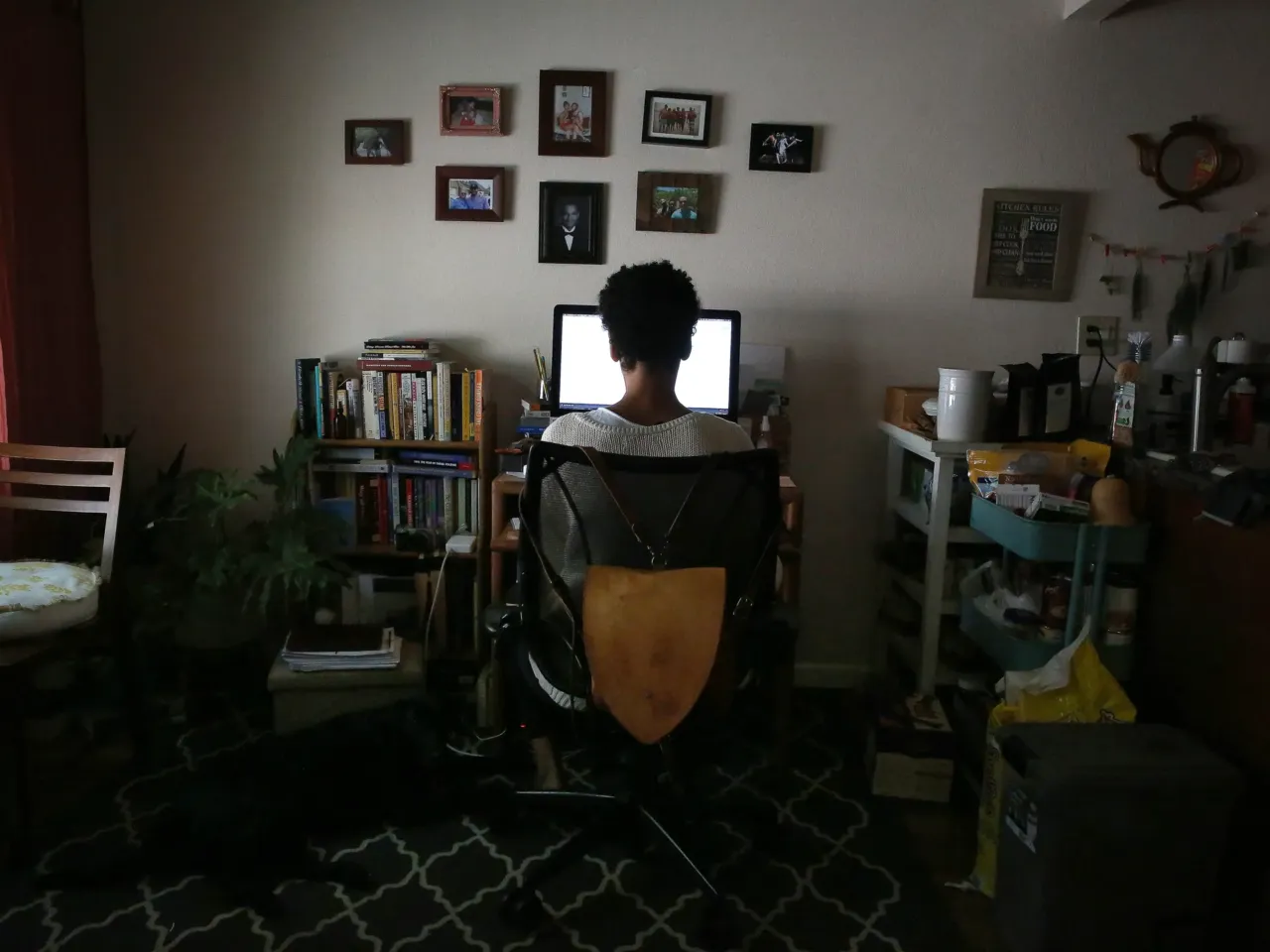
Remote work has soared in popularity since the COVID-19 pandemic. But, a new study suggests the practice has made workers more socially isolated, anxious and depressed compared to people who work in-person in offices and other settings.
“Other studies have found that workers are willing to give up 4 to 10% of their earnings in order to have the ability to work remotely,” says Natalia Emanuel, an economist at Federal Reserve Bank of New York and the main author of the new study published in the journal Science. “So there is a great desire for remote work.”
Yet she and her colleagues found that people in remote jobs have seen a rise in hours spent alone during the workday, and more visits to mental health care providers. In self-reports, they also assess their own mental health negatively.
How does working from home change us?
The findings suggest that “people might be choosing poorly,” when it comes to their well-being, says Nicholas Epley, a professor of behavioral science at the University of Chicago’s Booth School of Business, who wasn’t involved in the study.
Want the latest stories on the science of healthy living? Subscribe to NPR’s Health newsletter.
That’s probably because “it’s very easy to recognize that the commute is a pain in the neck and the traffic sucks,” compared to anticipating how missed social connections at work will impact us down the line, he says. His own research has documented that people “underestimate how well things will go when we actually reach out to connect with other people,” he adds.
Epley says Emanuel and her colleagues found a way to answer a question he gets asked often: “What work from home does to us?”
“Everybody wants to know how is that changing things? And usually the answer is we can’t really tell,” he explains. “We can’t really tell because people weren’t randomly assigned to work from home or not as a terrible experiment.”
“Remotable” vs. “non-remotable” jobs
To get around that problem, Emanuel and her colleagues looked at data from five large national surveys on American workers, both in jobs that allow remote work, like software engineering and marketing — so-called “remotable jobs” — and those in jobs that can’t be done remotely (“non-remotable jobs” like surgery, or mechanical engineering).
They found that workers in remotable jobs had experienced a 58% rise in hours spent alone compared to people in non-remotable jobs. These workers also saw a 72% rise in chances of spending their whole day with no human contact.
“Not even like a wave to a barista, not somebody also checking for ripeness of the avocados at the grocery store,” says Emanuel. “Just no human contact at all.”
Remote workers aren’t making up for that lost social connection by socializing after work, she adds. “We even see a decrease in spending time with friends after the work day relative to people in non-remotable occupations.”
More psych meds, too
People in remote jobs also saw a rise in symptoms of emotional distress, evaluated with a standardized questionnaire about symptoms of anxiety and depression. They also had more visits to mental health care providers and used more prescription psychiatric meds.
All these impacts were worse for remote workers who live alone. For example, they saw the largest increase — 83% — in chances of spending their days with no social contact.
“Likewise, the increase in mental distress is almost twice as large for those living alone as for those living with their family,” notes Epley.
That’s no surprise, he adds. Scores of past studies have documented the negative impacts of isolation and loneliness on our mental and even physical health.
“Being alone compromises your immune system functioning, your cardiovascular system functioning,” says Epley.
Studies have also documented that the biggest predictor of well-being and happiness is “the quality of your social relationships,” he adds.
“Psychologists believe this feeling of human connection and belonging is just absolutely crucial to us as humans, that we cannot thrive, we suffer, if we don’t have that need met,” says psychologist Gillian Sandstrom at Sussex University and author of a book called Once Upon a Stranger: The Science of How ‘Small’ Talk Can Add Up to a Big Life.
While the new study’s findings are important, Epley notes that they “don’t suggest that every office should be forcing everybody to come in to work.”
Other studies have documented that remote work increases productivity in many industries, and that working from home is particularly helpful for certain groups, like caregivers and neurodivergent individuals.
Epley notes that employers should take into account that remote work can take a toll on workers’ mental health, and employers should make working in the office “more attractive for people.”
As many organizations are starting to bring employees back to work, Epley suggests, they should make sure that those who come in have other co-workers there, too. “What they’re providing that’s rewarding at work is social interaction, social connection,” he says.
And for those still working remotely, Sandstrom, who also often works from home, recommends being intentional about seeking daily human interactions like she does.
“I leave the house every day. I go for a walk, I see my neighbors, I pet some dogs,” she says. “I have my activities that I do. I play tennis. I have hobbies that mean that I see other people.”
Copyright 2026 NPR