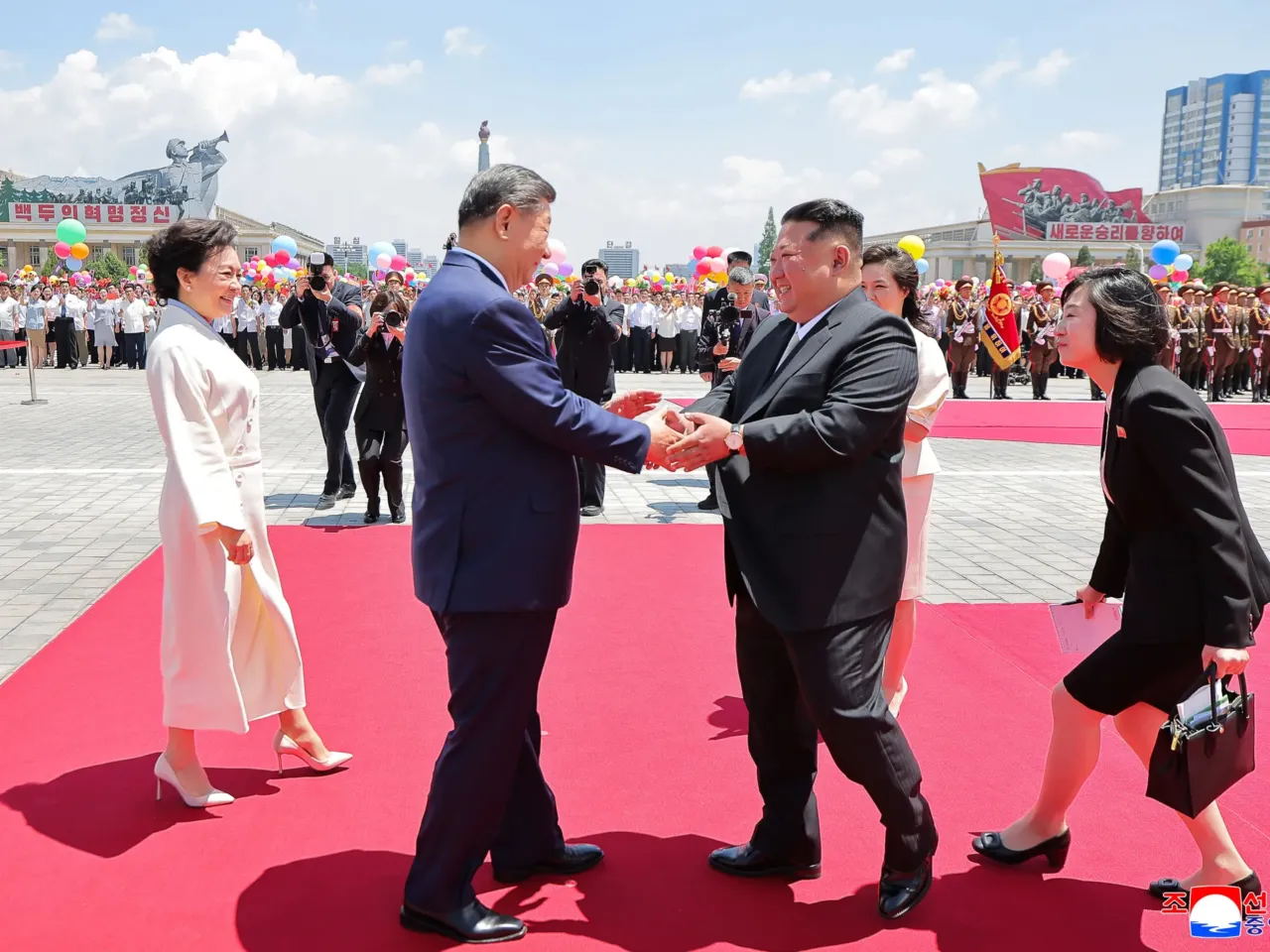
SEOUL/SHANGHAI — The leaders of China and North Korea reaffirmed their alliance this week in Pyongyang, emphasizing strategic cooperation while avoiding public discussion of North Korea’s nuclear weapons program.
The two-day trip — President Xi Jinping’s first to North Korea in nearly seven years — comes shortly after his summit with President Trump in Beijing, where the White House said both sides agreed on the shared goal of denuclearizing North Korea.
Beijing did not publicly echo Washington’s claim. And this week in Pyongyang, Xi made no public mention of denuclearization.
Instead, Xi focused on China’s “firm commitment to safeguarding the shared interests of the two countries and preserving a favorable strategic environment,” according to Chinese state media.
North Korea’s state media, meanwhile, quoted leader Kim Jong Un as saying that ties with China are “the most important and primary strategic undertaking” of his country.
This language suggests Kim is trying to balance his relationship with both Beijing and Moscow, elevating China’s diplomatic significance after a period of closer alignment with Russia.
China’s silence over North Korea’s nuclear program could also create a dilemma for itself
Xi’s silence on North Korea’s nuclear program came as Kim tried to convince the world of the irreversibility of his country’s status as a nuclear power.
Days earlier, Pyongyang unveiled a new nuclear bomb fuel plant. Kim also announced his plans to expand his country’s nuclear arsenal “at an exponential rate.”
The U.S. claims that a denuclearized Korean Peninsula is a shared goal with China. But Beijing has not publicly confirmed such an agreement, and Kim’s sister has dismissed the U.S. claim as “false.”
Tong Zhao, a senior fellow of the nuclear policy program at the Carnegie Endowment for International Peace, says China’s approach reflects its shift in priorities.
“China appears to downplay the issue of North Korea’s nuclear weapon program in order to prioritize improving bilateral relations [with Pyongyang],” says Zhao, adding that Beijing has made “a very significant policy change to tacitly accept the reality of a nuclear North Korea.”
But, he adds, this could also create a dilemma for Xi. “It could prompt U.S. allies like South Korea and Japan to strengthen their security relations with Washington,” Zhao says.
China and North Korea seek to “expand their alliance relationship beyond the Korean Peninsula”
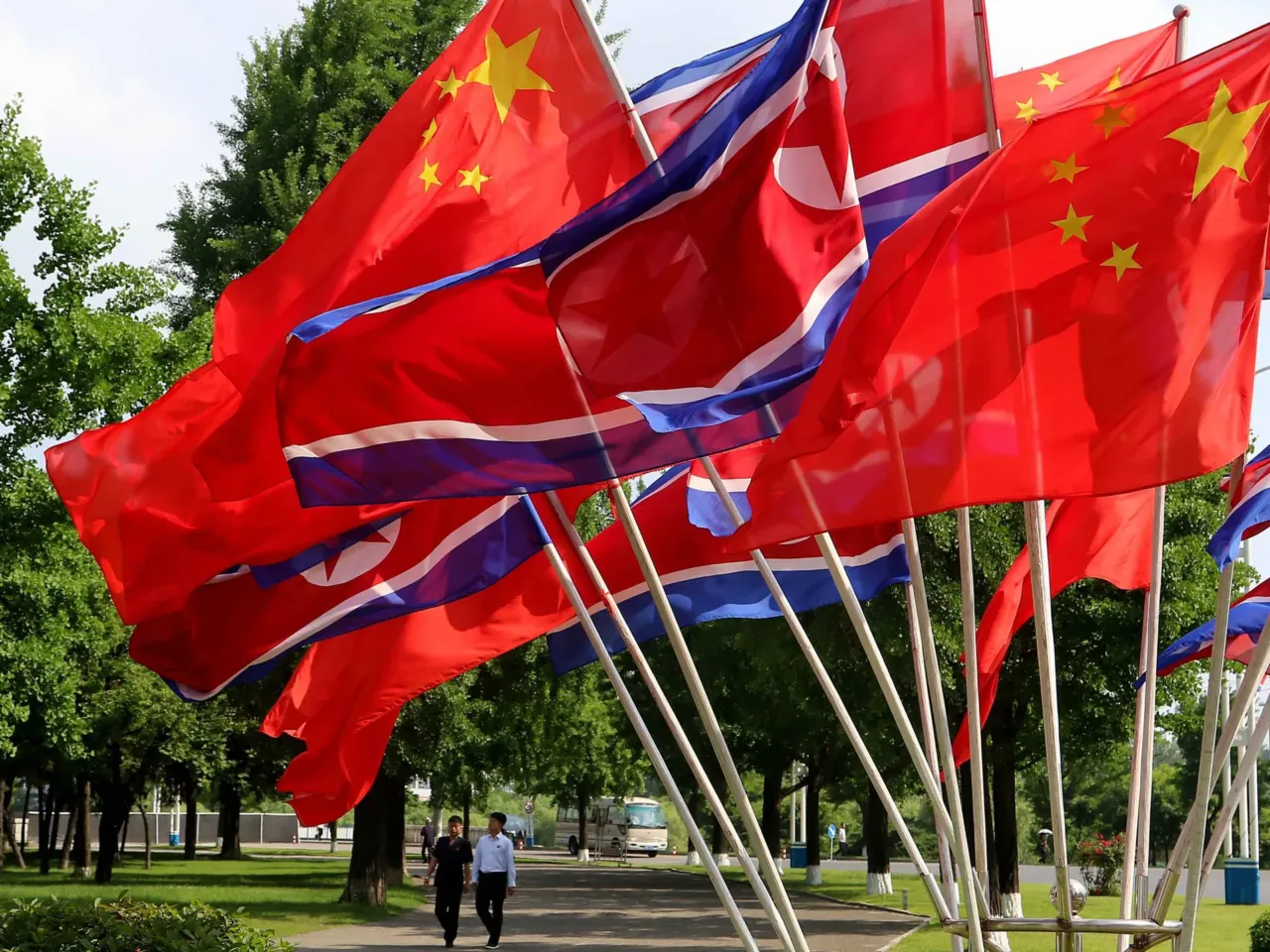
Until recently, both China and Russia publicly supported denuclearization. As recently as 2023, Beijing and Moscow backed a “dual track” approach, combining denuclearizing North Korea with a permanent peace regime to replace the 1953 Korean War armistice.
But geopolitics has changed since then.
Russia’s full-scale invasion of Ukraine drew North Korea closer to its orbit, with Pyongyang providing Moscow with munitions and troops. And a 2023 meeting at Camp David under the Biden administration advanced trilateral political and military cooperation between the U.S., Japan and South Korea — a move that angered China.
By 2024, China and Russia had largely pivoted away from the “dual-track” approach, focusing instead on criticizing U.S. sanctions and military pressure on North Korea.
Choo Jaewoo, a foreign policy expert at Kyung Hee University, says that Xi and Kim’s remarks suggest broader ambitions between the two allies.
“They would like to expand their alliance relationship beyond the Korean Peninsula,” Choo says.
This could include North Korea’s involvement in wider regional flashpoints, including Taiwan. This week, the two sides agreed on boosting exchanges, including military cooperation.
Kim has also articulated his broader ambitions for North Korea’s role in the new geopolitical environment.
He wants his country to act as a contributor to what he and his partners describe as a “fair and just international order” — language that echoes rhetoric used by both China and Russia to challenge the U.S.-led world order.
A loose alignment or a new alliance?
But while some see a growing threat from an emerging bloc including China, Russia, Iran and North Korea — sometimes known as “CRINK” — Seong-hyon Lee, an associate at Harvard University’s Asia Center, says the arrangement is more transactional than institutional.
“This does not require a formal alliance,” says Lee. “This just requires loose alignment.”
And Beijing and Pyongyang are not the only ones to discuss updating their decades-old alliance.
It comes as the U.S. and South Korea are discussing “alliance modernization” and “strategic flexibility,” which would entail South Korea’s military taking the lead in deterring the North, while U.S. forces shift their focus toward deterring China.
NPR’s Se Eun Gong in Seoul and Jasmine Ling in Beijing contributed to this report.
Copyright 2026 NPR