Copyright © 2026 VPM, all rights reserved.
PBS is a 501(c)(3) not-for-profit organization.
VPM News Morning Edition
NEXT UP: 9:00 AM

Thanks to our sponsors – Become a Sponsor

As western fires erupt, Trump’s Forest Service says it’s now fully staffed

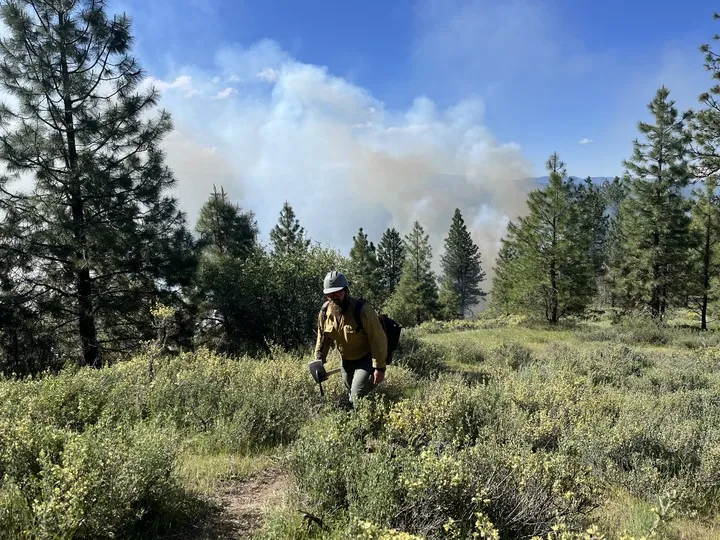
A U.S. Forest Service wildland firefighter in Idaho
Kirk Siegler / NPR
A U.S. Forest Service wildland firefighter in Idaho

The U.S. Forest Service says it has now exceeded its wildland firefighter hiring targets for this summer’s fire season.

Newly released numbers provided by the agency to NPR show that 11,550 seasonal staff are now either being trained or ready to deploy, which is about 200 more than their initial goals and about 6% ahead of schedule compared to this time in recent years.

U.S. Forest Service Chief Tom Schultz credits the solid numbers to recent pay raises for wildland firefighters. The hiring comes as Western states are historically dry and on edge, with fast moving wildfires igniting in the last day in and around populated areas such as Spokane, Washington.

“I think the conditions we have are alarming,” Schultz told NPR. “But the Forest Service will be prepared for this season.”

But in the West, many state officials and former agency employees aren’t so sure given the continued downsizing of the agency.

Since President Trump returned to the White House last year, the USFS has lost close to 6,000 permanent staff to layoffs, buyouts or early retirements. The agency is also undergoing a massive reorganization which includes moving its headquarters to Utah and the closure or consolidation of dozens of research facilities and regional offices. The Trump administration says it wants to put the agency closer to the actual forests it manages.

But Dave Upthegrove, Washington state’s elected public lands commissioner says, “these layoffs at the federal level are presenting risk as to our ability to respond to major wildfires.”

He’s worried that the downsizing of the Forest Service will lead to a shortage of elite incident command teams that states like his rely on during major fires. An untold number of permanent staff like rangers or timber technicians who have been let go recently also held what are called red cards, meaning they’re trained to leave their regular jobs and deploy to wildfires.

“If we have a bad year for fire throughout the United States it could mean a shortage of these federal teams,” Upthegrove says. “We are preparing contingency plans.”

Copyright 2026 NPR

As a correspondent on NPR's national desk, Kirk Siegler covers rural life, culture and politics from his base in Boise, Idaho.

His beat explores the intersection and divisions between rural and urban America, including longer term reporting assignments that have taken him frequently to a struggling timber town in Idaho that lost two sawmills right before the election of President Trump. In 2018, after the deadliest and most destructive wildfire in California history, Siegler spent months chronicling the diaspora of residents from Paradise, exploring the continuing questions over how – or whether – the town should rebuild in an era of worsening climate-driven wildfires.

Siegler's award winning reporting on the West's bitter land use controversies has taken listeners to the heart of anti-government standoffs in Oregon and Nevada, including a rare interview with recalcitrant rancher Cliven Bundy. He's also profiled numerous ranching and mining communities from Nebraska to New Mexico that have worked to reinvent themselves in a fast-changing global economy.

Siegler also contributes extensively to the network's breaking news coverage, from floods and hurricanes in Louisiana to deadly school shootings in Connecticut. In 2015, he was awarded an international reporting fellowship from Johns Hopkins University to report on health and development in Nepal. While en route to the country, the worst magnitude earthquake to hit the region in more than 80 years struck. The fellowship was cancelled, but Siegler was one of the first foreign journalists to arrive in Kathmandu and helped lead NPR's coverage of the immediate aftermath of the deadly quake. He also filed in-depth reports focusing on the humanitarian disaster and challenges of bringing relief to some of the Nepal's far-flung rural villages.

Before helping open the network's first ever bureau in Idaho at the studios of Boise State Public Radio in 2019, Siegler was based at the NPR West studios in Culver City, California. Prior to joining NPR in 2012, Siegler spent seven years reporting from Colorado, where he became a familiar voice to NPR listeners reporting on politics, water and the state's ski industry from Denver for NPR Member station KUNC. He got his start in political reporting covering the Montana Legislature for Montana Public Radio.

Apart from a brief stint working as a waiter in Sydney, Australia, Siegler has spent most of his adult life living in the West. He grew up in Missoula, Montana, and received a journalism degree from the University of Colorado at Boulder.

Related Stories