LONDON — In England, students memorize one date above all else: 1066.
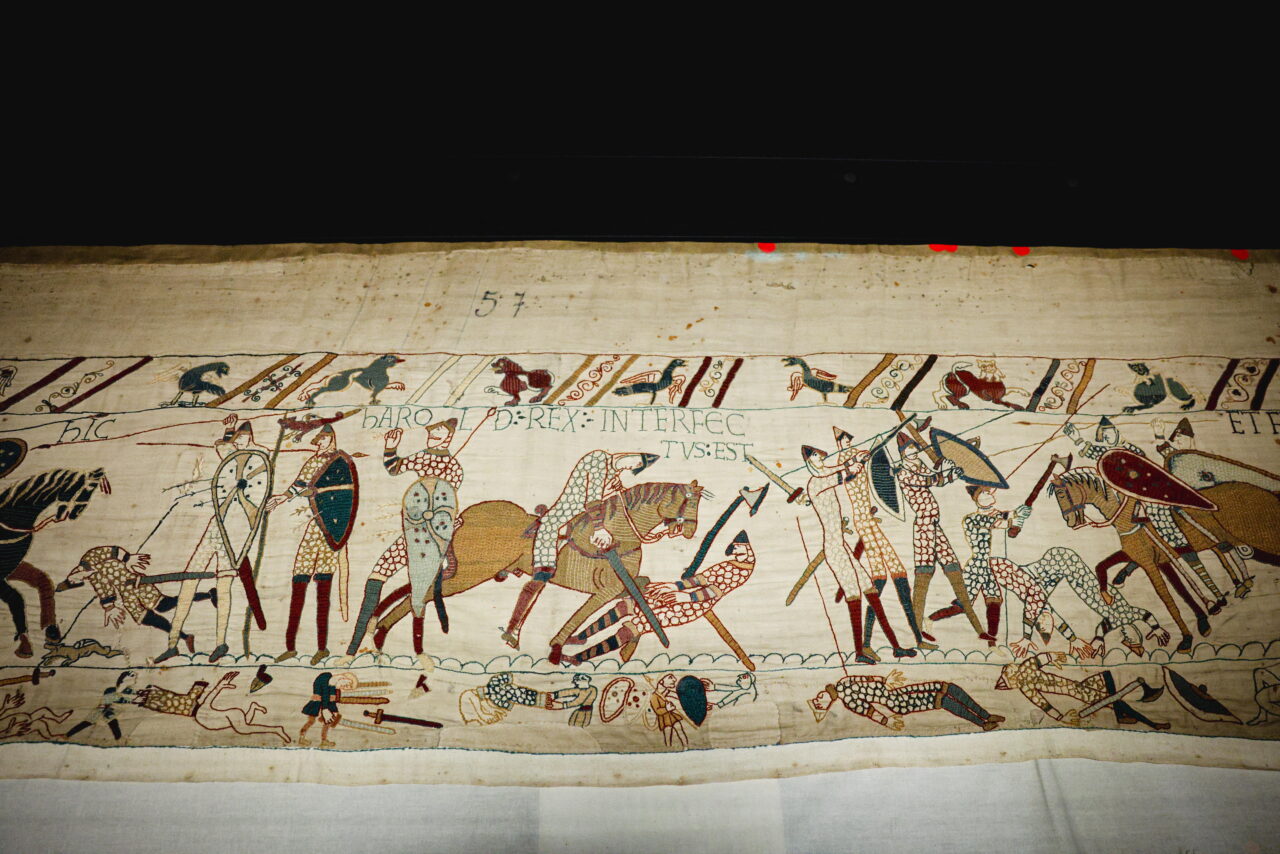
It was the year of the Battle of Hastings, at the start of the Norman Conquest, an epic invasion from France, when William the Conqueror crossed the English Channel with an army of Norman soldiers of Viking descent and killed England’s Anglo-Saxon King Harold II with an arrow through his eye.
The battle changed England’s language, ethnic makeup and rulers. King Charles III is a descendant of the victors. People joke that 1066 is the country’s most-used PIN number. It’s in an advertising jingle for a famous brand of car insurance, among other things.
The oldest depiction of 1066’s events is on a medieval tapestry sewn in England but whisked away to France in the late 11th century, where it’s been ever since. It’s normally displayed in a small museum in Bayeux, Normandy.
But after years of diplomacy, the tapestry was transferred this summer to London, on loan while renovations are underway at the French museum where it’s usually kept. On Thursday, the Bayeux Tapestry went on public display at the British Museum as the centerpiece of a sold-out, 10-month temporary exhibition.
What the tapestry shows — and what’s hidden in its stitches
The Bayeux Tapestry is a piece of narrative embroidery — wool thread sewn into linen panels — with surprisingly bright colors, despite its age. It’s about 20 inches high and nearly 230 feet long. That’s about as long as a 747 airliner, or about 2.5 times the length of a blue whale.
Part war propaganda, part comic strip, it depicts the start of the Norman Conquest — horsemen in battle, royal banquets and mythical beasts — along with gory scenes from the Battle of Hastings. There’s a panel showing William the Conqueror’s soldiers sinking into quicksand, and several decapitations. Near the end, it shows the death of Harold, the last Anglo-Saxon king of England — though some scholars believe the arrow through his eye may have been added to the tapestry during a 19th century restoration.
The tapestry was commissioned by William the Conqueror’s half-brother, Bishop Odo of Bayeux, to celebrate the Norman victory in the Battle of Hastings and decorate his cathedral. But scholars believe it was stitched on the losing side, in England — likely by seamstress nuns.
“On the face of it, [the tapestry] is broadly telling the story [of the Norman Conquest] the way Norman historians do,” says Gale Owen Crocker, an expert on Anglo-Saxon history and professor emerita of the University of Manchester. “But if you look at which images depict William and his half-brother bishop, they tend to be biblical villains!”
She believes the women who sewed the tapestry secretly modeled their depictions of the victors after villains in manuscripts kept at St. Augustine’s monastery in Canterbury, England.
On one hand, it was a dangerous, subversive act. On the other, “only people who were familiar with the context — English folk who’d seen those manuscripts in Canterbury — would have gotten the point,” Owen Crocker says.
England has Bayeux fever
That may be one reason Brits love this tapestry. Another is that their modern-day monarch descends from this battle. When King Charles got a private viewing of the tapestry earlier this month, he praised its depictions of history that “changed the course of these islands forever.”
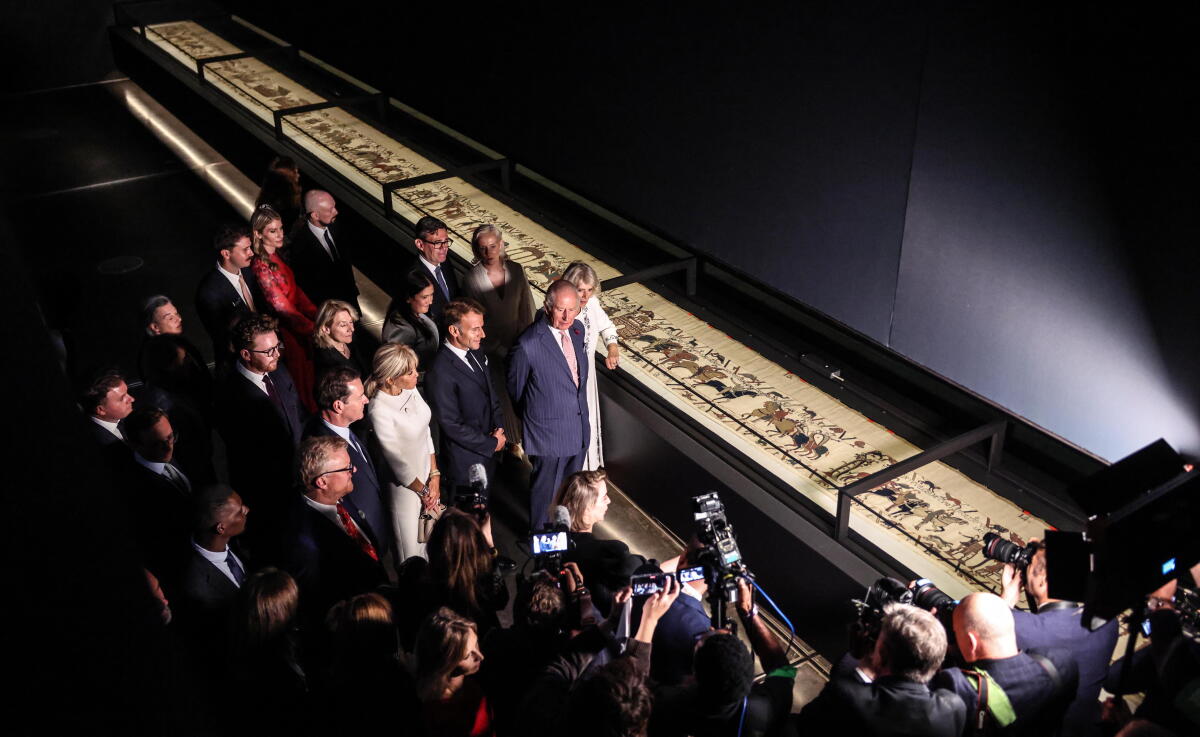
“It also tells the story of the beginning of what I like to think of as the French side of my family’s history,” he said in a speech alongside French President Emmanuel Macron.
Last year, when Macron announced plans to the British Parliament for the Bayeux Tapestry’s loan, he joked that the arrangements had taken longer than the Brexit negotiations between the U.K. and European Union.
Unlike in Bayeux, where the tapestry has been displayed as a wall hanging, the British Museum exhibits it laid flat, under glass, in a darkened room, to avoid light damage. The experience begins with a musical installation and photos of forests around Hastings, England.
Spectators descend some stairs, then see the tapestry illuminated. Walking the length of its nearly 230 feet, the experience is like a medieval action movie, following the Battle of Hastings frame by frame, scene by scene.
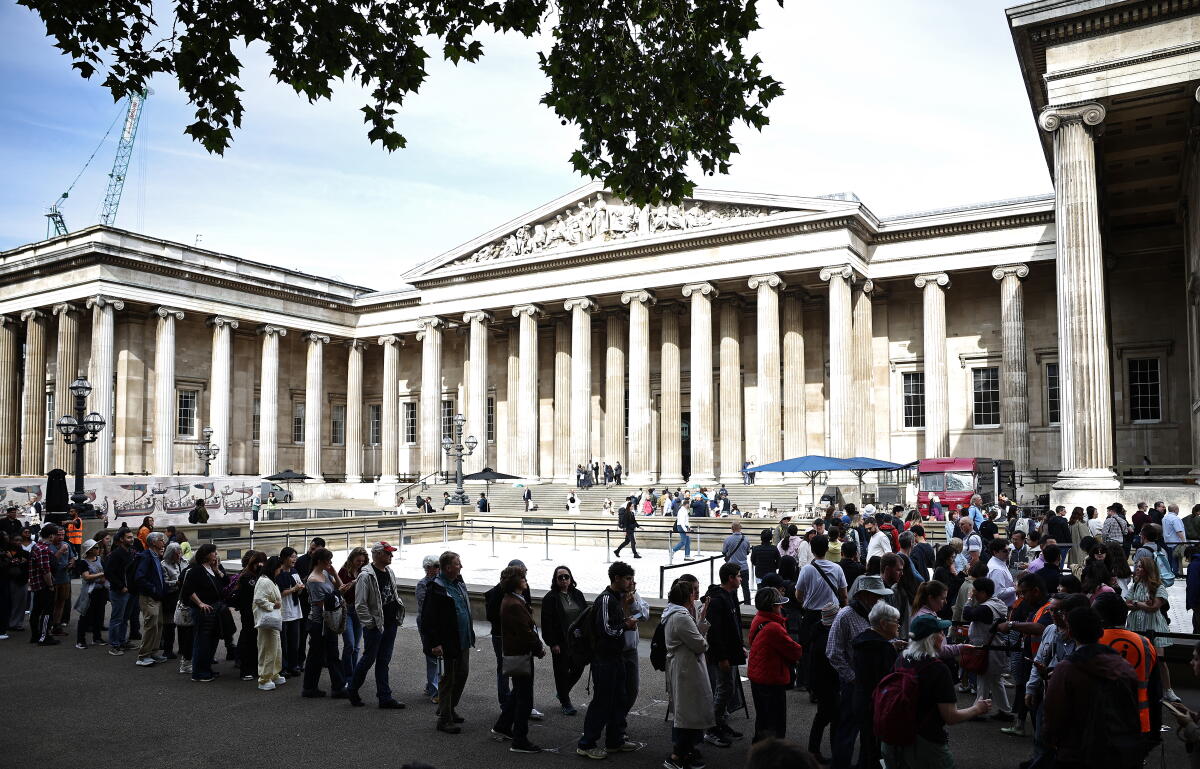
Tickets cost £33 (about $44) and are sold in 10-minute intervals, for a 40-minute visit, but the first batch are sold out. The next batch goes on sale in October. The exhibition is scheduled to last through July 2027, and could be the museum’s most popular.
What the tapestry has survived in its nearly 1,000 years
The tapestry has made several lucky escapes. It almost met its demise as a wagon covering in the French Revolution, before it was rescued by a lawyer. Later, it was prevented from being cut up to decorate a carnival float.
It survived stage-coach transport back and forth to Paris under Napoleon, who used it as propaganda to drum up support for another invasion of England. When the Nazis occupied France during World War II, the French Resistance hid the tapestry from SS leader Heinrich Himmler, who was fascinated by it. It survived the war wrapped around a wood bobbin in a zinc-lined crate underground.
It also survived plunder by generations of common clothes moths, while folded for centuries in a cedarwood chest.
“It’s got a checkered conservation history, to put it mildly!” says Millie Horton-Insch, co-curator of the British Museum’s exhibition.
How curators transported the tapestry to London
Before the tapestry’s transport, curators did months of test runs with a replica. Everything was considered — vibrations, temperature, humidity. Then on July 10, it arrived on a refrigerated, shock-absorber truck, through a tunnel under the English Channel, and finally, to the British Museum.
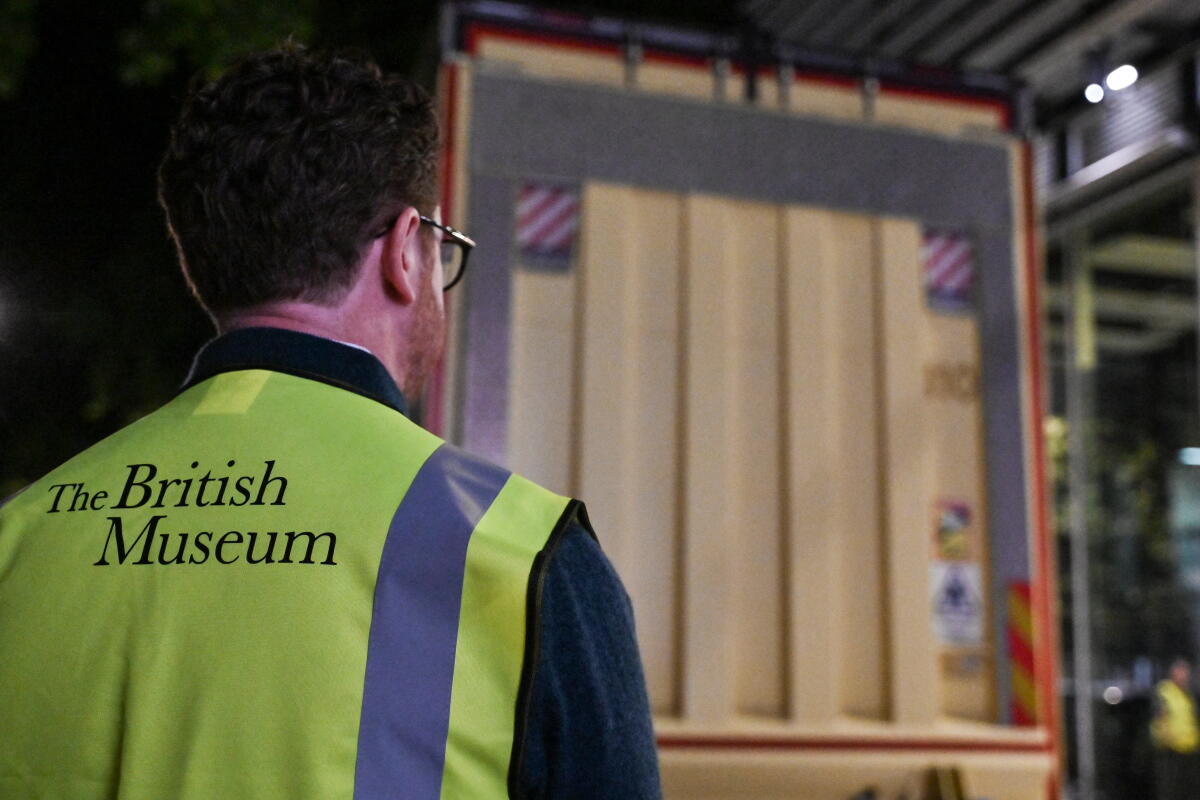
“I was here at around 3 o’clock in the morning on the day the tapestry arrived. You could have heard a pin drop!” Horton-Insch says. “It was quite moving. The first time the tapestry was back on English soil since it was likely made here almost 1,000 years ago.”
Horton-Insch says one of the “most extraordinary moments” for her was when the tapestry was taken out of a custom-made case, and she glimpsed its first panel, which depicts Edward the Confessor — another Anglo-Saxon king whose death triggered a succession crisis that led to the Battle of Hastings. (He was also King Harold’s brother-in-law.)
“They moved the first panel of it, and Edward the Confessor was sort of waving at you from the 11th century!” she says. “It was the most incredible feeling in the world.”
Fatima Al-Kassab contributed to this story from London.
Transcript:
SACHA PFEIFFER, HOST:
In England, students memorize one date above all else, 1066, the year of the Norman Conquest, an epic invasion by France. The oldest depiction of that history is on a tapestry that’s normally in a small French museum. But this year, it’s journeyed to London. And tomorrow, it goes on public display there for the first time in more than 900 years. NPR’s Lauren Frayer got a sneak peek.
LAUREN FRAYER, BYLINE: 1066 is everywhere. People joke it’s the country’s most used pin number. It’s on TV commercials for car insurance.
(SOUNDBITE OF ARCHIVED RECORDING)
UNIDENTIFIED PERSON #1: 0-800-00-1066, or visit our website.
FRAYER: 1066 was the Battle of Hastings, which The British Museum calls…
(SOUNDBITE OF ARCHIVED RECORDING)
UNIDENTIFIED PERSON #2: The battle that decides who becomes king, marking the dawn of the Norman era.
FRAYER: When William the Conqueror led a Norman army to kill the Anglo-Saxon King Harold with an arrow through his eye. It’s celebrated in one of the oldest pieces of war propaganda, a giant comic strip embroidered on linen depicting the Norman Conquest in bright colors. It’s a few feet high and nearly 230 feet long. That’s longer than a 747. It was commissioned by the victors.
GALE OWEN-CROCKER: So let’s have a bigger one than anyone’s had before. It was the Norman eyes.
FRAYER: Historian Gale Owen-Crocker says the tapestry was commissioned by William’s half-brother, the Bishop of Bayeux in Normandy, France. And that’s where it’s been for more than 900 years. But its intricate scenes of horsemen in battle, royal banquets and mythical beasts were actually stitched on the losing side in England.
OWEN-CROCKER: Every thread passed between some woman’s finger and thumb.
FRAYER: Probably by seamstress nuns, who snuck in subversive insults, Owen-Crocker says.
OWEN-CROCKER: On the face of it, it’s bluntly telling the story the way the Norman historians did. But if you look at which images depict William and his half-brother, Bishop, they tend to be biblical villains.
FRAYER: And that’s one reason Brits love this tapestry. Another is that their modern-day monarch descends from this battle. King Charles, when he saw it, said…
(SOUNDBITE OF ARCHIVED RECORDING)
KING CHARLES III: It also tells the story of the beginning of what I like to think of as the French side of my family’s history in these islands.
FRAYER: After years of diplomacy, last year, French President Emmanuel Macron announced…
(SOUNDBITE OF ARCHIVED RECORDING)
PRESIDENT EMMANUEL MACRON: France will loan the United Kingdom the Bayeux Tapestry.
(APPLAUSE)
FRAYER: But it was quite a feat to get it here. It’s a nearly 1,000-year-old piece of cloth that almost met its demise as a wagon covering in the French Revolution. It survived Napoleon, the Nazis and plunder by the common clothes moth while folded for centuries in storage.
MILLIE HORTON-INSCH: It’s got a checkered conservation history, to put it mildly. And less than a hundred years ago, the Nazis had it rolled up on a bobbin.
FRAYER: Curator Millie Horton-Insch oversaw its transport from France.
HORTON-INSCH: Test runs with a replica. Everything was considered, vibrations, the temperature, the humidity.
FRAYER: In the dead of night, in a refrigerated shock-absorber truck…
HORTON-INSCH: Squishy bits of fabric in between each bit so that it didn’t rub against itself.
FRAYER: …Through a tunnel under the English Channel and finally here to the British Museum.
HORTON-INSCH: When it was first taken out of the case, and Edward the Confessor was sort of waving at you from the 11th century, it was the most incredible feeling in the world.
FRAYER: The museum expects this to be its most popular exhibition ever. Before the crowds, I got a tour.
(SOUNDBITE OF MUSIC)
FRAYER: It starts with this musical installation. You come down these stairs, and then it’s sort of illuminated. Wow.
Walking alongside it, it feels like a medieval action movie.
This is where William the Conqueror’s soldiers sink into quicksand. There is a sword through somebody’s tummy. They’re decapitating someone here. And there he is, King Harold of England, felled.
And through his eye is that arrow that changed this country’s history forever. Lauren Frayer, NPR News, London.
(SOUNDBITE OF J DILLA’S “REQUIEM (INSTRUMENTAL)”)