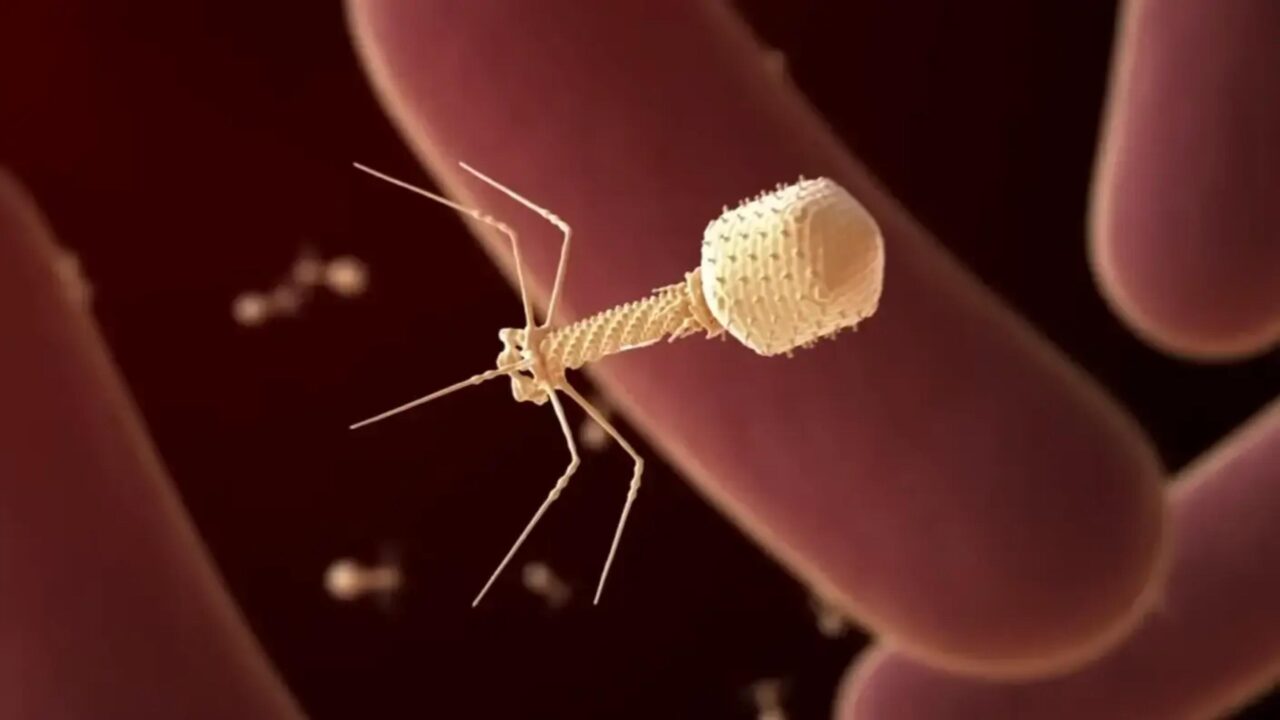
The era of AI-generated viruses is here. Some scientists are using AI to design viruses that can attack bacteria. The hope is that these tailor-made viruses can fight drug-resistant bacterial infections in people. And longer-term, Brian Hie, the Stanford researcher spearheading this project, hopes that AI can help create more complicated biological systems to treat formidable diseases. But some experts warn that placed in the wrong hands, this technology could create the next pandemic.
Interested in more AI-related research? Email us your question at [email protected].
Support public media with NPR+ and enjoy perks for over 25 podcasts like this one. This show’s perks include sponsor-free listening. Learn more at plus.npr.org.
Listen to Short Wave on Spotify and Apple Podcasts.
This episode was produced by Juan Diego Ramirez. It was edited by Rebecca Ramirez. Tyler Jones checked the facts. The audio engineer was Jimmy Keeley.
Transcript:
REGINA BARBER: You’re listening to Short Wave from NPR. Hey, Shortwavers. Regina Barber here with NPR science correspondent Katia Riddle. Hey, Katia.
KATIA RIDDLE: Hiya. Thanks for having me.
BARBER: Of course. You are always welcome. So today, you’ve come on the show because you’ve been looking into another way scientists have been using AI– to create viruses, and I don’t mean the kind that exists in nature.
RIDDLE: Yes. So just to be clear from the outset, these viruses are infect bacteria, not humans.
[MUSIC PLAYING]
RIDDLE: The researchers took a number of precautions to make this work safe. Their work was recently published in the journal Science. Basically, a group of scientists train AI models on DNA sequences. You know how large language models like ChatGPT have ingested, you know, like, basically all of the internet, which is written in words?
BARBER: Yeah. I’m guessing, instead of like using words, these researchers fed the AI DNA sequences?
RIDDLE: Exactly. It’s a language, you know, just like English is. DNA is written in an alphabet of just four letters A, C, G, and T. The model learned patterns in enormous amounts of that genetic language. It’s similar to the way a large language model like ChatGPT learns patterns in text just reading the internet, and you can read a DNA sequence essentially like you can read a book.
BARBER: I mean, somebody can. Biology is still a little mysterious to me.
RIDDLE: Yeah, fair point.
BARBER: OK, so the goal of this training, right, is not just to replicate existing viruses, but to create new ones, right?
RIDDLE: That is right. So after all this training, they asked the models to come up with a new viral genome sequences, which the researchers then introduced into bacteria. They did that roughly 300 times. Brian Hie is one of the researchers who worked on this project. He’s a scientist at Stanford. Notably before he worked on this project, he worked at Facebook. He described to me how exciting it was when he and his colleague, Samuel King, first got the results of this experiment.
BRIAN HIE: I think Samuel had pulled an all nighter or something like that and got the first batch of around 3:00 or 4:00 AM. I, like, woke up at 6:00 AM a couple hours later and saw the data that was posted onto our group Slack.
RIDDLE: It took them only one year to complete this work, which is a lot faster than pre-AI science timelines.
BARBER: Yeah, this is giving me, like, PTSD for my own grad program. But yes, back to Brian, so what did the data say, the data that he was so excited to tell his lab group about?
RIDDLE: So like I said, they tried roughly 300 of these AI-designed viruses. 16 of them worked. That means they produced functioning viruses that could go on to infect other bacteria. As far as we know, Brian’s lab is the first to do this.
HIE: The first time the data was actually presented at my lab meeting, the lab spontaneously broke into applause, which is the first time that’s ever happened in my lab meeting.
BARBER: Today on the show, humans are using AI to create new viruses. What are the implications?
RIDDLE: How big a deal is this breakthrough? And how can we regulate it to keep it safe?
BARBER: You’re listening to Short Wave, the science podcast from NPR. OK, so researchers trained AI in the language of DNA. We talked about that. Then they asked the DNA to use genomic sequences to make these new viruses, and then they introduced the viral DNA to the bacteria, turning them into these like little factories that pumped out the viruses, which went on to infect other bacteria. Is that– is that all right?
RIDDLE: Yes, you got it.
BARBER: What does that mean for the rest of us?
RIDDLE: So there’s short- and long-term goals for this kind of technology. In the more near term, researcher, Brian Hie, imagines a time when we could use it to tailor-make viruses in order to fight drug-resistant bacterial infections that happen in people.
HIE: I do think that applying this to real clinical isolates or strains of bacteria with real clinical benefit would be a very exciting next step to bring this technology to better help patients.
BARBER: OK, so I can see how this would be useful since like the whole problem with drug-resistant bacteria is that it’s evolved to fight all of the treatments we have against it.
RIDDLE: Right Some existing viruses are actually useful to us. They infect and kill bacteria. So researchers hope they could use AI to design new versions of these viruses as bacteria evolve resistance. Potentially, this could give us another way to fight these drug-resistant infections.
BARBER: OK, so that’s the short term, new viruses to help people’s existing drug-resistant infections. So what’s the long term?
RIDDLE: So long term is quite a ways out. We’re talking decades. But Brian imagines eventually using AI to design much more complicated biological systems that could potentially help treat really formidable diseases. He talks about how it could design larger genetic systems or pathways, multiple genes working together to perform a function.
BARBER: OK, so you’re saying instead of, like, treating a disease with a single molecule or a drug that hits like one target, scientists maybe can design, like, complex systems, biological systems that intervene maybe at like multiple points to perform multiple functions.
RIDDLE: Exactly. Here’s how Brian puts it.
HIE: But in the future, it could be something like– I don’t know. This is totally out of the scope of this paper, but something like Alzheimer’s or cancer can be addressed by more complex tools for genome design.
BARBER: And do other people in his field agree?
RIDDLE: Some people I talk to, yes. Tom Inglesby is the director of the Johns Hopkins Center for Health Security. He was not involved in this study, but he agreed.
TOM INGLESBY: It’s a big breakthrough, and it has the potential to do good in the world, as people figure out how to use this powerful technology to create new genomic designs.
RIDDLE: Tom studies biological threats. He co-wrote a commentary on this work published in the journal Science. And he stresses that this project was done responsibly. But here’s the thing that’s worrying. Tom says once this technology, the new viruses become more widely available, that safety is not a guarantee.
INGLESBY: The problem is that we don’t really have any governance in place to prevent either accidental or deliberate misuse of the technology.
RIDDLE: That’s not a concern for today. Right now there just aren’t that many people like Brian, he and his colleagues who know how to do this kind of stuff. It requires a lot of specialized expertise. But if this technology continues to evolve, that could change. People with not good intentions could get their hands on it.
BARBER: OK, I mean, I can guess what bad intentions would be, but how could someone misuse this technology?
RIDDLE: Basically, Tom anticipates a time when eventually these models make it much easier for people to design biology or even dangerous biology. Biological warfare, that’s the concern.
BARBER: Mm-hmm, yeah.
RIDDLE: We’ve seen how quickly like ChatGPT became widely available. As biological AI becomes more capable and accessible, experts worry it could lower some of the technical barriers to designing dangerous pathogens.
BARBER: Like engineering the next pandemic.
RIDDLE: Yep, exactly. You know–
BARBER: Oof.
RIDDLE: –weaponized biology is not necessarily a new kind of risk. Scientists already have ways to genetically modify viruses and other organisms. That includes experiments that give them new biological functions. Researchers have been able to synthesize some viruses from genetic sequences for decades. But again, these kinds of things are hard for people to get a hold of. With the speed at which AI is evolving, this kind of AI-driven biotechnology could become much more accessible.
BARBER: Oof. So what do we do?
RIDDLE: Well, so that’s what I talked to Kevin Esvelt about. He’s a genetic engineer at MIT who also studies biological threats and how to regulate them. He says we really need government regulation on this stuff, which it’s not easy to just snap fingers and make that happen.
KEVIN ESVELT: This is hard because governments are broadly reluctant to pass laws regarding what kinds of experiments can be done, period.
BARBER: Yeah. I mean, governments might not know what is best or not.
RIDDLE: Mm-hmm, yeah, they’re very hesitant to get into that space of saying what kind of things we can innovate. Tom did have another suggestion, though. He says, rather than trying to control who has access to the AI, it may be more effective to regulate the point where a digital design gets turned into physical DNA.
INGLESBY: Better is just to prepare for the world where it’s easy to cause pandemics.
BARBER: So what does that look like, like making a bottleneck of, like, when you can get from digital to physical?
RIDDLE: Basically, even if someone could use AI dangerous virus on a computer, they’d still need to turn that digital sequence into physical DNA. Esvelt says that’s a crucial chokepoint. Companies manufacture custom DNA for researchers. One approach is requiring those companies to screen orders for dangerous sequences. There’s already a bipartisan bill proposed in the Senate on this issue. So lawmakers are starting to hear the alarms on this.
ESVELT: And this bill would require companies that make and sell custom DNA sequences to screen their orders for dangerous sequences.
BARBER: OK, so, Katia, what do you think? Like, will these AI viruses be weaponized and bring, like, the downfall of our society? Or will it galvanize major breakthroughs, let’s hope, like in medicine and biotechnology? Or maybe it’ll do both.
RIDDLE: Yeah. Honestly, Gina, I still do not know. I think the jury is out, which is kind of where we are on questions of AI in general in society right now.
BARBER: Yeah, I think so.
RIDDLE: But I can tell you that researcher Brian, he’s one of the scientists at Stanford who’s responsible for this work. He at least is optimistic that it will do more good than harm.
BARBER: OK, what’s his argument for that?
RIDDLE: Well, he points out that we’re already up against a lot. Nature is not necessarily a good actor either.
HIE: If you think about it, nature itself is constantly producing viruses with pandemic potential.
BARBER: I mean, it’s true, right? Like, even if humans don’t create another pandemic with AI, nature could create one eventually. We’ve seen that firsthand with, you know, the COVID pandemic.
RIDDLE: Exactly. And the ultimate goal of their research, Brian says, is to develop biological technologies that can rapidly respond to something like the next pandemic.
HIE: If the technology is allowed to develop, we can have very, very powerful means of defense against dangerous biology.
BARBER: OK, so he’s betting that these will ultimately be used for good instead of people trying to cause harm.
RIDDLE: That is the bet he is making.
BARBER: Let’s hope he’s right. Katia Riddle, thank you so much for being here.
RIDDLE: Thanks, Gina.
[MUSIC PLAYING]
BARBER: If you liked this episode, check out our story on researchers using AI to find new proteins. Also, maybe share this episode with a friend. This episode was produced by Juan Diego Ramirez and edited by Rebecca Ramirez. Tyler Jones checked the facts, and Jimmy Keeley was the audio engineer. I’m Regina Barber. Thank you for listening to Short Wave from NPR.