A money tree needs very little to sustain life, yet I almost killed one before Chinese New Year’s Eve.
In Chinese culture, a money tree — Fa Cai Shu 发财树 — is a good omen for the new year. I bought one from Costco the night before New Year’s Eve and texted my mother, who still lives in China, to say I’d planted financial abundance at the center of my living room. She made fun of me, saying, “Even with a Western education, you still believe in superstition.” Then she asked me not to wash my hair or take out the trash on New Year’s Day. “Don’t throw away the sense of abundance,” she chided.
The next morning, the tree’s glossy green leaves turned transparent yellow. Some were dangling, as if offended by the air, and some were like loose soles that cobblers rip off the bottom of old shoes.
Oh no, I thought, the tree was dying. Was there negative energy in my apartment? Then I remembered: Costco has an excellent return policy. I could, in theory, exchange my plant as many times as needed until I found one that was fresher, livelier and more vibrant. But as I spotted a tiny green stem beneath the depressing plastic-like leaves, I decided to wait. I wanted to see if those tiny strands of hope would pull through.
Following the instructions of more experienced gardeners online, I gave my money tree a haircut and brought her — yes, I’ve decided it’s a she — a mineral cocktail. She was now a naked, braided trunk, standing exposed near my windows, with half of her body dipped into indirect sunlight. She looked alone, yet unfazed.
I wondered if her sudden loss of vitality was the result of shock, a response to uncertainty. She had traveled from a Costco warehouse in Everett, across Boston, in my car, in the middle of one of the coldest winters, to my apartment in Brighton. Before that, she had to take a road trip from the Costa Farm in Miami — where Costco sources most of its plants — all the way north to New England.
Roughly 80% of young adults in America live within 100 miles of their birthplace. Yet my money tree had already traveled at least 1,500 miles, before finally settling down in my apartment.
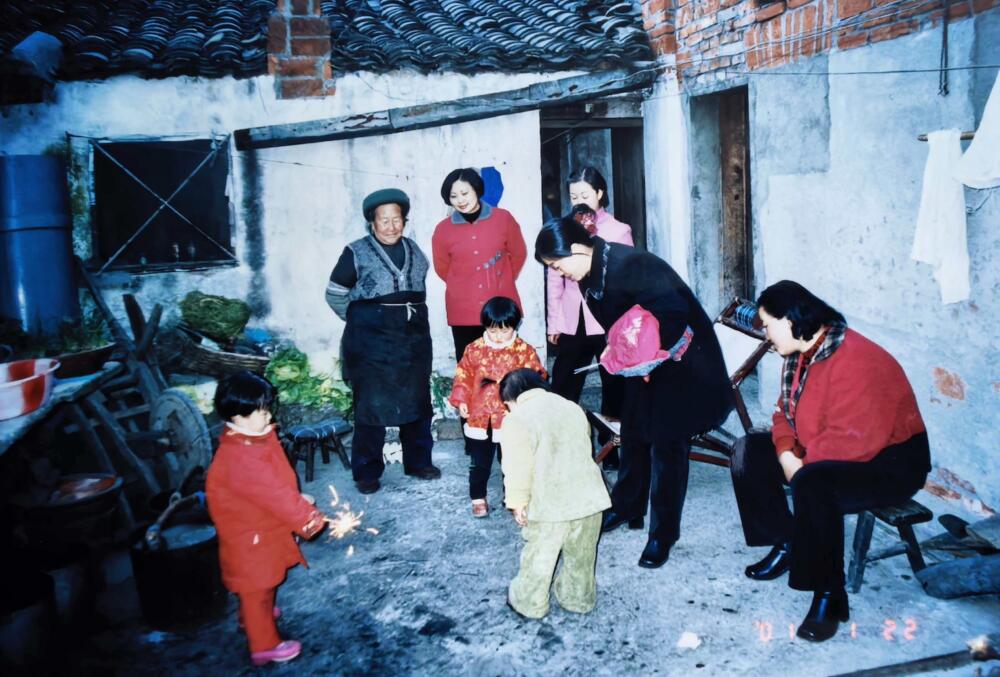
I was like the tree in 2016, when I spent my first Chinese New Year as a young adult in college in New York. I was 7,550 miles away from home. There was no celebration that night, only three midterms. In my dorm, late at night, I shriveled on my bunk bed, drooling over dinner photos from my parents. Part of me hoped for a loud gathering, but I was also afraid of being too different — most of my classmates had celebrated their New Year’s two months earlier. Yet that weekend, a few upperclassmen, Chinese and Chinese Americans, asked me out for a hot pot dinner in Chinatown. Red lanterns were hanging on every street corner, and wherever we went, there always stood a Chinese lady with silver hair and a bright red scarf.
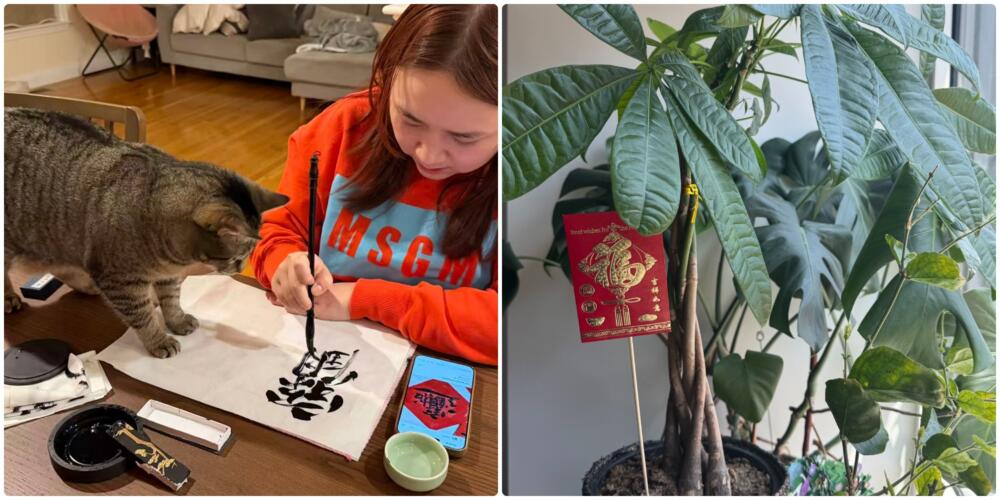
That was the first and only year that I didn’t celebrate Chinese New Year on its day. The first and only year I felt embarrassed by my identity as a “non-American.” I have since found — or learned to build — a community: in New York, in Chicago, where I did my master’s, and now in Boston, where I chose to root myself. The salon I always go to in Brookline is run by a Japanese lady. My favorite dinner spot in the South End is owned by a lady from Yunnan, China. The trick was in learning that it’s never about where I am, but about how much I’m willing to embrace who I am, and what I can represent.
Cities cannot be moved, but people can choose to build our community, and culture is always a movable feast.
While looking up ways to nurture my money tree, I stumbled on something unexpected. The money tree, despite being somewhat of a symbol of Chinese superstition, wasn’t native to the land. Its birth name is Pachira aquatica, and it is originally from tropical wetlands in Central and South America. When Pachira was first imported into China through the Canton area, local businesses renamed it “Fa Cai Shu” because, first, it sounded similar to “Pachira,” and second, they realized that, given time, patience and sunlight, the tree thrives wherever it stays.
The tree isn’t good luck because it’s called Money Tree. Its prosperity and adaptability gave it the name.
Immigrants don’t learn resilience because we moved from one place to another. Resilience was at the core of migration, when we decided to travel thousands of miles, uproot, replant ourselves and grow our communities.
By the morning of Chinese New Year’s Day, I rushed to my living room window and checked on my money tree. She seemed to have found home, because the pea-sized leaves had grown to the size of a cashew, and around the top of the trunk, where the leaves were trimmed, tiny stems had already appeared. She will grow, just as I have.
This article was originally published on WBUR.org.