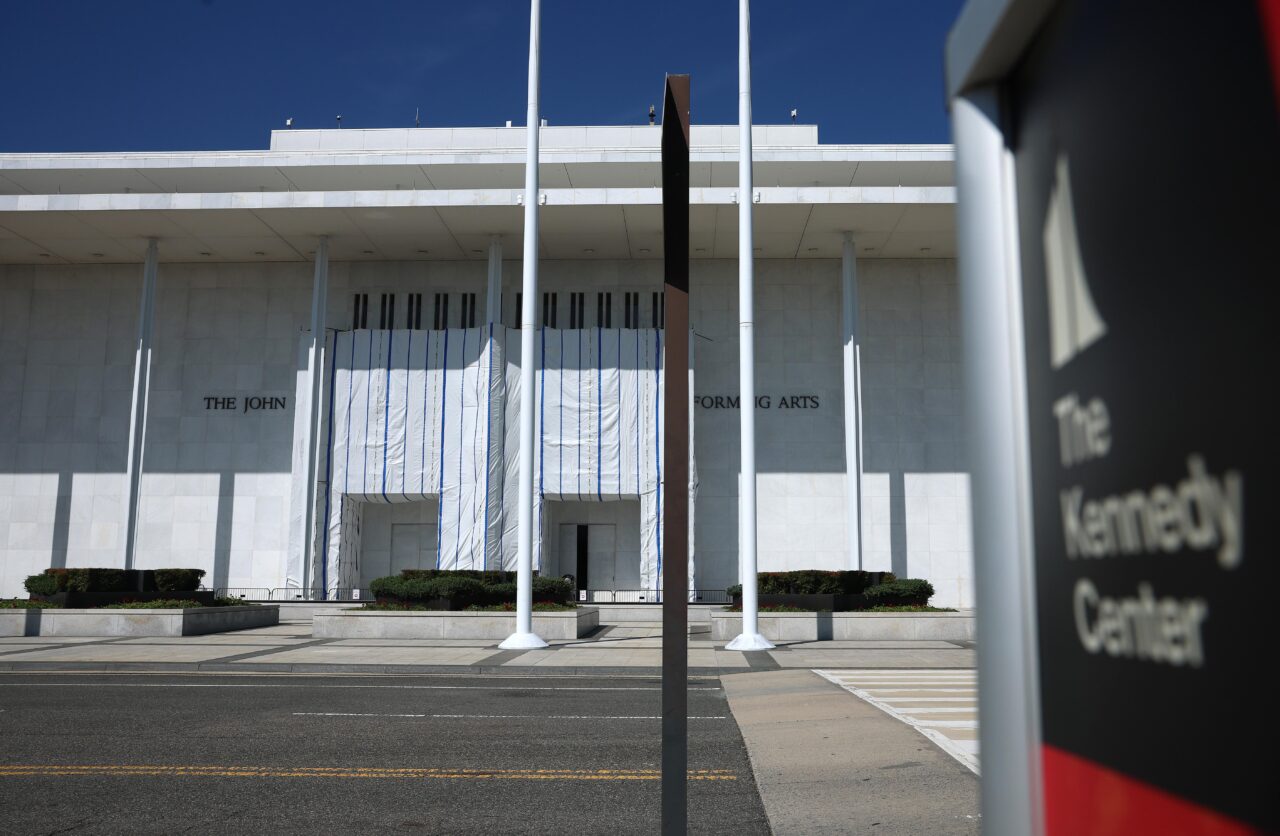
In a legal filing, the board of the Kennedy Center said that the arts complex and living memorial to President John F. Kennedy may be torn down if its plans for a two-year renovation and to add President Trump’s name back on the complex do not move forward.
The board called the Kennedy Center “embarrassing to the nation’s capital” and a “sick and poorly run facility.” Lawyers for the Justice Department also argued that the board and President Trump, who was named as the complex’s chairman in February 2025, should be allowed to move ahead with a two-year renovation that would shut down most of the complex’s performance venues and cost at least $250 million.
If not, the filings said, “the center will deteriorate further into an unsafe, decrepit structure that will be required to be taken down, with a determination to follow on what to build on the site, such as a large outdoor amphitheater overlooking the Potomac River that has been proposed, by some, for many years.”
The court papers were submitted by attorneys from the DOJ’s civil division late Monday in advance of an emergency hearing scheduled for Thursday afternoon. The hearing is part of a federal lawsuit by Rep. Joyce Beatty, Democrat of Ohio, againstTrump and the Kennedy Center’s current board, most of whom were appointed by the president.
In a statement emailed to NPR on Wednesday, a Kennedy Center spokesperson, P.J. Elliott, wrote: “This language describes a hypothetical scenario of what could happen if the center’s desperately needed renovation is blocked by partisan interests.”
Last Friday, Beatty, an ex officio member of the Kennedy Center board, filed an emergency motion asking U.S. District Judge Christopher R. Cooper to stop the board from its plans to put Trump’s name back on the front of the complex. The board’s latest proposal, which the group approved in a meeting on Aug. 13, would put Trump’s name on the entryway sign twice, and again on a third location on the complex’s grounds.
The proposed signage would eventually read: “The John F. Kennedy Memorial Center for the Performing Arts, Restored and Renovated by President Donald J. Trump, Endowed by the Trump Kennedy Center Fund.” The last line would be added if the fund reaches $100 million in donations. Additionally, the board is seeking to rename the physical grounds of the arts center “President Donald J. Trump Plaza.”
In May, Judge Cooper ruled that the board’s decision in December to rename the institution as the Trump Kennedy Center was unlawful, writing: “The Kennedy Center’s organic statute makes crystal clear that the Center is to be named for President Kennedy, and it cannot bear any other formal name or public memorial based on the Board’s unilateral say-so. Congress gave the Kennedy Center its name, and only Congress can change it.”
The board has said it would not put Trump’s name back up until after Sept. 8. In her request to have this additional naming halted, Beatty’s legal team called the September date an “arbitrary deadline,” adding that the Kennedy Center’s board “have created an unnecessary fire drill … there is no need for this manufactured emergency.”
As part of the board’s filings in advance of Thursday’s hearing, its lawyers also submitted minutes from board meetings held on June 11 and Aug. 13 that provide the first public glimpse into the board’s renovation plans in any detail.
Those filings reveal that the board received renovation guidance from Darin Buchalter, the chief executive officer from Delta Consulting Group, a firm that specializes in real estate and construction. The construction company JLL has also been named in the board’s renovation plans.
NPR has reached out repeatedly to both Delta and JLL for comment, but has not received any reply.
It is unclear whether either firm has any experience with arts venues that feature unamplified performers, such as orchestras, solo and chamber instrumentalists, opera companies and dance ensembles who have comprised much of the Kennedy Center’s programming since it opened in 1971.
The board minutes show no evidence that the board sought advice from arts administrators, acoustic experts or performers in making or approving renovation plans. The specific plans and Delta’s complete report remain under seal.