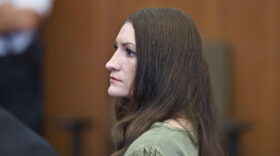
After a hung jury in the trial of Lindsay Clancy, legal experts are bracing for the possibility of a second trial should prosecutors again seek a murder conviction for the Duxbury mother accused of killing her three children in 2023.
Several experts told WBUR they expect jury selection to be more difficult and take longer than it did during the trial, which ended in a mistrial on Friday. They also said many potential jurors might shrink from the role amid the public furor surrounding the case.
Clancy is accused of strangling her children, 3-year-old Dawson, 5-year-old Cora and 8-month-old Callan. Her defense has argued that she should not be held criminally responsible for the crimes because she was experiencing postpartum psychosis, was taking numerous medications and was not in control of her actions on the night of the killings.
Over seven weeks, the trial became an international media spectacle and shined a spotlight on the failings of maternal mental healthcare.
Twelve jurors and six alternates were selected in July for the murder trial. Plymouth County District Attorney Tim Cruz has not yet said if he will re-try Clancy on the same — or lesser — charges. He disputes that the case was about postpartum mental health, as Clancy’s defense claimed. Prosecutors argued that she knew what she was doing and planned the killings as part of a suicide attempt.
“This was, and always has been, about getting justice for those three little babies,” Cruz said outside the Plymouth courthouse after the judge declared a mistrial.
In the event of another trial, legal experts said potential jurors would be carefully questioned before 12 people could be chosen to decide a verdict, and they said the selection would be more difficult, but would still be possible, even after the attention the first trial received.
“I expect it would be a more intense jury selection process — more questions, more follow up, a more intense process that might even take twice as long,” said Jack Lu, a retired judge and adjunct professor at Boston College Law School. “I don’t see a problem with a slow but steady jury process in which you ask the potential jurors a lot of questions.”
Lu said one challenge would be keeping jurors impartial and away from online debates about the trial.
“Social media seems to really have grabbed hold of this case, and that’s a problem,” Lu said.
Defense attorney Keith Halpern, who was not involved in Clancy’s case, said the voir dire process, in which judges and attorneys question potential jurors and decide who is seated, would likely include questions about social media use, given the intense online commentary and polarization surrounding the Clancy case.
“There will be a lot more questions about social media, whether you’ve not only been an observer, but whether you’ve been a participant,” Halpern said. “But this happens in every case. The judge has to make a determination whether people’s media exposure renders them unfit for serving on a jury.”
While the defense could request a change of venue citing all the publicity, legal experts said they don’t expect that to happen in another Clancy trial. In fact, they said location might not make a difference in this case, due to the ubiquitous nature of social media. Potential jurors are likely aware of the strong public opinions about — and interest in — the Clancy trial, and they may anticipate ferocious criticism of any verdict.
Judge William Sullivan sealed the names of the first Clancy jurors for two weeks, but three members of the jury spoke to NBC10 Boston. They described seven days of intense deliberations over horrific testimony, and said one holdout juror would not go along with the other 11, despite expressing reasonable doubt that Clancy was mentally well enough to understand what she was doing.
“He admitted he had reasonable doubt,” the jury foreperson said in the interview. “But he said, ‘I’m still not going to say she’s not guilty by reason of insanity.’ ”
In the last days of the trial, jurors twice reported that they could not reach a unanimous verdict. Clancy’s attorney, Kevin Reddington, asked for the holdout juror to be removed because he was not following the law on reasonable doubt. The judge read the legal instructions on reasonable doubt out loud to the jury, but ultimately denied Reddington’s request.
On the final day of the trial, Reddington unsuccessfully appealed to the state Supreme Judicial Court, and the mistrial was declared.
Speaking that afternoon in front of the courthouse, Reddington said his client was “robbed” of an acquittal by one holdout juror. But Lu, the retired judge, said he disagrees.
“This is a result in the legal system,” Lu said. “The process is the result, and the process is very difficult and complicated and emotional, almost kind of weirdly textured, and all the jurors did a great job. They should be proud. The system worked as it should.”
During jury selection for Clancy’s trial, several people said they could not commit to sitting on a jury for six to eight weeks and accepting the state’s pay rate of $50 a day.
If there is a new trial, Cruz, the district attorney, could decide to prosecute on lesser charges, such as second-degree murder. Unlike first-degree murder cases, lesser charges could be argued before a judge — without a jury.
Clancy supporters have criticized Cruz for not taking that approach in the first trial, arguing it could prioritize mental health treatment over prison time.
Cruz is known as a “tough on crime” prosecutor who has served as Plymouth County district attorney for 25 years. He is running unopposed for reelection in November. A status hearing on Clancy’s case is scheduled for later this month.
In the midst of the first Clancy trial, the state’s highest court ordered Cruz’s office to grant a new trial to another mother, Latarsha Sanders, who was convicted of killing her children in 2022. The state Supreme Judicial Court ruled that medical records should have been allowed during her trial. Cruz has not said if he will re-try that case.
Halpern, the defense attorney, said he expects that in another trial, Cruz would consider that jurors will hear testimony showing Clancy as a devoted mother who repeatedly tried to get help in the months leading up to the killings.
“I don’t believe that 12 people will ever find her guilty of murder, no matter how many times the case is tried,” Halpern said.
But, he added, the prosecution could benefit in a second murder trial. For example, they could avoid apparent missteps from the first trial, such as claiming that Clancy was tired and overwhelmed by her life, and did not make a serious suicide attempt. Prosecutors later shifted strategy and argued that the killings were part of a planned effort to take her own life.
“I thought it was probably the most inept prosecution of a significant case I’d ever seen,” Halpern said. “ The first two weeks of the case were a huge mistake, and they’re not going to make that mistake again.”
Lu, the former judge, said conventional wisdom is that a second trial favors the prosecution, but he said in Clancy’s case, the intense public attention and discourse may aid the defense.
“It would be nice to have closure, but this is not a made-for-TV movie intended for the true crime crowd,” Lu said. “This is real life. This is justice.”
This article was originally published on WBUR.org.