Transcript:
[AUDIO LOGO]
SPEAKER: NPR.
ADRIAN MA: Medicare For All is a politically divisive topic. Progressive Democrats think it’s a great idea.
[AUDIO PLAYBACK]
ABDUL EL-SAYED: It’s an improved version of Medicare.
[END PLAYBACK]
RICKY MULVEY: Republican lawmakers, including the president, think it’s terrible.
[AUDIO PLAYBACK]
DONALD TRUMP: It will be the worst thing that’s ever happened to you and your family.
[END PLAYBACK]
MULVEY: It’s either the worst thing or The best thing ever, Adrian.
MA: This is The Indicator from Planet Money. I’m Adrian Ma.
MULVEY: I’m Ricky Mulvey.
MA: And you may remember Medicare For All from some years ago. Well, it is hot in the streets again, a key issue in the Democratic primaries and a top priority for the progressive wing of the party.
MULVEY: But what is Medicare For All? Is it what people think it is? And what would it do to our economy? Today on the show, one of the loudest voices on Medicare for all.
[AUDIO PLAYBACK]
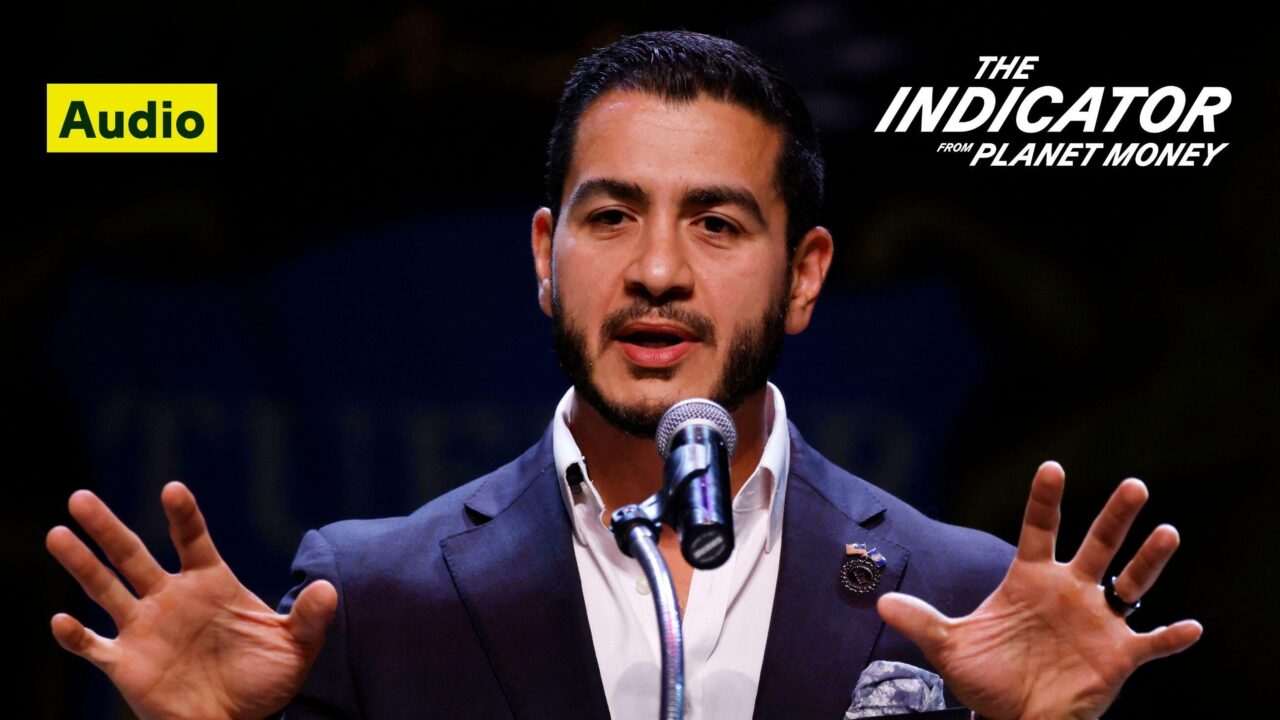
EL-SAYED: Doctor Adbul El-Sayed, Democratic candidate for US Senate in Michigan.
[END PLAYBACK]
MA: We’ll see you and El-Sayed after the break.
MULVEY: So what is Medicare, the current version? Fundamentally, Medicare is health insurance that the federal government helps pay for. It’s available to Americans and some lawful residents age 65 and older. You may get it earlier if you have a disability. But it’s not free.
MA: Medicare Part A is generally the free bit, but it only covers part of your inpatient hospital treatment. You still have co-pays.
MULVEY: So on top of that, Medicare enrollees will have to pay for doctors insurance, dental and hearing, preventative care, annual checkups, and, of course, all of the copays and deductibles that entails.
MA: And that’s why there’s even an entire industry built around extra Medicare insurance.
CRAIG GARTHWAITE: I don’t think that the people who say they want Medicare For All actually want traditional Medicare for everybody because traditional Medicare, without any supplemental insurance or anything like that, actually doesn’t provide great financial protection for people.
MULVEY: Craig Garthwaite is a professor of strategy at Northwestern’s Kellogg School of Management. He wrote a paper called “The Economics of Medicare For All.”
MA: Craig laid out this example. Imagine a patient who has cancer, a really expensive illness to treat. That Medicare-insured patient is still on the hook to pay for a portion of expensive drugs.
GARTHWAITE: So when you go to get a physician’s service of which chemotherapy drug is, you pay of the cost of that drug with no end. And so that can add up when you’re talking about drugs that are $70,000, $100,000, $200,000 a year.
MULVEY: So when you hear Medicare For All, you’re hearing a proposal to append the entire health care system in America, a proposal that would provide government-paid health care from cradle to grave. That isn’t Medicare at all.
GARTHWAITE: So I think really, what people mean when they say Medicare for all is they want national insurance of the quality of health care they get today for free.
MA: Still, the promise of a nationalized health system with no more health insurance premiums, that’s a key part of Abdul El-Sayed’s. He just won Michigan’s Democratic Senate primary. And he’s also an epidemiologist who co-authored a book called Medicare For All– A Citizen’s Guide.
MULVEY: We caught up with Abdul for a few minutes on the phone toward the end of a long day of campaigning. He sees Medicare For All, not just as Medicare but Medicare with more options.
EL-SAYED: I actually think, on net, Medicare For All would be substantially better for hospitals across this country.
MULVEY: I shared with him some of the fears I have with our current system, anxiety about going to when the costs are unknown, those random bills that show up a few weeks after your visit.
MA: Right. You didn’t know about the facility fee that’s actually separate from doctor’s bill. Yeah, sorry, yeah. Sorry we didn’t tell you about that.
MULVEY: It’s not good. And a dread I feel paying my health insurance premium. My wife and I spend over $900 a month on just OK marketplace insurance. We’re in our 30s and relatively healthy.
EL-SAYED: Under Medicare For All, you’d be guaranteed public health insurance without a premium. So that goes away. Without a co-pay or deductible, so that goes away. So you wouldn’t dread being able to see a doctor if you needed one.
MA: Abdul’s vision for Medicare has no more bills to see a doctor for necessary medical care.
EL-SAYED: You can see whatever doctor you wanted because, rather than having to choose between the doctors your private health insurance company negotiated with for a sweetheart deal and a reimbursement package that benefits them both, you could go take your portable health insurance wherever you want.
MA: Yeah, you know, this is sounding like universal health care, not Medicare.
MULVEY: Either way, Medicare For All, as it’s being called, means that your health insurance is no longer tied to your employer. So one economic effect would be that more Americans may be able to take a risk in their careers, leave their job, try opening a new business.
MA: And we just reported on a growing number of Americans who don’t want to leave their job because they need the health insurance. They’re job locked into it. We’ll leave a link to that in the show notes.
MULVEY: But a Medicare For All program would require trillions of dollars in additional federal government spending.
MA: Creating an estimate for how much this would cost is difficult. For example, a 2020 estimate from the Congressional Budget Office said that federal subsidies could be between $1.5 and $3 trillion.
MULVEY: For context, that range is close to the total amount of money that the United States spent on Social Security in 2025.
MA: Yeah. So there’s a trade off. Yes, taxes in some way would go up, but so could wages since your employer wouldn’t directly pay individual health insurance companies.
MULVEY: We asked Abdul how his version of Medicare For All, one without co-pays, that covers just about everything, could be funded. Abdul says the money will come from avoiding wars and closing tax loopholes.
EL-SAYED: And I would rather make sure that rather than paying a health insurance company off the top of my paycheck, right, that I pay the government a little bit more for health care that is more efficient, that’s not gatekept, and that’s durable to me losing that job.
MA: He believes the trade off is worth it and says that we’re paying for health care one way or another.
EL-SAYED: And we can start subsidizing it in more progressive ways by asking billionaires to pay their fair share and a little bit more off the top so everybody pays less in health care.
MULVEY: Still, Medicare for all is a disruptive idea. Close to 20% of America’s gross domestic product is spent on health care, and that doesn’t count people in the health system who spend money in the economy.
MA: And implementing nationalized health insurance would disrupt hundreds of thousands of jobs in the health care industry.
MULVEY: But Abdul says that health insurance companies are already using AI to try to destroy many of these administrative jobs.
EL-SAYED: These corporations themselves are trying to automate out these jobs. And so I’m not under the impression that we can get Medicare For All switched over tomorrow. It’s going to take a lot of political work and technical questions.
MA: He’s also concerned about how health insurers will use artificial intelligence.
[AUDIO PLAYBACK]
EL-SAYED: I would much rather be in a situation where, rather than a corporation using an AI to tell me what health care I can have, that we have a agency where it’s not motivated by their bottom line with humans making sure I can have the health care I actually need to have.
MULVEY: Did we just get a pivot? Is AI always the villain we can rely on? Like, dang, he’s good, Adrian.
MA: To his credit though, a majority of physicians are concerned that health plans are using AI to deny more care.
MULVEY: Craig Garthwaite, the health care economist, pointed out a negative economic effect, drug innovation. Hospitals and drug companies generally make a higher profit margin from privately insured patients than those on Medicare or Medicaid.
MA: Some of this profit goes into research for new drugs.
GARTHWAITE: So we will just get fewer drugs. And again, I want to be clear. That is a choice we can make.
MULVEY: Craig thinks this is a key part of the conversation about Medicare For All.
GARTHWAITE: What I get frustrated about by people whose support either prescription drug negotiations for Medicare or Medicare For All is this belief that is put out there that we can lower the spending and not see innovation go down. And that just is not the way that this works.
MA: For his part, Abdul El-Sayed thinks that we can’t just apply the rules of Medicare to Medicare For All. For example, this new program would have to change how it pays medical providers.
[MUSIC PLAYING]
MULVEY: That’s part A of our Medicare For All story. Part B tomorrow. Are we ready for Medicare For All? Do we need a different medicine first?
MARK CUBAN: The challenge is the lack of information.
MA: That is Mark Cuban, billionaire entrepreneur, former Shark, and now a health care executive. He continues the conversation tomorrow. This episode was produced by Cooper Katz McKim and engineered by Cena Loffredo. It was fact checked by Vito Emanuel. Kate Concannon is our show’s editor, and The Indicator’s a production of NPR.