Copyright © 2026 VPM, all rights reserved.
PBS is a 501(c)(3) not-for-profit organization.
VPM News Morning Edition
NEXT UP: 9:00 AM

Thanks to our sponsors – Become a Sponsor

NASA’s newest telescope has a top secret past

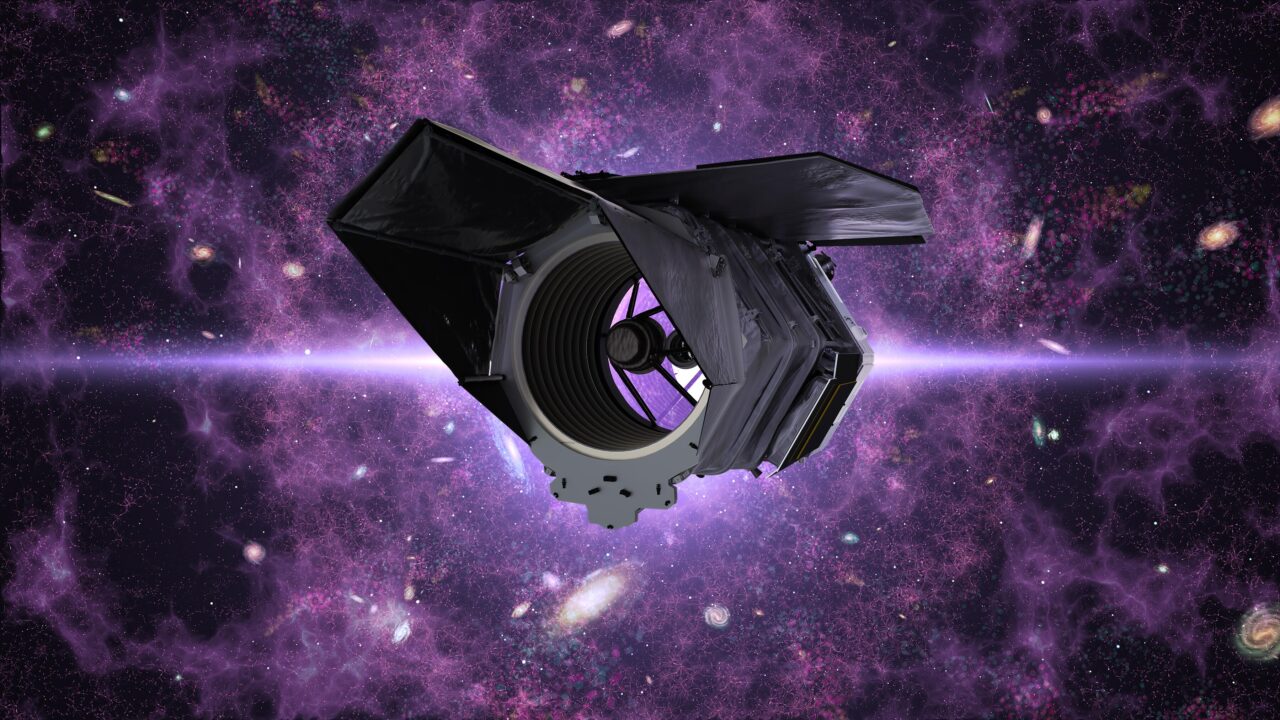
An illustration of a black satellite floats in space. It has an open circular center. The background is a cloud of vivid purple  with pink dendritic connections, all over blackness. Galaxies and stars are sprinkled across the background.
Goddard Space Flight Center Scientific Visualization Studio / NASA
The Nancy Grace Roman Space Telescope is a NASA observatory designed to settle essential questions in the areas of dark energy, exoplanets, and infrared astrophysics.

The new Nancy Grace Roman space telescope is slated to launch this weekend. It was originally built for the National Reconnaissance Office as a spy satellite, but was never launched. Instead, NRO gave it to NASA about 15 years ago. After some major modifications, it’s set to begin its five-year mission peering at new supernovas, distant galaxies and planets orbiting stars outside our solar system. It should help scientists get a better understanding of the mysterious force known as dark energy – which will tell us about the fate of the universe.

If you liked this episode, check out Regina’s reporting demystifying the mysterious red dots spotted by the James Webb Space Telescope.

Interested in more space news? Email us your question at [email protected].

Support public media with NPR+ and enjoy perks for over 25 podcasts like this one. This show’s perks include sponsor-free listening. Learn more at plus.npr.org

Listen to Short Wave on Spotify and Apple Podcasts.

This episode was produced by Berly McCoy. It was edited by Rebecca Ramirez. Tyler Jones checked the facts. The audio engineer was Jimmy Keeley.


Joe Palca is a science correspondent for NPR. Since joining NPR in 1992, Palca has covered a range of science topics — everything from biomedical research to astronomy. From 2011 to 2020 he produced stories that explored the minds and motivations of scientists and inventors as part of his series, Joe's Big Idea. Palca is also the founder of NPR Scicommers – A science communication collective.

Palca began his journalism career in television in 1982, working as a health producer for the CBS affiliate in Washington, DC. In 1986, he left television for a seven-year stint as a print journalist, first as the Washington news editor for Nature, and then as a senior correspondent for Science Magazine.

In October 2009, Palca took a six-month leave from NPR to become science writer in residence at The Huntington Library, Art Collections, and Botanical Gardens.

Palca has won numerous awards, including the National Academies Communications Award, the Science-in-Society Award of the National Association of Science Writers, the American Chemical Society's James T. Grady-James H. Stack Award for Interpreting Chemistry for the Public, the American Association for the Advancement of Science Journalism Prize, and the Victor Cohn Prize for Excellence in Medical Writing. In 2019, Palca was elected to the American Academy of Arts and Sciences for outstanding achievement in journalism.

With Flora Lichtman, Palca is the co-author of Annoying: The Science of What Bugs Us (Wiley, 2011).

He comes to journalism from a science background, having received a Ph.D. in psychology from the University of California at Santa Cruz, where he worked on human sleep physiology.

Related Stories