Ken Lacovara is something of a paleontology rock star. In 2004, he discovered the Dreadnoughtus, a new dinosaur species that later debuted on the big screen in Jurassic World Dominion.
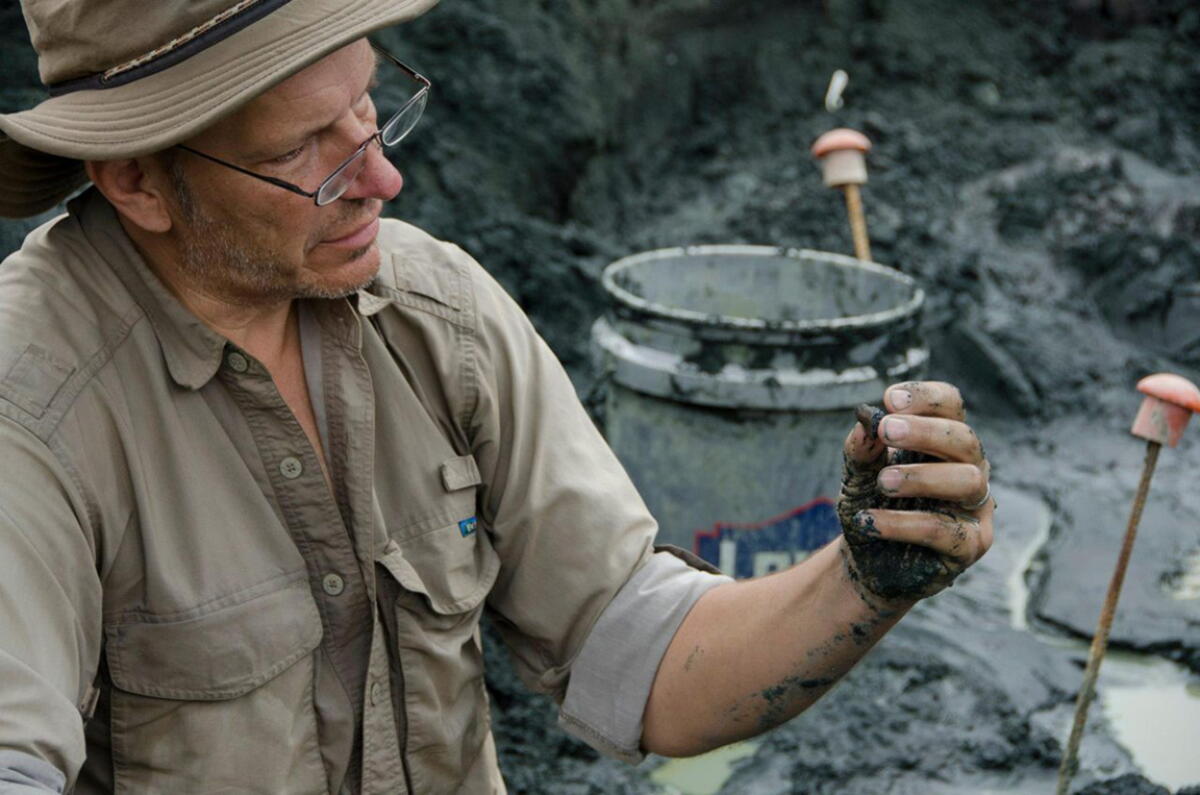
Lacovara has spent his career roughing it in remote excavation sites in Egypt, the Gobi Desert, Montana, and Patagonia. But his latest research is much closer to home — in the New Jersey suburbs.
What started as a dirt pit behind a Mantua Township strip mall has turned into one of the world’s most important excavation sites, and is now the Edelman Fossil Park & Museum, which recently opened to the public.
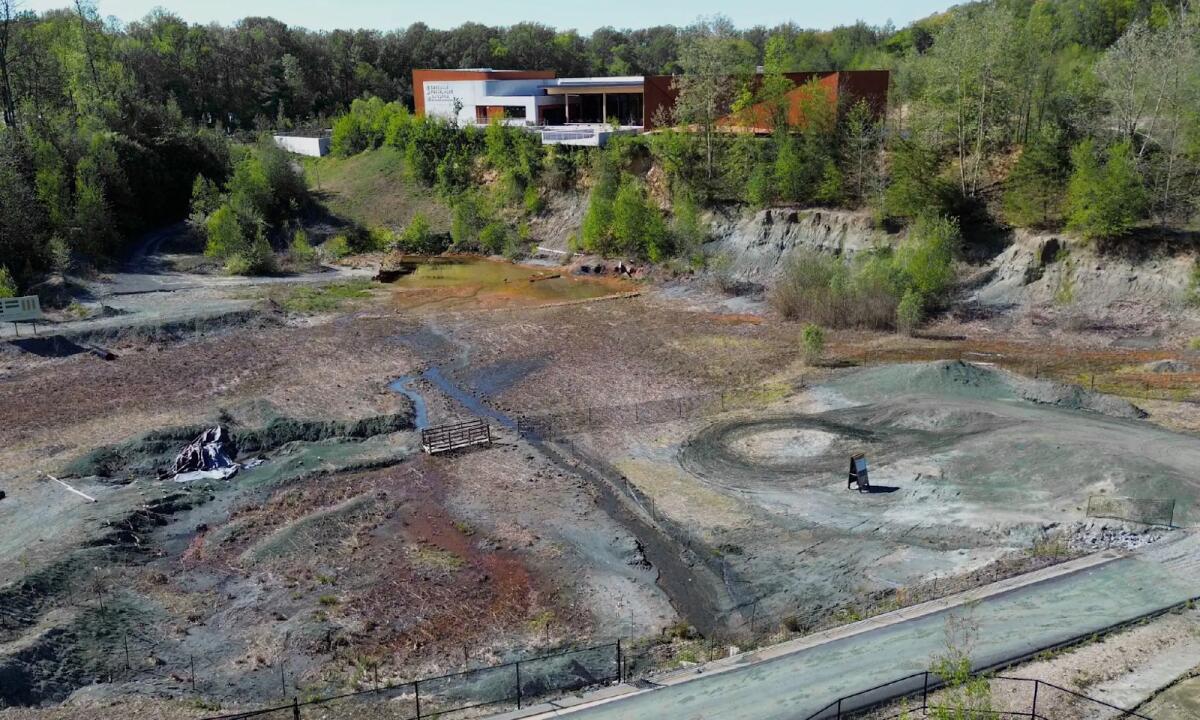
A time machine back to the Cretaceous Period
Paleontologists have been collecting fossils in southern New Jersey for over a century, but Lacovara didn’t think there was anything left to discover there. He first visited this quarry in 2003, located just behind a Lowe’s and Chick-fil-A. At the time, he saw it as nothing more than a convenient place for his university students to try their hand at fossil digging. “And I was very, very wrong about that,” he says.
Lacovara slowly realized that his students’ sandbox might be something special.
“The more I saw, the more I learned, the more I realized that now if I lived in Australia or Cape Town, I’d be coming here to do my research.”
That’s because running across the quarry is a sediment layer that tells the extinction story — the most significant record to date of the days, even hours, after the asteroid hit Earth 66 million years ago, and spurred the 5th mass extinction.
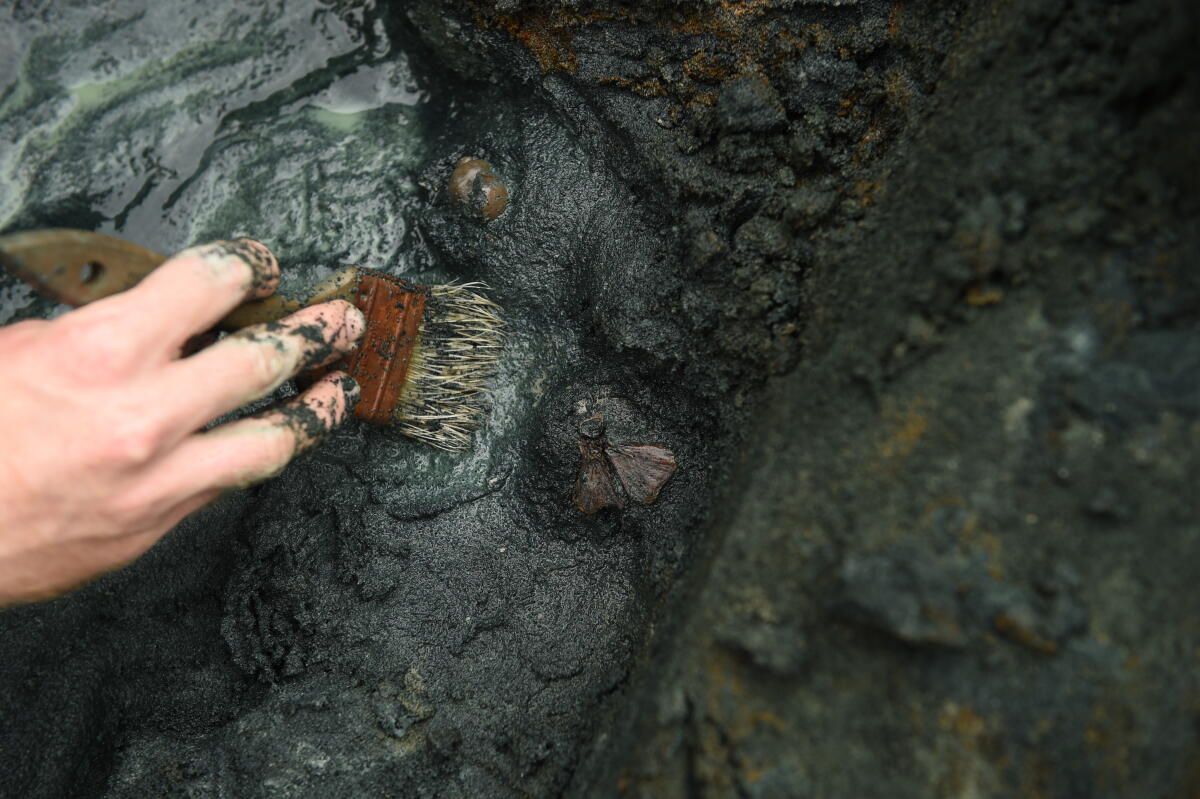
An asteroid graveyard
In that layer, Lacovara and his team have recovered over 100,000 fossils, representing over 100 species. They also unearthed a metal called iridium, an element found in asteroids.
Lacovara says that when the asteroid landed near the Yucatan Peninsula, a 10.3 magnitude earthquake crossed modern-day North America within minutes. Followed by a second shock roughly 15 minutes later.
Within the hour, global temperatures shot up to “somewhere between toaster oven and pizza oven,” Lacovara says.
Smaller animals, like our pre-human mammalian ancestors, likely burrowed into the earth to escape the heat. But dinosaurs had no places to hide. After ruling Earth for 165 million years, dinosaurs were functionally extinct within an hour.
In the aftermath, a 130-foot tsunami struck parts of the North American coastline, sweeping the dinosaur carcasses out to sea. They sank down to the ocean floor, creating the bonebed that Lacovara studies today.
“So this makes this the best window on the planet at that pivotal calamitous moment that wiped out the dinosaurs and really made the modern world as we know it,” Lacovara says.
Many people in New Jersey and the surrounding area may be unaware of the Cretaceous treasure trove beneath their feet. But Lacovara hopes the opening of Edelman Fossil Park and Museum can change that.
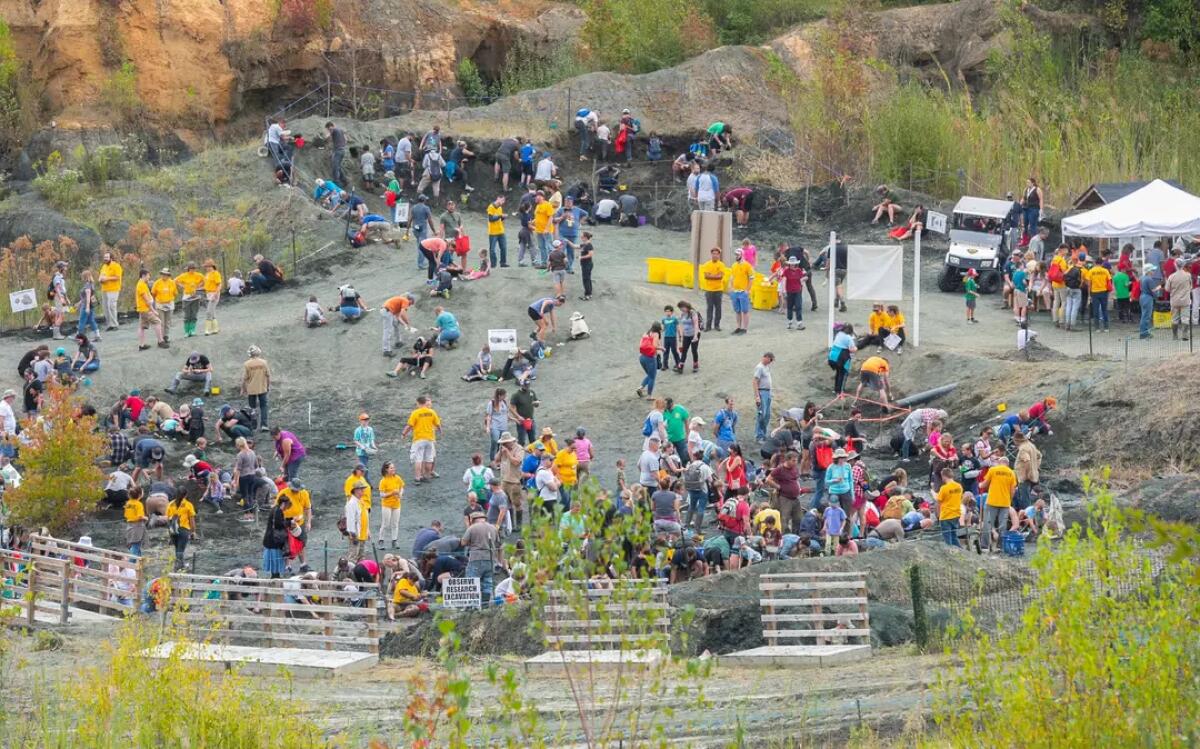
A safer version of Jurassic Park
Edelman Fossil Park and Museum encourages visitors to learn about dinosaurs and even dig for fossils with their own hands. “There’s no place like this,” Lacovara says. “There’s no place that combines a world-class museum with, really, a world-class excavation site.”
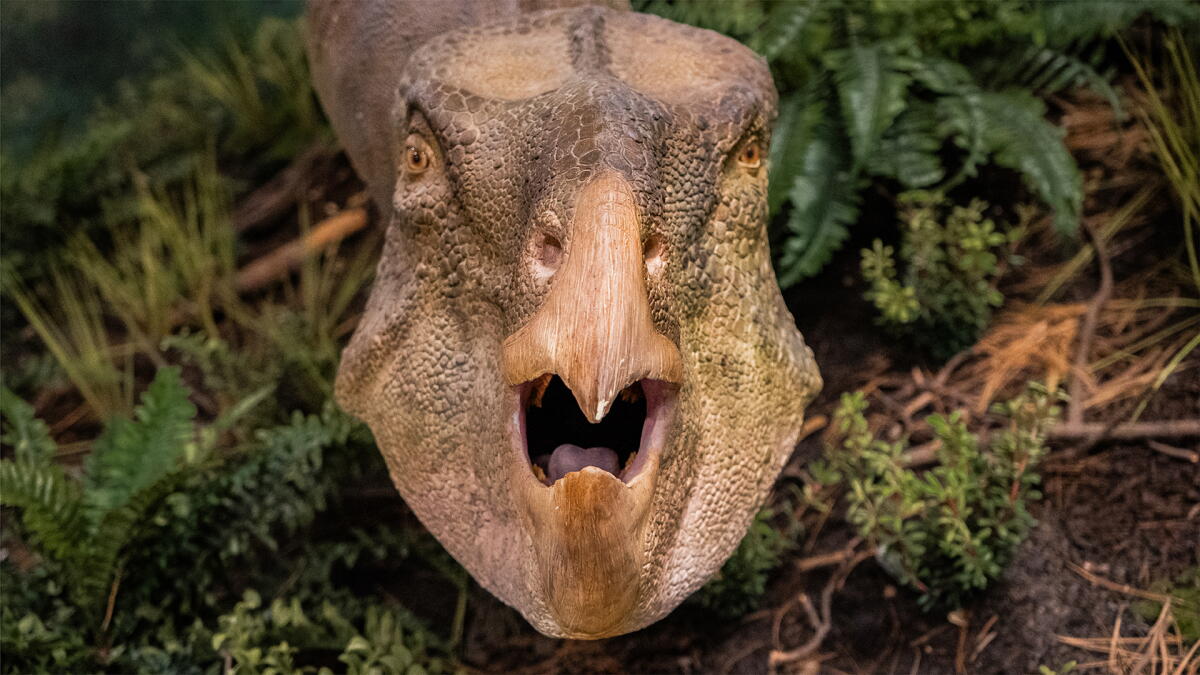
Learning from dinosaurs to escape our fate
Lacovara insists that dinosaurs are not just for kids. He wants everyone to have fun looking for fossils, but he says it’s important for adults to reflect on the dinosaurs’ mass extinction through a climate lens.
“This world really isn’t all about us, and we can see now through the lens of deep time, through the lens of geology, that things can go off the rails,” he says. “We have had five previous mass extinctions, and every one of those, we know now from geology and paleontology, was the result of a climate crisis. If you think about it in terms of that asteroid, well, we are now the asteroid of our age. But we don’t have to be, and it’s not too late to turn the tide.”
In that spirit, Edelman Fossil Parks offers visitors climate action resources. And the park’s motto reads, “Discover the past, protect the future.”
This segment of the TED Radio Hour was produced by James Delahoussaye and edited by Sanaz Meshkinpour.
The digital story was written by Fiona Geiran.
You can follow us on Facebook @TEDRadioHour and email us at [email protected].
Transcript:
MANOUSH ZOMORODI, HOST:
It’s the TED Radio Hour from NPR. I’m Manoush Zomorodi.
One, two, three, four, five.
Today on the show – the Day the Dinosaurs Died.
The directions are…
So this summer, I was invited for an early peak at an unusual place in Southern New Jersey just before it’s about to be open to the public.
Oh, here’s the Lowe’s.
Because down Route 55, just a few minutes off Exit 53B, if you take a quick right onto a road that tucks behind a Lowe’s hardware and a Chick-fil-A fast food restaurant…
Whoa. There it is. Oh, it’s beautiful.
There looms a massive, modern wooden building set at the edge of a large pit of dirt.
A humungous pit in front of it.
But this isn’t just dirt. This pit is actually a dry quarry full of fossils.
Wait, Ken.
KEN LACOVARA: Hi there.
ZOMORODI: So nice to meet you.
The paleontologist in charge of this operation and my tour guide is Ken Lacovara.
LACOVARA: And we are at the Edelman Fossil Park and Museum in Mantua Township, N.J.
ZOMORODI: As we walked from the parking lot to the museum and the pit, Ken explained that paleontologists have been collecting fossils in Southern New Jersey for over a century.
LACOVARA: In 1858, the world’s first nearly complete dinosaur skeleton is found and dug up 11 miles from here in Haddonfield, N.J.
ZOMORODI: But in 2003, when Ken first visited this site, just south of Haddonfield, he wasn’t that impressed.
LACOVARA: Honestly, I didn’t think much of the site at the time.
ZOMORODI: Ken was a professor in Philadelphia. Between lectures, he was bopping around the world to sites in Egypt, the Gobi Desert, Montana, Wyoming.
LACOVARA: And I looked at this site, and I thought, oh, what a muddy hell hole.
(LAUGHTER)
LACOVARA: And this was just a close place where I could take our students so they could get a little experience digging fossils. You know, I’m embarrassed to say that I just didn’t think much about doing research in New Jersey. And I was very, very wrong about that.
ZOMORODI: Ken had no idea that this muddy hell hole, it had hundreds of thousands of fossils that could answer mysteries from 66 million years ago.
LACOVARA: And the more I saw, the more I learned, the more I realized that now if I lived in Australia or Cape Town, I’d be coming here to do my research.
ZOMORODI: Really?
LACOVARA: Yeah, absolutely. It’s a unique window into a pivotal moment in time, the end of the time of the dinosaurs.
ZOMORODI: On the show today, we’re traveling back 66 million years to the end of the dinosaurs and spending the hour with paleontologist Ken Lacovara. How his globe-trotting, discovering some of the biggest fossils ever eventually led him back to his home state of New Jersey, why the clues he’s uncovering here shed light on what happened in the days, even hours, after an asteroid hit the planet, and why Ken thinks the public needs to experience paleontology for themselves.
LACOVARA: So there you go. You found your first fossil. 66 million-year-old fossil sponge.
ZOMORODI: What?
LACOVARA: Yep.
ZOMORODI: That’s amazing.
Ken started visiting this quarry in 2003. At the time, it was a mine owned and operated by the same company since the 1920s.
LACOVARA: They mine a certain kind of mineral called glauconite here, which farmers call Marl, like Marlton, Marlborough.
ZOMORODI: Oh yeah.
LACOVARA: And it’s a good fertilizer, especially for acidic-loving plants, like tomatoes and peppers, which are, you know, a big crop here in Southern New Jersey.
ZOMORODI: For a while, Ken and his students would just follow the bulldozers around, collecting whatever fossils may have turned up by accident. But then, in 2007, with the recession, the company started to go belly up.
LACOVARA: And I thought, wow, it would be a shame to lose this site.
ZOMORODI: Yeah.
LACOVARA: And my immediate reaction was, we’ll just dig faster.
ZOMORODI: As Ken dug, he realized that the pit wasn’t just a good experience for his students. It had a lot more to offer.
LACOVARA: And so I started to ruminate on how we could maybe save this site. And in 2011, I partnered with Mantua Township, the local government here. Usually, us palaeontologists, we try to keep our site secret for obvious reasons.
ZOMORODI: Yeah.
LACOVARA: But I thought, no, I’m going to have to open this up to the public and build a grassroots effort around preserving this property.
ZOMORODI: Eventually, Ken and Mantua Township raised millions of dollars. They partnered with the nearby Rowan University. And now, over a decade later, the bulldozers are back. But this time, they’re finishing up the landscaping surrounding the new museum. And the quarry, it will be accessible to anyone.
LACOVARA: So here we are at our first stop along the path to the bottom of the quarry. And every footfall, every step you take, on average, will take you back in time about 400,000 years.
ZOMORODI: As we descended, Ken pointed out layer after layer of sediment from earlier epochs.
LACOVARA: That’s Pleistocene, which isn’t terribly long ago. There was a glacier that went from the north pole down to New Brunswick, N.J., about 40 miles north of here. This area at the time would have been tundra with woolly mammoths and mastodons and dire wolves and giant sloths and things like that running around on the landscape.
ZOMORODI: Down, down through time until…
Right there.
LACOVARA: Right there. There it is.
ZOMORODI: …You get to the bottom and the end of the Cretaceous period.
We are walking through reeds down to the spots where we can see what happened 66 million years ago, the fifth extinction, one of the most important events to affect life on our planet.
This layer of sediment, the ground we’re walking on, is the extinction layer. And it’s pretty thin.
LACOVARA: Yeah. So the layer that we have that represents the extinction event is only about 15 centimeters thick, so 6 inches or so. And we’ve recovered over 100,000 fossils representing over 100 different species.
ZOMORODI: The ground is teaming with fossils if you know how to look for them.
LACOVARA: So most of them are invertebrate fossils – clams, snails, oysters, things like that. We’ll have turtles and sharks, and mosasaurs and bony fish, the rare dinosaur.
ZOMORODI: But in addition to all those fossils, the other key thing that Ken and his team have unearthed is a metal called iridium that’s usually only found in asteroids. Ken explained the latest thinking on exactly what happened that day 66 million years ago when an asteroid slammed into the earth.
LACOVARA: The asteroid impact happens 1,500 miles away from here off the Yucatan Peninsula and what is now Mexico.
(SOUNDBITE OF EXPLOSION)
LACOVARA: It blasts a crater in the Earth’s crust. It’s about 110 miles across by 12 miles deep. So that’s roughly the size of Massachusetts, say.
ZOMORODI: Eight and a half minutes after the asteroid hits, a magnitude 10.3 earthquake rolls across the continent, probably knocking the largest dinosaurs down. But the deadliest moment comes about 16 minutes after the asteroid.
LACOVARA: All that material is blasted up through the atmosphere, goes into the low Earth orbit, is pulverized into maybe millimeter-sized pieces, but it still has all the mass. So you’ve given that mass a tremendous amount of potential gravitational energy. When that stuff comes back in, it’s got to balance the energy books. And the result that day, within the first hour, is global temperatures get up somewhere between toaster oven and pizza oven. So the dinosaurs that have dominated the Earth’s terrestrial ecosystems for 165 million years, I think are functionally extinct within an hour after that impact.
ZOMORODI: An hour?
LACOVARA: Yeah.
ZOMORODI: Do we know that for sure?
LACOVARA: Well, here’s what we know. I mean, all dinosaurs lived on land. Well, that day, if you can’t do what little mammals did or crocodiles or lizards or turtles – if you can’t get into a burrow somewhere, dig underground somewhere, well, it’s between toaster oven and pizza oven, you die on the surface of the Earth that day if you don’t have a place to hide. And it doesn’t look like the dinosaurs had a place to hide. Were there a few stragglers that, you know, maybe were at the mouth of a cave or, you know, swimming at the time? Sure. But I think they were functionally extinct at that moment.
ZOMORODI: Several hours later, Ken says a tsunami, likely over 130 feet high, would have crashed into the coast right here, sweeping the dead dinosaurs out to sea where they’d sink down to the ocean floor, creating a bone bed.
LACOVARA: A bone bed that is from the exact moment of the asteroid impact. In fact, it’s the only place in the world where you can see a complete death assemblage of many, many species that are victims of that event with the fallout from the asteroid.
ZOMORODI: We walk around the site to get a different vantage point. And Ken says that the fallout from the asteroid, tiny pieces of it, have been found in over 350 sites around the world.
LACOVARA: But just from the ash, just from the material that falls from the sky. To date, the fossil occurrences in that layer have been very, very meager. There’s some fish scales in Belgium. There’s a pile of paddlefish and a dinosaur leg in North Dakota. That’s about it. This site here that you’re looking at has an entire collapsed ecosystem. At that moment. We’ve recovered over 100,000 fossils, representing over 100 species, and they are interbedded with the fallout from that impact that happened off the coast of Mexico. So we have little glass spherules that rained down from the sky, little grains of what we call shocked quartz, and we have a spike in the level of the metal iridium. So this makes this the best window on the planet and at that pivotal calamitous moment that wiped out the dinosaurs and really made the modern world as we know it.
ZOMORODI: Why here?
LACOVARA: Well, I mean, it was everywhere. We happen to have those deposits preserved here, and then we had a quarry here because of the mining operation since the first one of those that have been found.
ZOMORODI: Are there any others?
LACOVARA: Oh, there must be. You could probably go under the Lowe’s and find these same deposits or the Chick-fil-A or…
ZOMORODI: How do you stop yourself from just, like, wanting to dig up everywhere here?
LACOVARA: Well, I kind of do, but, you know (laughter). It’s taken us 14 years to excavate only 250 square meters. And these fossils are very important to science, and so, we – you know, we excavate these for ourselves, but for future scientists as well. And so we have to document everything very carefully, curate the material very carefully, and make sure it’s preserved forever so that scientists 200 years from now can study these same fossils.
ZOMORODI: In a minute, more with paleontologist Ken Lacovara. He explains the geological conditions needed to preserve extraordinary fossils, like the one he found in Patagonia that led to the discovery of one of the biggest species of dinosaur to ever exist. On the show today – the Day the Dinosaurs Died. I’m Manoush Zomorodi, and you’re listening to the TED Radio Hour from NPR. We’ll be right back.
It’s the TED Radio Hour from NPR. I’m Manoush Zomorodi. On the show today, we are coming to you from Mantua Township, N.J. It’s the home of a former fertilizer quarry that also happens to be a hotbed for fossils. And soon, this largely unknown pit, which is filled with dinosaur bones and ancient sea life, it will be open to the public as the Edelman Fossil Park and Museum.
So we’re standing on a terrace, and we’re looking down how many feet would you say?
LACOVARA: It’s 45.
ZOMORODI: Serving as my tour guide today, Ken Lacovara, the museum and park’s director, and a world-renowned paleontologist.
LACOVARA: You know, we’ll move 20 meters a year. But we map everything. We map the smallest oyster shell and every snail. And then, you know, the occasional large bone from a mosasaur or something like that. An occasional dinosaur bone shows up here. In fact, right over in the corner there, we found a femur of a dinosaur, and it had shark bite marks in it.
ZOMORODI: No way.
LACOVARA: Yeah. And because of the shape of the bite marks, we can actually take a pretty good guess and say it was a shark called Cretalamna that was scavenging this dinosaur as it floated out to sea.
ZOMORODI: Ken’s enthusiasm as he describes this shark chomping down on a dinosaur thigh, it is infectious. And he first felt this excitement back in second grade when he was growing up just an hour from here near the Jersey Shore.
LACOVARA: I grew up on the bay near Atlantic City, N.J. And where I lived, there was really only sand and mud. And in second grade, a woman brought a box of rocks and minerals and fossils into my Cub Scout meeting, and I literally didn’t know these things were in the world. And I got so excited after that. I wrote a little essay in second grade about igneous, metamorphic and sedimentary rocks, and I wrote that sedimentary rocks are the best kinds of rocks because you can find fossils in them.
ZOMORODI: (Laughter).
LACOVARA: And now that I have a Ph.D. in geology, I can confirm that they are the best kinds of rocks.
ZOMORODI: Ken’s love of rocks, all kinds of rocks, continued throughout his young life. He actually played rock professionally right after graduating high school.
LACOVARA: I spent a year as the house drummer at the Golden Nugget Casino in Atlantic City.
ZOMORODI: And then at the age of 20, Ken went to college, got a master’s in geography, a Ph.D. in geology and landed a job as a professor at Drexel University.
LACOVARA: And before you know it, I’m in the Bahariya Oasis digging up giant dinosaurs. And that year, our team discovered a dinosaur that I would later coin Paralititan, which means tidal giant.
ZOMORODI: And even after all those decades traveling the world, looking for fossils…
LACOVARA: I still feel today, every time I pick up a fossil, this unbelievable sense of awe and wonder and connectedness to things that are much bigger than myself. When you realize that you’re the first person to ever see that object, that object hasn’t moved in, in this case, 66 million years until you applied some energy to it, and you now know a little something that no human has ever known before. And when you have that experience, you want it again and again and again.
ZOMORODI: You have quoted a friend who likes to say an expedition is an adventure with a purpose. Tell me about some of the expeditions, or shall we say, adventures with purpose, that you went on.
LACOVARA: Yeah. That’s right. This kind of lifestyle is not for everybody. I’ve spent probably two years of my life living in a tent without plumbing, without electricity, in some very harsh conditions. You know, what I’ve really come to learn is that I think comfort is overrated. I mean, the things that give you the creature comforts aren’t really the things that result in meaning in your life. And when I’m in the field, I am almost always uncomfortable. I’m always too hot or too cold or just weather-beaten, sand pelting your skin all the time. Food poisoning is an old friend of mine. You know, in Patagonia, I would wake up in the morning, and the water bottle inside my tent would have ice in it. And there were almost always scorpions living under my tent, so I had to be careful to just stay on that little foam pad that I had in the middle of the tent. Usually, puma tracks outside the tent in the morning.
ZOMORODI: Wow.
LACOVARA: You know, you get weather-beaten, and my skin would get leathery, and my hands would crack and be calloused and would bleed. And you know what? None of that matters. None of that matters when you are time-traveling with stuff that you bought at the hardware store. None of that matters when you’re seeing things that no human has ever seen before. And I wouldn’t trade a minute of it for anything. And, you know, I’ve never felt more like me than I do when I’m in the field digging up dinosaurs.
(SOUNDBITE OF TED TALK)
LACOVARA: How do you find a dinosaur? Sounds impossible, doesn’t it? It’s not.
ZOMORODI: In 2016, Ken gave a TED Talk, and he said that when it comes to finding fossils, there’s a simple formula.
(SOUNDBITE OF TED TALK)
LACOVARA: First, find rocks of the right age. Second, those rocks must be sedimentary rocks. And third, layers of those rocks must be naturally exposed. That’s it. Find those three things and get yourself on the ground. Chances are good that you will find fossils. The question is, will you find something that is scientifically significant? And to help with that, I’m going to add a fourth part to our formula, which is this – get as far away from other paleontologists as possible.
(LAUGHTER)
LACOVARA: It’s not that I don’t like other paleontologists. When you go to a place that’s relatively unexplored, you have a much better chance of not only finding fossils but of finding something that’s new to science. So that’s my formula for finding dinosaurs, and I’ve applied it all around the world. In the austral summer of 2004, I went to the bottom of South America to the bottom of Patagonia, Argentina, to prospect for dinosaurs, a place that had terrestrial sedimentary rocks of the right age, in a desert, a place that had been barely visited by paleontologists.
That site in Patagonia had these vast, vast expanses of badlands, which is just kind of the sweet spot in terms of erosion. You don’t want too much erosion because it destroys the sediment and the fossils, and you don’t want too little because then the ground becomes stabilized and covered with plants, and you can’t see what’s under it. So in a badlands environment, like we have out west at Badlands National Park or in Patagonia or lots of other places that paleontologists love, you get just the right amount of rain so that you get – you always get new faces of the rock exposed, where you can see new fossils. But it’s not so much that it destroys things too fast. So you have an opportunity once they’re exposed to get to them. Because when you think about it, like, those fossils that have been preserved underground for 66 or a hundred or hundreds of millions of years, when they hit the surface because of erosion, they start to weather very rapidly. And I have seen dinosaur skeletons that I know were only exposed maybe a few years before that have essentially turned to dust.
ZOMORODI: Oh, really?
LACOVARA: Sure. So out of, you know, think of out of 100 million years, the fossil and the paleontologist have to arrive at the same spot on earth within a couple of years or they never get to see each other.
ZOMORODI: It’s a rendezvous in the cosmos that seems very, very unlikely.
LACOVARA: It really is. And it’s extremely unlikely for any one individual. The chance of any one individual becoming a fossil is almost zero. But it’s not zero.
(SOUNDBITE OF MUSIC)
LACOVARA: So it was down there in Patagonia where I first came across what I would say would be maybe a tea-saucer-sized piece of bone exposed in the desert. Didn’t get too particularly excited about that because you do find that all the time. And began to uncover that, and it turned into what was a 7-foot femur.
(SOUNDBITE OF TED TALK)
LACOVARA: This is a femur, a thigh bone of a giant, plant-eating dinosaur. That bone is 2.2 meters across. That’s over 7 feet long. Now, unfortunately, that bone was isolated. We dug and dug and dug, and there wasn’t another bone around. But it made us hungry to go back the next year for more. And on the first day of that next field season, I found this – another two-meter femur. Only this time, not isolated. This time, associated with 145 other bones of a giant plant eater. And after three more hard, really brutal field seasons, the quarry came to look like this. And there you see the tail of that great beast wrapping around me and the giant that lay in this grave, the new species of dinosaur we would eventually call Dreadnoughtus schrani. Dreadnoughtus was 85 feet from snout to tail. It stood 2 1/2 stories at the shoulder, and all fleshed out in life, it weighed 65 tons. People ask me sometimes, was Dreadnoughtus bigger than a T-rex? That’s the mass of eight or nine T-rex.
Now, one of the really cool things about being a paleontologist is when you find a new species, you get to name it. And I’ve always thought it a shame that these giant plant eating dinosaurs are too often portrayed as passive, lumbering platters of meat on the landscape. They’re not. Big herbivores can be surly, and they can be territorial. You do not want to mess with a hippo or a rhino or a water buffalo. The bison in Yellowstone injure far more people than do the grizzly bears. So can you imagine a big bull, 65-ton Dreadnoughtus, in the breeding season defending a territory? That animal would have been incredibly dangerous, a menace to all around, and itself would have had nothing to fear. And thus, the name Dreadnoughtus, or fears nothing.
ZOMORODI: Dreadnoughtus was huge, one of the biggest dinosaurs ever discovered. And it was huge for you, personally, and the world of paleontology. But Ken, what about the moment when you saw Dreadnoughtus appear in the “Jurassic World” movie?
LACOVARA: Well, that is a heck of a thrill for a paleontologist, I have to say. The adult me and the 8-year-old me couldn’t be happier about that. So yeah, I was sitting in a theater in Wilmington, Del., watching that movie, and Sam Neill kind of takes off his glasses and looks out of the helicopter and says, is that a Dreadnoughtus?
(SOUNDBITE OF FILM, “JURASSIC WORLD DOMINION”)
SAM NEILL: (As Alan Grant) Is that Dreadnoughtus?
LACOVARA: And I said, hell yeah, it is (laughter).
(SOUNDBITE OF FILM, “JURASSIC WORLD DOMINION”)
MAMOUDOU ATHIE: (As Ramsay Cole) Her name means fear nothing. Well, I guess you’d know that.
ZOMORODI: OK. Shall we go in?
LACOVARA: Sure.
ZOMORODI: So coming face to face with a live dinosaur is, of course, impossible today. Sorry, “Jurassic World.”
LACOVARA: So this hall is called Dinosaur Coast.
ZOMORODI: But in the Edelman Museum, Ken wants to give people maybe the next best thing.
Oh, my gosh.
LACOVARA: Yeah.
ZOMORODI: Getting to stand next to life-sized cretaceous era dinosaurs as they roam, eat, protect their nests and fight, just as they would have done so long ago.
OK. This is some models, very impressive models. They’re two beasts battling it out. I – tell us exactly what I’m seeing right now.
LACOVARA: So this is a big, plant-eating dinosaur. Think long neck, long tail, quadruped. It’s 40 feet long. And you see here, a big predator from the East Coast called Acrocanthosaurus.
ZOMORODI: The Acrocanthosaurus is like a slightly smaller T-rex, and it is pinned down on its back, teeth bared, as the long-necked, much larger plant-eater towers above it.
LACOVARA: And, you know, they’re big herbivores. They’re surly, and they’re territorial. They don’t want to eat you. They just want to kill you.
ZOMORODI: Wow.
LACOVARA: Right? So here we have a giant, you know, maybe 25-ton plant-eater. And this also juvenile Acrocanthosaurus made the mistake of trying to attack it. And you can see its pain for that indiscretion with its life.
ZOMORODI: Working with a paleo artist – that’s a cool job – Ken has filled the exhibit with ultra-realistic sculptures, each one special in its own way…
LACOVARA: Yeah. That’s right. So this is Hadrosaurus here, a big plant-eater…
ZOMORODI: …Complete with scaly skin, flexing muscles, even worn-down toenails on their hind feet.
LACOVARA: And again, this is a dinosaur that is often portrayed as kind of, like, the cows of the Cretaceous, kind of dopey, sleepy plant eaters. Not so. This thing is the mass of two hippos. So it’s going to be an extremely dangerous creature. And our amazing sculptor, Gary Staab, who recreated all these with us. And I think he’s really the world’s best. You know, I said Gary, like, make this thing look menacing. Give it the crazy horse eyes, you know? And, like…
ZOMORODI: Oh, yeah. He’s looking me in the eye right now…
LACOVARA: Yeah.
ZOMORODI: …And I am feeling a little bit spooked.
LACOVARA: Exactly. And the reason that this mama hadrosaur is so upset, because Dryptosaurus here is about to leap over the aisle here and attack the baby hadrosaur.
ZOMORODI: There’s no sugarcoating…
LACOVARA: No, there’s not.
ZOMORODI: …Life here.
LACOVARA: We’re really trying to show the authentic, gritty side of the dinosaur world. And dinosaurs, like any creatures, they had their triumphs and their tragedies and their challenges. And, you know, this isn’t about, like, ha-ha funny dinosaurs.
ZOMORODI: No.
LACOVARA: This is, like, these are real, authentic creatures that evolved and were amazing under their own auspices, and we’re trying to show all of that.
ZOMORODI: And, of course, they want to show what would have happened to these dinosaurs in those pivotal moments after the asteroid hit.
LACOVARA: And then, about three hours later, the heat blast, which would be hurricane-force hot air, comes through this area, knocking down probably 90% of trees. And then somewhere between, like, maybe 12 to 18 hours, a tsunami that might have been 42 meters high crashes on the coast. It grabs the now-barbecued dinosaur bodies and the trees that are knocked down and the sediment, hauls it out the sea, where it sinks down to the ocean in marine deposits, like we have here.
ZOMORODI: Wow. So here, right here, would have been water, but this would have been a floating sea of carcasses, essentially?
LACOVARA: That’s right. Yeah. And for big, marine animals like a Mosasaur – big marine lizard – probably a great time right after that, right? All these bodies to scavenge. And remember I told you that years ago, I found a dinosaur femur in the quarry that had shark bite marks?
ZOMORODI: Oh, yeah.
LACOVARA: So this is a recreation of that scene with the kind of shark we think was making those marks called Cretalamna. And then, to get ready to sculpt this bloat and float dinosaur, our sculptor, Gary Staab, got a dead plucked chicken and put it in an aquarium outside for a month and watched it rot and bloat and unfold. And this position that you see here is the exact position that the chicken struck after a month of rotting in the aquarium.
ZOMORODI: I mean, I’ve never seen a model like this. It is a massive dinosaur that looks like it’s floating listlessly with pieces of flesh hanging off of it. Oh, wow, a whole foot has fallen off to the ground. Gross. But this is it.
LACOVARA: Yep. Keeping it real (laughter).
ZOMORODI: So this idea of being able to see the land from whence the dinosaur came and then also see the bones that have been extracted, that is the experience that you are offering visitors in New Jersey, back to your home state.
LACOVARA: That’s exactly right. New Jersey actually has a very historic place in the history of paleontology. Very few people know this, but we hope to change that. So dinosaurs are first recognized as a group of organisms by a British paleontologist, Sir Richard Owen. In 1842, he gives them the name dinosaurs from some very scant remains that he’s working with that are found mostly in southern Britain. He can’t really tell what they are because his evidence is so poor. So he gives them the name dinosaur, which means terrible lizard. They’re not lizards at all, but he couldn’t tell the difference based on what he had to work with. So that’s 1842. In 1858, the world’s first nearly complete dinosaur skeleton is found and excavated in Haddonfield, N.J., about 11 miles from the fossil park.
And, of course, everybody’s heard of T-rex, the world’s most famous dinosaur. The T-rex is not the only tyrannosaur. There are about 25 other species of tyrannosaur. And T-rex was not the first one found. The first tyrannosaur ever discovered is named Dryptosaurus, found in 1866 in Mantua Township, N.J., about a mile from the fossil park. So the world’s first nearly complete dinosaur skeleton and the world’s first tyrannosaur found in Southern New Jersey. So paleontologists all over the world actually know about the dinosaurs of Southern New Jersey, even though people in Southern New Jersey might not be aware.
ZOMORODI: When we come back – what’s in store for New Jersey residents and people all over the world if they visit and dig for fossils themselves, and my experience in the dirt.
Oh. What’s this?
LACOVARA: Oh, that’s a nice piece.
ZOMORODI: Today on the show, paleontologist Ken Lacovara and the Day the Dinosaurs Died. I’m Manoush Zomorodi, and you’re listening to the TED Radio Hour from NPR. Stick with us.
(SOUNDBITE OF MUSIC)
ZOMORODI: All right. It’s the TED Radio Hour from NPR. I’m Manoush Zomorodi. And I am walking in a chapter of history, a quarry in southern New Jersey, where 66 million years ago, a bunch of dinosaurs perished and formed a special library of bones that is being excavated. All this hour, we have been talking to paleontologist Ken Lacovara. And in addition to doing research at the new Edelman Fossil Park and Museum, he and the team have another mission – invite people to get down and dirty, literally.
LACOVARA: So this is an area where the public is invited to come and collect. And this is…
ZOMORODI: It looks like a pile of dirt, Ken.
LACOVARA: It is definitely a pile of dirt. But it’s a very special pile of dirt.
ZOMORODI: A few years ago, before construction started on the museum, the public was invited for a kind of open house – come dig for the day. Two thousand people signed up within 14 minutes. Nine thousand ended up on the waiting list. Ken says people are gaga for fossils. And soon, folks will be able to visit the museum and look for fossils all year long.
LACOVARA: Well, there are some great museums, of course, in our country. And there’s lots of dig sites where professionals like me work. There’s no place like this. There’s no place that combines a world-class museum with, really, a world-class excavation site that also has places where people can dig for fossils with their own hands.
And just – I should say, with that extinction layer, which is our research area, we protect and curate that very carefully and excavate that very, very methodically. But a layer above that, which is from just after the last moments of the dinosaurs, is still full of fossils. And those fossils aren’t particularly scientifically important. So I think their best use is really for education, for inspiration. And that’s the layer, when people come here, that they get to dig in. And everybody that comes here and who’s not afraid to get their hands dirty and who tries a little bit finds a 66-million-year-old fossil with their own hands that they get to take home.
ZOMORODI: After hearing about the history of the site, the story of the asteroid and Ken’s incredible adventures all around the world, I was ready to look for a fossil myself.
So what do I do?
LACOVARA: Well, so you’re looking for things that used to be alive. So you want to look for the hallmarks of life, which…
ZOMORODI: OK.
LACOVARA: …Is pattern, form, symmetry. If you find something that looks like a random clump of dirt, it’s probably a random clump…
ZOMORODI: (Laughter) OK.
LACOVARA: …Of dirt, right?
ZOMORODI: OK.
LACOVARA: So think of a snail. Think of a clam. Think of a bone. Like, it’s a very particular shape, right? So there are fossils right here. I see some fossils right here.
ZOMORODI: You do?
LACOVARA: I do.
ZOMORODI: You see them? Just, like…
LACOVARA: I do. I see fossils everywhere. So there you go. You found your fresh fossil.
ZOMORODI: That’s it? That was easy.
LACOVARA: This is a fossil sponge. So a sponge is a little filter-feeding organism that lives on the sea floor. They draw in water, and they have these little cilia – these little hairs – and they filter feed what’s in the water. And you just found a 66-million-year-old fossil sponge.
ZOMORODI: What?
LACOVARA: Yep.
ZOMORODI: That’s amazing.
(SOUNDBITE OF MUSIC)
ZOMORODI: So what do you hope to learn next? Because you showed me the area where the public will not be allowed to go, where you and your colleagues are working to excavate. And when you find something there, you take it to your lab. And tell me some of the questions you’re hoping to answer next.
LACOVARA: Well, it’s all about the context. And so we’re trying to really understand how this moment in time unfolded. What’s the sequence of events? And so we do what I would call microstratigraphy. We really look at things, you know, almost a millimeter at a time to try to understand the minutes and the seconds that unfolded after this earth-shattering calamity.
But also, we’re learning a lot about the ecosystem. We can see who lived there. We can see who floated into it, so who was also living on land. We can see, in some cases, who was eating who by predation marks or scavenging marks on the bone. And then occasionally, we find either new species or maybe the best example of a known species. And so it’s really increasing our knowledge of the fossil fauna of this part of the world.
And the East Coast has received relatively little attention compared to the western part of our country and other places in the world. It’s not because those creatures weren’t there. They were certainly there. What matters is presence, that they were here. And there’s a story to be told.
ZOMORODI: I want to make sure we talk some more about the ultimate mission of the museum, which is getting people to think about dinosaurs and humans as part of the same story, which I don’t think we actually do think, right? We think, oh, my gosh. There was this ancient time and so far away. But you’re trying to get people to really connect with that, to realize that you cannot tell our story without theirs. Was that something that you’ve always been thinking about?
LACOVARA: It’s been all my adult life, I have to say. I always felt this connectedness, when I would see a rock or a fossil, to the ancient past. And dinosaurs, you know, you think of them as being old. They were here not that long ago. They went extinct less than 2% of Earth history ago. So if you turn Earth history into a single calendar year, the dinosaurs go extinct the day after Christmas, December 26. So dinosaurs just happened. They were just here in terms of Earth history.
ZOMORODI: You talk about wanting people to understand this concept of deep time. How do you hope to explain that to people?
LACOVARA: Well, there’s two things, really. When you look at our place in the cosmos, it’s incredibly small, right? I mean, even just in the solar system, it’s very, very tiny. You could fit a million Earths in Jupiter and a million Jupiters in the sun. So we want people to really feel that isolation that is reality, that we live on this tiny, fragile, little lifeboat in space. And, you know, there is no planet B. We have no other place to go. All we have and all we will ever have is our biosphere and our hydrosphere and our very thin atmosphere and each other. So we want to provide that perspective, and then the deep time perspective, that, you know, another analogy that we use in a film in the museum is to look at Earth’s history in a 1,000-page book with the Earth beginning 4 1/2 billion years ago on Page 1. So if I gave you, Manoush, a 1,000-page book and said, just read the last word and tell me what this book is about, you wouldn’t have a very good idea, would you?
And so those two things, giving people a sense of how small we are in space and how small we are in time, those two things – what Carl Sagan called the Great Demotion – I think sets us up to realize that, you know what? This world really isn’t all about us, and we can see now through the lens of deep time, through the lens of geology, that things can go off the rails. We have had five previous mass extinctions. And every one of those, we know now from geology and paleontology, was the result of a climate crisis. If you think about it in terms of that asteroid, well, we are now the asteroid of our age. But we don’t have to be, and it’s not too late to turn the tide. And so, really, what we want to do at the Edelman Fossil Park Museum is to use that window on the past to contextualize our present to help us protect the future.
(SOUNDBITE OF TED TALK)
LACOVARA: Sixty-six million years ago, an asteroid hits the Earth and wipes out the dinosaurs. This easily might not have been. But we only get one history, and it’s the one that we have. But this particular reality was not inevitable. The tiniest perturbation of that asteroid far from Earth would have caused it to miss our planet by a wide margin. The pivotal calamitous day during which the dinosaurs were wiped out, setting the stage for the modern world as we know it didn’t have to be. It could have just been another day among the 63 billion days already enjoyed by the dinosaurs. But over a geological time, improbable, nearly impossible events do occur along the path from our wormy Cambrian ancestors to primates dressed in suits, innumerable forks in the road led us to this very particular reality. The bones of Dreadnoughtus lay underground for 77 million years.
Who could have imagined that a single species of shrew-like mammal living in the cracks of the dinosaur world would evolve into sentient beings capable of characterizing and understanding the very dinosaurs they must have dreaded? Why study the ancient past? Because it gives us perspective and humility. The dinosaurs died in the world’s fifth mass extinction, snuffed out in a cosmic accident through no fault of their own. They didn’t see it coming, and they didn’t have a choice. We, on the other hand, do have a choice. And the nature of the fossil record tells us that our place on this planet is both precarious and potentially fleeting. Right now, our species is propagating an environmental disaster of geological proportions that is so broad and so severe it can rightly be called the sixth extinction. Only unlike the dinosaurs, we can see it coming. And unlike the dinosaurs, we can do something about it. That choice is ours.
ZOMORODI: I have to admit, Ken, that I – depending on what mood I’m in, whether it’s optimistic or pessimistic, I could also see this understanding of deep time or this idea that we’re just one word at the end of a big book, I could see it as from – sort of an existentialist nihilistic perspective, you know? What if we just erase that one word or – no one might even notice. Maybe we are just tiny specks, and our time here will be short. And I know that that’s not helpful in any way, but I can’t help but having sort of a dark look on it. We are so insignificant in light of all you show us at the museum.
LACOVARA: You could easily go down that route. You know, I think those thoughts too. I mean, you can eventually start thinking about the proton death of the universe. And then, you know, why bother? But I just feel knowing what I know about the fossil record and deep time, I feel so fortunate to be alive, to be a Homosapien, to be, you know, me in particular. Not that I’m anything special, but I mean, just to be, you know, to have the life that I’ve lived. I just feel gratitude for that and I would like to preserve that for others. Yeah, we are tiny, little specks, but, you know, I love all the other specks and I’d like them to have a nice planet to live on. And, you know, what – really, what choice have we? You could look at what’s happening with the climate right now. You could look at what’s happening with the biodiversity crisis right now, and it could fill you with despair. Rightly so. But I think hope is a choice. I do think that we can turn the tide on this, but we have to act, and we have to act now. That’s clear.
ZOMORODI: I think one of the things that really struck me visiting the museum was, like you say, it is addictive. Finding fossils and being there on the site where something so significant happened is really moving. I guess I’m wondering, do you think you can shift the – this sense of hopefulness and optimism? ‘Cause it needs to happen at younger ages when it comes to climate change, doesn’t it? I mean, kids connecting with this idea of deep time so that it can motivate them to remain optimistic and hopeful and do something about climate change.
LACOVARA: You know, really, we need everybody. If you’re not familiar with something, how are you going to fall in love with it, right? I mean, you love what you know, and then you protect what you love. And we need everybody to fall in love with our planet. We need everybody to fall in love with our biosphere. And when that happens, we’re going to protect it ’cause that’s what humans do. And I don’t actually worry that much about the younger generation. They get it. But we don’t have time for them to grow up and take those positions of power to do something about it. We need to act now.
ZOMORODI: It was time to wrap up our day at the fossil park, but we wanted to look for one last fossil. And it turned out my son Kai had a knack for it.
LACOVARA: Oh, that’s a nice piece.
ZOMORODI: What is it, Ken?
LACOVARA: Well, it looks like a sponge, but it’s so big. It’s kind of throwing me a little bit. They don’t usually get this big.
ZOMORODI: And it is kind of weirdly uniform.
LACOVARA: Well, it’s alive. I mean, it was alive, right? It’s alive to me. But it has, you know, the symmetry of nature. I’m just hesitating because there’s an outside chance that this is bone.
ZOMORODI: There was a long pause as everyone watched Ken examine the mysterious fossil.
You’re poking and prodding it.
LACOVARA: Yeah, I’m seeing if I can dig my fingernail into it, which tells me something about the hardness of it, the texture. All right, this is one I want to look at later.
ZOMORODI: Ooh.
LACOVARA: Yeah. It’s a good one, though.
ZOMORODI: Ken popped the fossil into his pocket. We’re still waiting to hear back whether it’s another sponge or indeed a dinosaur bone. But it’s easy to imagine kids of all ages – and adults – passing hours here, looking at the ground and thinking about how extraordinary it is that they are standing right there, a place that tens of millions of years ago was teeming with life – life that has changed form but we can still touch. And in addition to all the biology, geology and philosophy, it just feels good to touch the earth with our human hands.
LACOVARA: You know, a lot of kids these days don’t get a lot of outdoor time.
ZOMORODI: No, they don’t get dirty.
LACOVARA: Yeah. And so we kind of have to teach them how to get their hands dirty here and, in some cases, teach them how to be outside and, you know, take the gloves off – literally – and get your hands in the mud and – but they get it. And they have a ball doing it. I’ve never heard a kid who wanted to leave this place. I’ve only heard kids begging their parents or their teacher for them to stay longer.
ZOMORODI: How unusual is that to have professional paleontologist working within the same vicinity of the public kids digging around, too?
LACOVARA: There are a few. It’s not usual. That’s not for lack of desire of paleontologists to help educate the public. It’s just that most of the places that we work are very remote, and, you know, they can often be dangerous. They’re pretty hostile. The place where I worked in Patagonia for a long time, like, everything there wants to hurt you – the plants do, the rocks do, the wind does, the temperature does. So it’s not that hospitable for the general public. This place is nice. It’s all sand here. So, I mean, it’s literally a big sandbox. You can have a 3-year-old in here, and they can do a belly flop, and nobody gets hurt.
ZOMORODI: (Laughter).
LACOVARA: It’s just fine.
ZOMORODI: And they can go to Applebee’s afterwards (laughter).
LACOVARA: Exactly, yeah. There’s plenty of amenities. I mean, you know, for a paleontologist, having an excavation site next to a Lowe’s is kind of our dream.
(LAUGHTER)
LACOVARA: In Patagonia, I would have an eight-hour drive to get a shovel or screwdriver.
(SOUNDBITE OF MUSIC)
ZOMORODI: Ken Lacovara is a professor of paleontology and geology and founding dean of the School of Earth and Environment at Rowan University. He is also founder and executive director of the Edelman Fossil Park of Rowan University and the author of the book “Why Dinosaurs Matter.” Many thanks to Ken and the team at Rowan and the Edelman Park. And thank you for listening to our show today.
This episode was produced by James Delahoussaye and edited by me and Sanaz Meshkinpour. Many thanks to Josh and Kai Robin for their help, too. Our TED Radio Hour team also includes Rachel Faulkner White, Katie Monteleone, Fiona Geiran, Matthew Cloutier, Harsha Nahata and Chloee Weiner. Irene Noguchi is our executive producer. Our audio engineers were Robert Rodriguez and Peter Ellena. Our theme music was written by Ramtin Arablouei. Our partners at TED are Chris Anderson, Roxanne Hai Lash, Alejandra Salazar and Daniella Balarezo. I’m Manoush Zomorodi, and you’ve been listening to the TED Radio Hour from NPR.
(SOUNDBITE OF MUSIC)