The Hawk Fire that’s been threatening Reno, Nevada is the latest destructive wildfire in the West in recent weeks that investigators believe was human-caused.
That moniker fits a larger pattern: Federal data show that more than three-quarters of all the wildfires in the U.S. tend to be started by people, whether through negligence such as a campfire that wasn’t fully extinguished, a downed power line or deliberate arson.
“There are more people living in fire prone landscapes every year and every one of those people is a potential ignition source,” says Kelly Pohl, a researcher at Headwaters Economics, a Montana-based think tank.
Recent studies in California show human-caused fires are almost always more dangerous than natural blazes: think of the power lines that ignited the deadly Eaton Fire in Los Angeles County or the Camp Fire in Paradise in rural northern California.
Federal data compiled by Headwaters Economics also show that arson, while generally trending downward since the 1990s, is still a big problem, too.
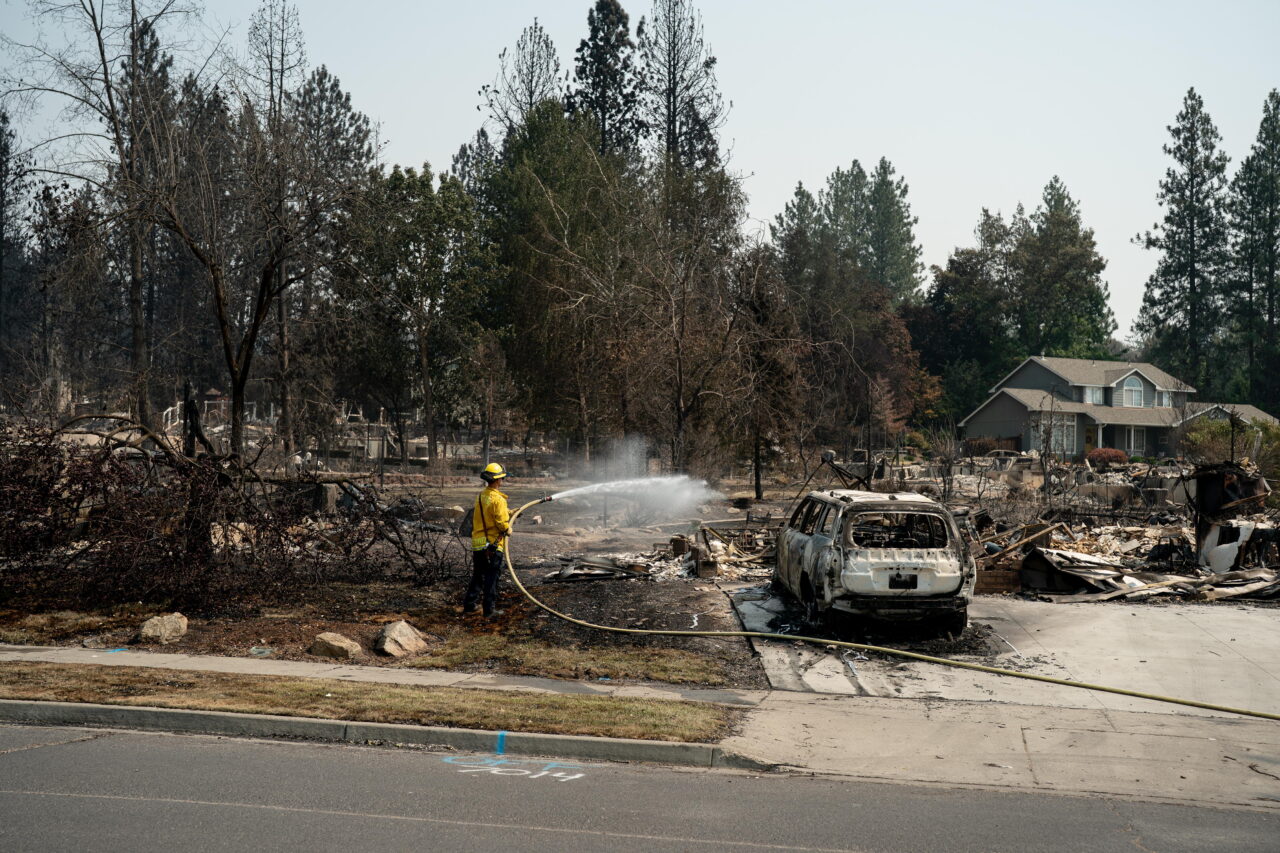
Authorities in Spokane, Washington arrested 37-year-old Aaron Farinacci for allegedly starting the Old Trails Fire in early August, which became one of the most destructive wildfires in that state’s history.
Court documents show Farinacci later told police he started more than two dozen wildfires including Old Trails. Authorities say he watched fire weather apps and waited for conditions where he could do the most damage. That weekend there were dire warnings about extreme heat and wind across the Northwest.
“The origin of the fire was indeed exactly where the witnesses had seen Mr. Farinacci kneeling in the grass earlier that day,” said John Nowels, Spokane county sheriff, at a news conference announcing the arrest.
Farinacci now faces additional arson charges for four other wildfires last year around Spokane. In Reno, investigators are still trying to pinpoint the exact cause of the Hawk Fire, saying only so far that they believe it’s human-caused.
Like much of the West, both cities have seen considerable growth in recent decades out into what fire managers call the wildland urban interface. Whatever the ignition source, Pohl says people tend to start wildfires in or near populated areas.
“More people are moving into these places,” she says. “So growth alone can drive up human-caused ignitions.”
While they tend to ignite in more remote forests, natural wildfires can still be incredibly destructive as well. Most of the 2.3 million acres burned in Oregon so far this summer were fires sparked by lightning strikes. Andrés Holz, a climate scientist at Portland State University, says it’s also just hotter now in the American West.
“In the background, we have climate change that makes vegetation drier,” Holz says. “So now we have a longer season where fuels are a lot drier than before.”
Wildland firefighters have gotten remarkably effective at containing most human-caused fires. It’s the small fraction that escape that dominate headlines. Researchers also point to better public awareness today about fire risks as another factor keeping most fires small. Holz says globally the number of human-caused ignitions is actually trending downward, “which is hard to believe because we see the news and we see these outliers which are super severe and catastrophic.”
In Spokane, fire survivors like Chris Matthews are left struggling to process how someone could have deliberately started the blaze that ravaged their city. Hundreds of homes burned in the Old Trails Fire, including his. His family lost everything but the car they escaped the flames in.
“I really want to understand why people would do something like that,” Matthews says. “I just don’t understand.”