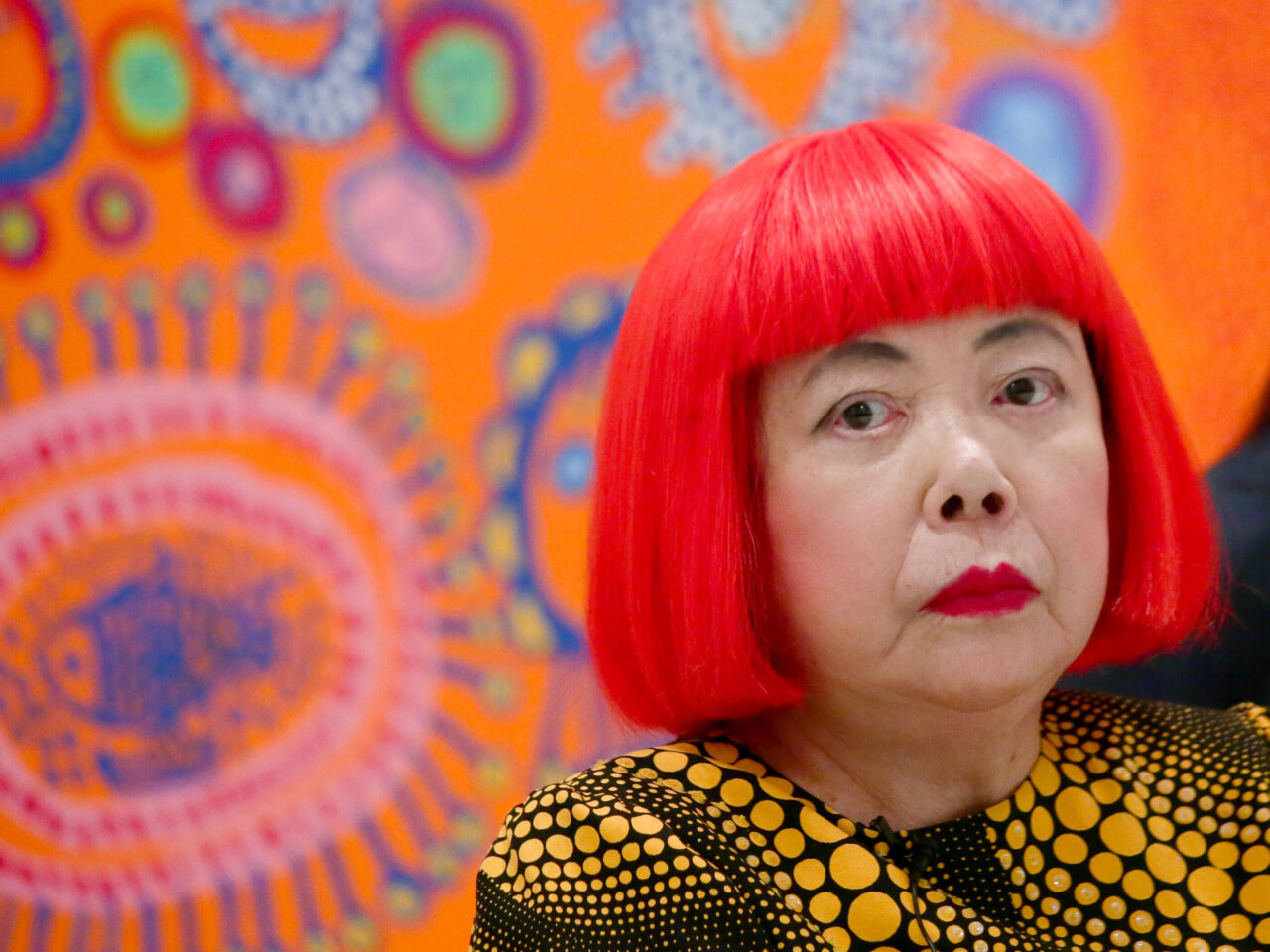
Japanese artist Yayoi Kusama, best known for her polka dot sculptures in eye-popping colors and shimmering “Infinity Rooms,” has died. She was 97 years old.
In a statement issued on Wednesday, her representative David Zwirner said Kusama passed away from “multiple organ failure” at a Tokyo hospital on Aug. 14.
The wildly imaginative Kusama used her art to express her obsessions: Repetitive brushstrokes on dotted canvases she called infinity net paintings; giant orange and black, polka dotted pumpkins; enclosed rooms with mirrored walls and twinkling lights that seem to go on forever; fluorescent paintings and sculptures. She often described her artwork as a means of survival. For the viewer, it was a reflection of one’s place in the vast universe.
“Our earth is only one polka dot among a million stars in the cosmos,” she wrote.

Kusama grew up in Matsumoto, at the foot of mountains in Central Japan. Her family owned a seed nursery. During World War II, she and other children worked long hours in a parachute factory.
Throughout her life she suffered from hallucinations. She wrote in her autobiography that, as a little girl, she would draw the visions in sketchbooks to “help ease the shock and fear” of the episodes. But her mother objected to her art-making and would take away her art supplies.
After discovering a book of paintings by Georgia O’Keeffe in a secondhand bookstore, Kusama wrote to the famous artist, asking for advice. O’Keeffe wrote back, telling her it was tough to make a living as an artist in the U.S. but encouraged Kusama to make the trip and to show her art to anyone who might be interested.
In the late 1950s, Kusama moved to New York and thrived within the city’s avant-garde scene. During the Vietnam War, she staged public “happenings” where she would paint polka dots on the naked bodies of fellow protestors. They handed out copies of an open letter the 28-year-old Kusama wrote to President Richard Nixon proposing they have sex if he end the war. “As we soar through the heavens, we’ll paint each other with polka dots, lose our egos in timeless eternity, and finally discover the naked truth: You can’t eradicate violence by using more violence,” she wrote.
“She shocked the living daylights out of people,” Richard Castellane told NPR in 2017. Castellane was Kusama’s dealer in the 1960s. He remembers one of her Infinity Rooms that was full of phalluses and another that had masses of blinking colored lights and a Beatles soundtrack. “The machine would be setting off these lights in almost like a machine-gun rhythm,” he remembers, “And what occurred, of course, was the lights would bounce from mirror to mirror to mirror to mirror. You couldn’t focus on anything. You had no sense of space because space was infinite.” Castellane says Kusama’s work astonished people. “They were just mesmerized and rather overwhelmed. It was something very new.”
But gaining respect as a female artist wasn’t easy. Curator Mika Yoshitake told NPR, “It was tough to get the attention in a very male-dominated art world at the time. She also was exoticised — and she didn’t hide it, either. She was wearing kimonos and presented this kind of exotic, oriental figure.”
Despite her successes, Kusama was barely making ends meet, and she continued to hallucinate and have panic attacks. In the early 1970s, she moved back to Japan and checked herself into a psychiatric institution where she lived for the rest of her life.
With major exhibitions in the U.S. and Europe, Yayoi Kusama’s popularity soared. The Smithsonian’s Hirshhorn and the Tate in London are among the many museums that have shown her work. In 2017, the Yayoi Kusama Museum opened in Tokyo.
Kusama continued to make art well into the 2000s in a studio across the street from the mental hospital. Her designs are on cellphone cases, Lancôme lipsticks and Louis Vuitton products.
Throughout her life, Kusama was adamant that, for her, creating art was a necessity.
“If, a hundred years from now,” Kusama wrote in her autobiography, “someone were to see my art and think ‘Kusama did some really good work,’ I would be satisfied. Art, for me, is a creed.”