Natalie Portman has played lots of different royalty, so to speak, from a galactic queen in the Star Wars prequels to a first lady in Jackie. But in the new movie Lucy in the Sky, Portman plays a member of an even more rarified club: an astronaut.
When we meet Portman’s character Lucy Cola, she is one of the first female astronauts to venture into space. But her adjustment back to Earth is uneasy, and she quickly spirals out of control. The character is inspired by the real story of astronaut Lisa Nowak, who was charged in 2007 with attempted kidnapping of the then-girlfriend of a man with whom she was having an affair.
For Lucy, the experience of going to space has been transformative.
“It’s so remarkable that this moment, that can be the most beautiful moment of her life — and probably is the most beautiful moment of most astronauts’ lives — is also the moment where they face the smallness of everything they’ve ever known, and everyone they’ve ever known, because they see how the Earth is situated, and how small it is, and how they can literally cover it with their outstretched hand,” Portman says. “And so to have those simultaneous experiences, I think, can be pretty jarring.”
In an interview, Portman spoke about the film alongside its director, Noah Hawley.
Interview Highlights
On the question posed by a review in The A.V. Club:
“Why make the astronaut-in-a-diaper movie if you don’t want to show an astronaut in a diaper?”
Hawley: I find it interesting, because I’ve seen those kinds of headlines as well, and I think it says a lot about the people who are writing them. … Well, for me, what was interesting was the realization that behind every tabloid story are human beings with dignity who’ve made mistakes, who’ve failed, maybe even ruined everything — and we’ve reduced them to a punchline. So when I see those headlines, what it makes me think is that, you know, there’s a segment of society that’s not OK with that, that need those people to be punchlines for whatever reason.
On how female characters often function reductively
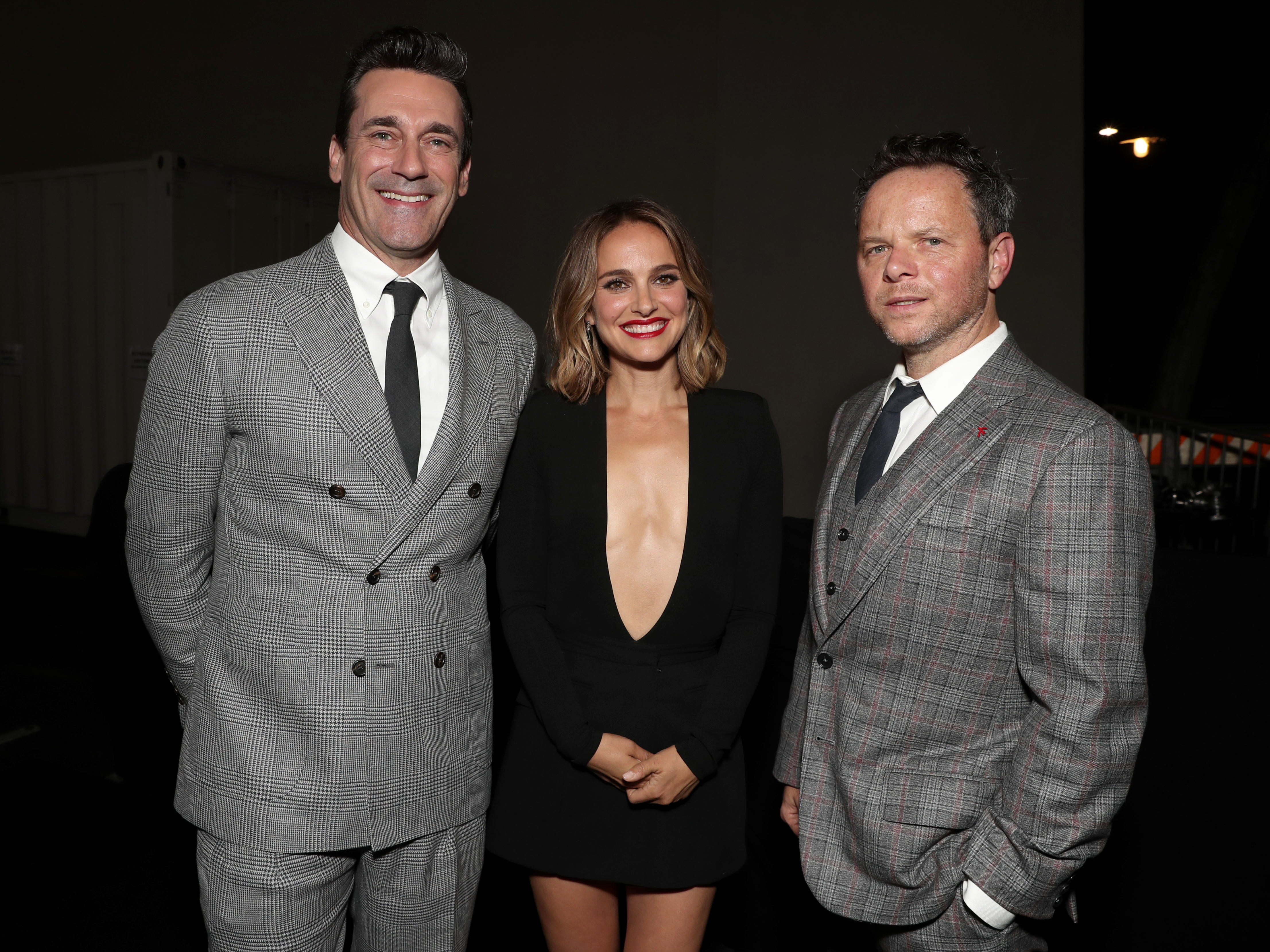
Portman: I think that often female characters are reduced to single-word descriptive possibilities. I think people talk a lot about “strong” women or “badass” women or “tough” women — or “victims” or “villains.” … I mean, there’s almost a genre of films about men who are lovable but curmudgeons. There’s so many male characters that [have] contradictory qualities, which is the most human kind of behavior, in my view.
Hawley: Look, I find it interesting that there’s two movies coming out this weekend about characters having a psychological decline that ends in violence. And he gets to be called Joker, with a capital J, but she’s just supposed to be a joke.
On who gets to direct female-driven movies
Hawley: You know, I thought a lot about the male gaze, especially since it’s a film that has an affair at the center of it, and the way that that might normally be portrayed by a filmmaker — and in making an experiential movie from her point of view, to also cinematically represent the female gaze. The romance or the sex at the heart of it is not — it’s not about the act of it as much as the feelings that go along with it. And the editing of the film, the calibrating of the journey, was one of the hardest parts, just in terms of shaping the audience’s journey. Because there’s never a moment that I want you to step outside and judge her. …
Portman: It’s actually really disturbing to me when people ask male directors how they feel telling a female story — if they can do it. And I’m like: We take it for granted that they can tell stories about serial killers. Like, if you can get into the mind of a serial killer, why can’t you get into the mind of a woman? … I don’t think there’s anything qualitatively different about women directors or men directors except that women directors get way fewer opportunities. So yes, I’m very conscious of working with female directors. I am a female director. I think women directors need more opportunities at every level. And the more disturbing thing is male directors who only tell stories about men — because then I feel like they do not consider female stories as human stories.
On the novelty of making a space movie with female astronauts
Hawley: I think if I had been offered the male version of this film, I wouldn’t have found it that interesting, just because I’ve seen so many versions of it. You know, Brad Pitt is having his existential crisis in space right now [in the movie Ad Astra]. … Whether or not people like that movie, they don’t question its right to exist. This story, obviously, is a story that is meant to portray the reality of experience, of someone who has an existential crisis basically, and makes mistakes, and on some level ruins everything. And there’s nothing more human than that, you know; there’s no redemption without the fall. So that’s what was appealing.
Sophia Alvarez Boyd and Ed McNulty produced and edited this interview for broadcast. Patrick Jarenwattananon adapted it for the Web.
Copyright 2026 NPR