Updated April 13, 2026 at 12:38 PM ET
LAGOS, Nigeria — Pope Leo XIV said he is undeterred by criticism from President Trump and will continue speaking out against war, emphasizing peace, dialogue and cooperation between nations.
Speaking to reporters on Monday as he began an 11-day tour of Africa, the first American pope stressed that global conflicts are causing immense human suffering and insisted that moral leadership requires advocating for alternatives to violence.
“I will continue to speak out loudly against war, looking to promote peace, promoting dialogue and multilateral relationships among states to find just solutions to problems,” he said. “Too many people are suffering in the world today. Too many innocent people are being killed. And I think someone has to stand up and say there’s a better way.”
The remarks come amid escalating tensions between the Vatican and Washington over the Iran conflict.
Speaking at a worldwide peace vigil at St. Peter’s Basilica in Vatican City on Saturday, Pope Leo warned against what he described as a “delusion of omnipotence” driving global instability, urging world leaders to prioritize diplomacy over military escalation.
Trump responded sharply the following day, criticizing the pope’s leadership and accusing him of being weak on crime and ineffective on foreign policy.
In posts on Truth Social on Sunday night, he argued that the pontiff should focus on religious leadership rather than politics.
“I don’t want a Pope who thinks it’s OK for Iran to have a Nuclear Weapon,” Trump posted. “I don’t want a Pope who criticizes the President of the United States because I’m doing exactly what I was elected, IN A LANDSLIDE, to do.”
Trump also took issue with the pope’s criticism of U.S. policy.
In a flurry of late-night posts, Trump shared an AI-generated image image of himself portrayed as Jesus Christ. The image showed him laying hands on a sick, bedridden man as light appeared to radiate from his fingers. The sky all around him is filled with eagles, and an American flag. The post was later deleted.
A Vatican spokesman responded to Trump’s social media posts, saying they reflected his “impotence” in the face of the Vatican’s criticism of the Iran war.
“When political power turns against a moral voice, it is often because it cannot contain it,” Father Antonio Spadaro, under-secretary of the Vatican’s Dicastery of Culture and Education, wrote in a social media post. “… Unable to absorb that voice, power tries to delegitimize it. Yet in doing so, it implicitly acknowledges its weight.”
Trump’s rebuke came as three U.S. cardinals chose to speak out against the Iran war in a rare joint television appearance on 60 Minutes on Sunday night.
“In Catholic teaching, this is not a just war,” Cardinal Robert McElroy, the archbishop of Washington, D.C., told the program. “This is a war of choice. … I think it’s embedded in a wider moment in the U.S. that’s worrying: We’re seeing before us the possibility of war after war after war.”
The Iranian president also took the opportunity to weigh in. President Masoud Pezeshkian posted a message on Monday that said in part – “I condemn the insult to Your Excellency on behalf of the great nation of Iran, and declare that the desecration of Jesus, the prophet of peace and brotherhood, is not acceptable to any free person.”
Despite the attack from Trump, Pope Leo reiterated that he will continue to speak out “loudly against war,” advocating for dialogue and multilateral solutions.
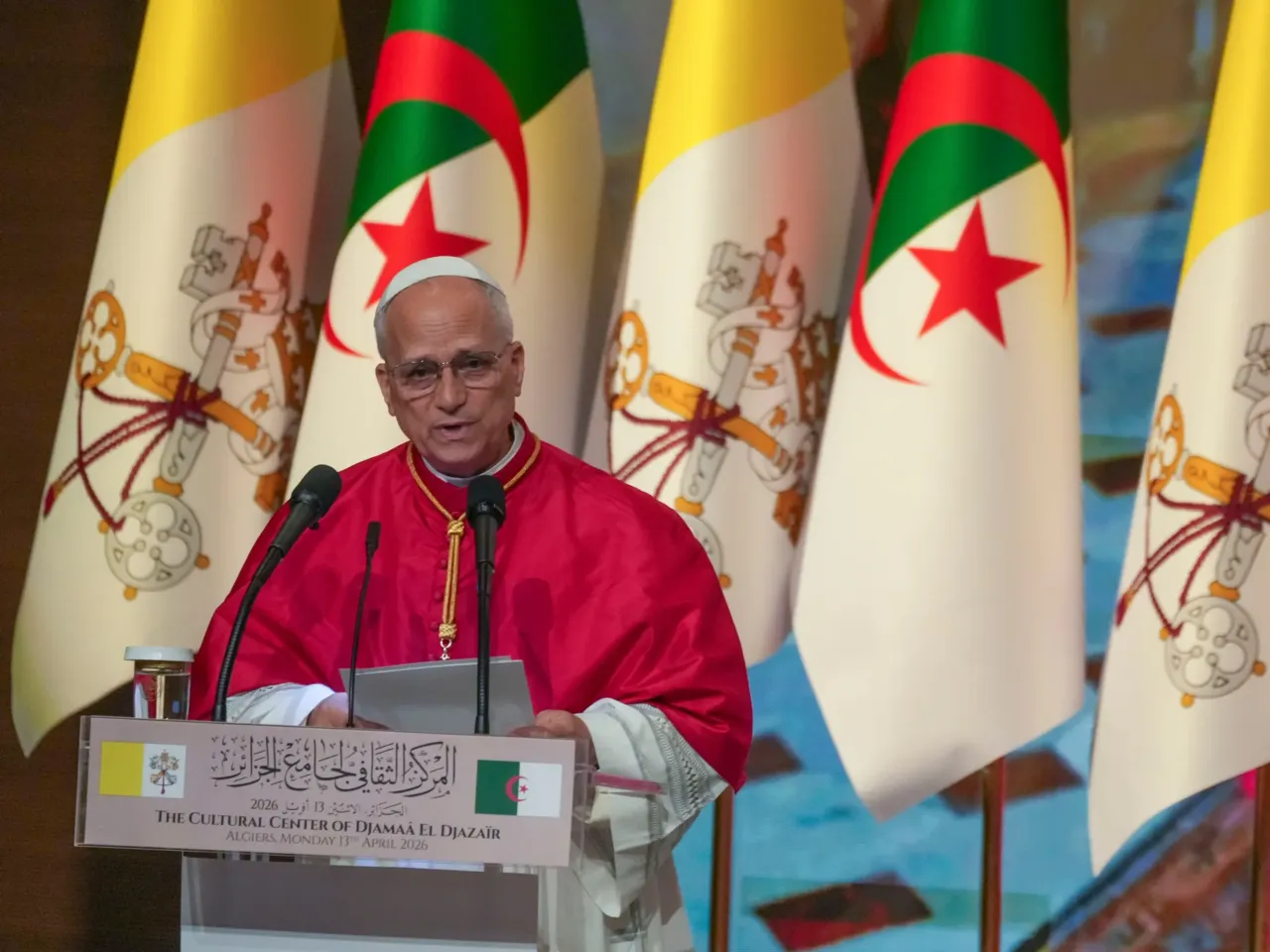
His trip to Africa — which includes stops in Algeria, Angola, Equatorial Guinea and Cameroon — is focused on promoting unity, peace and stronger interfaith relationships.
The pope opened the journey in Algiers, where he was welcomed by President Abdelmadjid Tebboune, marking the first-ever papal visit to the country and underscoring the symbolic importance of engaging with predominantly Muslim nations.
But the trip is set to be dominated by the deepening rift between the Vatican and Washington, as the pope’s calls for peace play out amid an increasingly public and personal clash with Donald Trump — all the more striking given he is the first American to lead the Catholic Church.
Copyright 2026 NPR