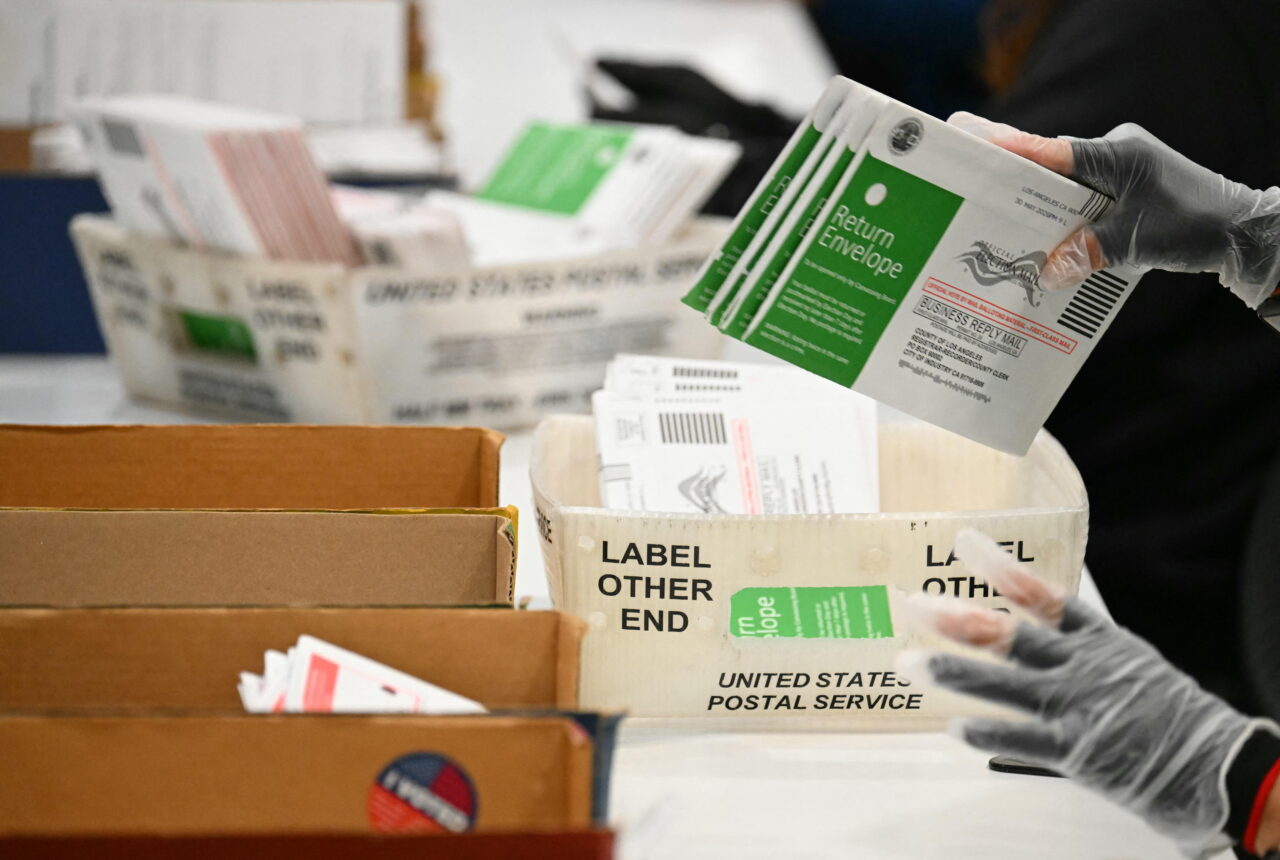
The Supreme Court has ruled against President Trump, rejecting his efforts to enact new mail-in voting restrictions for the midterm election.
The ruling released Monday by the high court means the U.S. Postal Service is expected to continue delivering ballots as usual.
Voting by mail has already begun in states including Alabama, North Carolina and Wisconsin, with more soon to follow — including Western states such as Hawaii, Oregon and Washington, where elections are held primarily or fully with mail ballots.
Under the still-blocked USPS plan, which followed an executive order by Trump, states would have had to turn over lists of voters’ names and addresses and have certain specific barcodes on ballot envelopes in order to have them delivered by the mailing agency.
Earlier this month, a federal judge in Boston issued a preliminary injunction against USPS, blocking it from imposing those new ballot requirements on states. The judge found the requirements are likely illegal because the Postal Service has no authority to control mail-in voting. A second federal judge issued another preliminary injunction late Sunday.
Now, a majority of the Supreme Court decided to keep that injunction in place. The court said the Trump administration was unlikely to succeed on the merits of its challenge.
Conservative Justice Brett Kavanaugh wrote a short concurring opinion, saying “there is at least a fair prospect that the final rule falls within the Postal Service’s statutory authority.” But, he added, “applying the rule in the 2026 elections would be arbitrary and capricious in violation of the Administrative Procedure Act because state and local election officials do not have sufficient time to reasonably implement the rule before the elections.”
Indeed several Republican state election officials, including from the mostly vote-by-mail state of Utah, signed on to a Supreme Court brief, warning that any attempt to carry out the USPS plan now “will almost certainly lead to mistakes, delays, and confusion for both voters and election officials.”
Conservative Justices Samuel Alito and Clarence Thomas dissented from the order, and would have granted the administration’s request to pause the Boston-based judge’s ruling.
While the USPS plan remains paused for the midterms, the legal fight will likely continue over how the agency may try to implement it for future federal elections.
For now, challengers of the proposal are celebrating their victory.
“Today, the Supreme Court refused to allow the federal government to throw our elections into chaos just weeks before Election Day. The Postal Service exists to deliver Americans’ mail — not to rewrite election rules, demand voters’ personal information, or decide which ballots make it through the system,” Celina Stewart, CEO of the League of Women Voters, said in a statement.
New York State Attorney General Letitia James said in a separate statement that she was “truly relieved” by the high court’s ruling.
“Voters should never have to wonder whether a ballot they legally cast will be counted because the federal government suddenly changed the rules,” said James, whose state was among the 24 mainly Democratic-led states that sued alongside Washington, D.C. “We will keep fighting to make sure every eligible ballot is counted come November. Now, I encourage all eligible Americans to get out and vote — and vote early.”
Trump said he issued the call for USPS to change its rule for mail ballots as a way to stop illegal voting by non-U.S. citizens, a problem that many studies and audits show is extremely uncommon. For this legal fight over the USPS plan, the administration’s lawyers have provided the courts with no evidence of mail-voting fraud.
Trump has been a vocal critic of the way about one-third of voters cast ballots in the last two federal elections. In 2024, the share of voters who reported casting ballots by mail was higher among Democrats (37%) than Republicans (24%), according to a national survey by the MIT Election Data and Science Lab.
In a social media post last year, Trump said he is “going to lead a movement to get rid of MAIL-IN BALLOTS” and claimed that “ELECTIONS CAN NEVER BE HONEST WITH MAIL IN BALLOTS/VOTING.”
This year, Trump himself voted by mail in Florida.
Editor’s note: USPS is a financial supporter of NPR.
Edited by Benjamin Swasey
Transcript:
JUANA SUMMERS, HOST:
The Supreme Court has rejected President Trump’s push for new mail-in voting restrictions for the midterm election. This new ruling is expected to bring some closure to a legal fight that was threatening to disrupt voting by mail that has already started. NPR’s Hansi Lo Wang has been tracking all of this and is with us now. Hi there.
HANSI LO WANG, BYLINE: Hi, Juana.
SUMMERS: So, Hansi, before we get into this new ruling, I want you to just clear something up for us. Didn’t the Supreme Court already rule on President Trump’s push for mail-in voting restrictions?
WANG: Yes. That was back in August, and that was a ruling on a procedural question about one of the lawsuits over President Trump’s executive order. Now we have a Supreme Court ruling on the legality of a plan the U.S. Postal Service came up with in response to Trump’s order. And I should note – the U.S. Postal Service is a financial supporter of NPR.
SUMMERS: Got it. And what does this new Supreme Court ruling say?
WANG: So this new ruling is about the midterm general election, and it basically keeps a USPS plan blocked. And under that plan, USPS would have been able to refuse to deliver mail-in ballots to voters in states where election officials do not turn over voter lists to the mailing agency and do not have certain barcodes on their ballot envelopes. And a federal judge in Boston found those requirements are likely illegal because USPS has no authority to impose them on states. And now this new Supreme Court order rejects the Trump administration’s request to pause the judge’s ruling.
SUMMERS: So if I understand correctly, the upshot for voters is that the status quo continues for mail-in voting?
WANG: That’s right. This means the Postal Service is expected to keep delivering ballots as usual. And voting by mail has already started in some states, including Alabama, North Carolina and Wisconsin. And more states are set to use USPS to mail their ballots as planned.
SUMMERS: Hansi, do we have any sense how the justices voted individually on this ruling?
WANG: Well, there was a dissenting opinion from two conservative justices, Samuel Alito and Clarence Thomas. But conservative justice Brett Kavanaugh joined the court’s majority in this case. And although Kavanaugh voted to keep the USPS plan blocked, he wrote that he believes there’s, quote, “at least a fair prospect” that USPS does have legal authority to carry out this plan. But the Postal Service, Kavanaugh says, just doesn’t have enough time to do that for the midterms without violating the Administrative Procedure Act.
SUMMERS: Right. And to Justice Kavanaugh’s point here, was it even possible for election officials and USPS to make these changes to mail-in voting for the midterms?
WANG: You know, that has been a big question looming over this legal fight. And for months, many election experts have said it’s too late to put in place these new mail-in ballot requirements. They said it was too late when President Trump put out this executive order in March. And it was certainly too late, they said, when USPS finally put out its plan last month, just over a week before the first mail-in ballots for the general election went out.
And on top of that, we had a whistleblower report claiming the online system election officials would need to use to follow these new ballot requirements has not been properly tested and was set up in a way that could’ve led to many eligible voters not getting their ballots in time for the midterms or at all. And as of today, it’s still not clear if that online system would have been ready to be used if the Supreme Court had ruled in the administration’s favor. So there was a real risk of major disruptions to mail-in voting for the midterms and potentially even disabled voters and voters in places without polling sites losing the ability to exercise their right to vote. But again, that is not happening now because this USPS plan is blocked for the midterms.
SUMMERS: Just trying to drill down here – what is the takeaway in all of this for mail-in voters?
WANG: Right. There’s been a lot of headlines coming out of this legal fight, but the bottom line is mail-in voting is still available to all eligible voters. USPS is expected to continue to deliver ballots as usual. And if you’re eligible to vote by mail in your state, your ballot may be on its way to you very soon, if not already. And if you need to request a ballot, it’s a good time to check your state’s deadline for getting in those requests.
SUMMERS: NPR’s Hansi Lo Wang. Thank you.
WANG: You’re welcome.