Richmond City Council unanimously approved Mayor Danny Avula’s second spending plan for the city during a packed meeting Monday.
Among the top items within the $1.1 billion general fund allocation for fiscal year 2027 are pay raises for all city employees, record funding for Richmond Public Schools and millions allocated for the city’s Affordable Housing Trust Fund. The nearly $3.5 billion budget also includes tax rate hikes that will lead to higher utility bills for residents.
“Now the real work begins: delivering on these investments thoughtfully, effectively, and with accountability to the people we serve,” Avula said in a statement after the budget was passed.
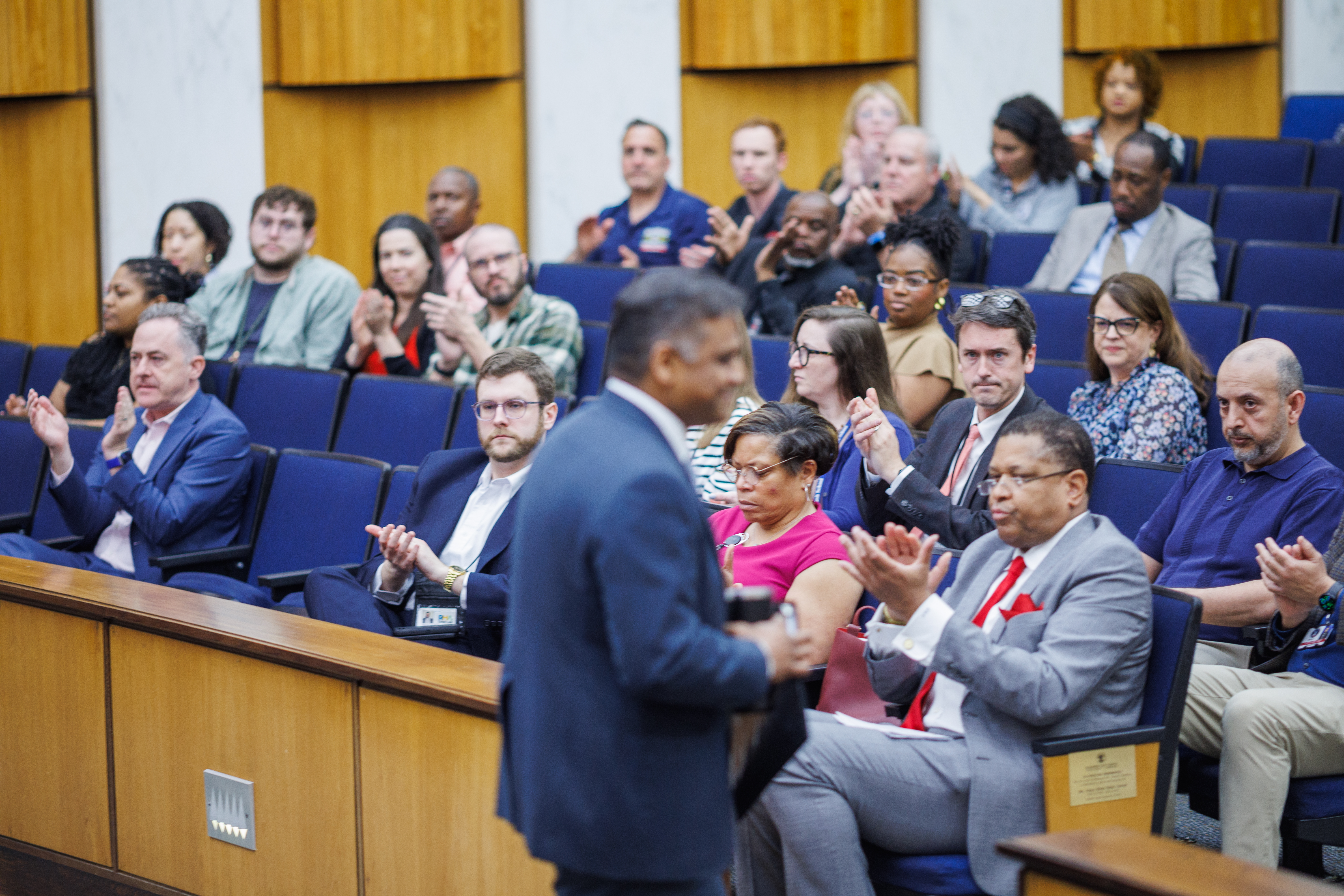
Residents and members of advocacy groups filled council chambers Monday, leaving only a few empty seats once the meeting opened. They advocated for more pedestrian and bicyclist safety measures, funding for housing and for the city to end its contract with Flock Safety for automatic license plate readers.
“Freedom and liberty are incompatible with mass surveillance,” said one city resident. “The evidence is clear: The people in this room, the mayor and police chief do not have the technical will to hold Flock accountable.”
When Avula first introduced the budget back in March, he noted it would be constrained by the city’s long-awaited tax assessment freeze. The freeze is in effect to align annual reassessments with the budget cycle moving forward. Real estate taxes are the city’s largest source of revenue.
Councilor Kenya Gibson (3rd District) said that this budget reflects one where the council was able to exercise oversight — noting that several of their amendments, including funding additional staff for the inspector general’s office and cutting out large severance payouts, made it into the budget.
“This is the day we can’t take democracy for granted,” Gibson said.
But Gibson and other councilors who spoke before the vote said that, like all budget plans, they couldn’t get all of what they wanted.
“Is it 100% the budget that I would like to see? Of course it isn’t,” Gibson said. “Unfortunately, that is also how democracy works, but there are some changes that I think are good ones.”
Record school funding — but still short of RPS’ request
Richmond Public Schools received a significant boost in funding under the adopted budget, reflecting a continued decade-long trend of rising city investment in the division.
Over the past decade, the city’s investment has increased by roughly 60%, which city leaders said has helped the division make significant academic strides — like achieving a graduation rate of more than 80% among students.
Avula’s spending plan allocates a record $257 million in funding — an $8.2 million increase over fiscal year 2026, and the largest-ever investment in RPS. The increased funding is expected to help the district meet its collective bargaining agreements and support summer school.
Still, the approved funding fell $4 million short of what the district originally budgeted for in March. The district has already proposed cuts, including to the Richmond Virtual Academy — which became a major point of contention throughout the budget process, drawing in parents and teachers to both city council and school board meetings to urge officials to “Save RVA.”
Prior to Monday’s vote, several students and parents spoke in favor of keeping RVA open.
One seventh grader said RVA has allowed him to not have to choose between his health and his education: “Please do not close my school, RVA is not just a virtual option for me. It is my lifeline.”
Still, the academy is expected to be cut after city council members were unable to identify funding to sustain it. RPS officials, including Superintendent Jason Kamras, have made it clear the program is not included among the division’s top priorities under this year’s budget constraints.
“The program is not funded not because there is not support,” Gibson said.
During budget work sessions, councilors had agreed on allocating $200,000 towards RVA — but after a miscalculation from the administration, the funding was dropped.
Before the vote, Councilor Reva Trammell (8th District) addressed the public to assure them council was not taking the matter lightly. She then asked Council President Cynthia Newbille (7th District) what would be done to fund RVA.
“We hear you, and we want to make sure that if we find the money and we give the money, that it goes towards you all,” Trammell said.
Newbille said that although council did not include RVA in budget amendments, that did not preclude them from looking into other ways to address funding.
To support major facility expenses, the city has frontloaded $9.3 million to RPS for its capital improvement plan budget. This year, RPS is prioritizing HVAC systems, roof repairs and structural projects at several schools.
In addition to school funding, the approved budget allocates $1 million for after-school programming at all RPS middle schools and $500,000 to support childcare providers through the city’s child care and education trust fund.
Councilors also helped secure nearly $1 million in additional support for RPS that will be split among transportation services, security for after-school programs and work tied to the redesign of Westover Hills Elementary.
Investing in affordable housing
Affordable housing remained another major focus, with $40 million allocated as Richmond continues to face rising rents and increasing pressure on lower-income residents.
In line with Avula’s mayoral plan and goal of thriving neighborhoods, the spending plan allocates $11.7 million to the city’s Affordable Housing Trust Fund.
The funding formula for the trust fund underwent revisions this year, after a city audit found that money didn’t make it into the fund.
Avula and councilors came together to establish a predictable and sustained funding stream from the city’s capital improvement budget, equal to 2.5% of yearly real estate tax revenue for FY27 and FY28. (Virginia fiscal years run from July 1–June 30.)
Additionally, the budget includes $1.8 million in Affordable Housing Performance Grants, as well as funding to support the city’s homelessness response and eviction prevention efforts. Older adults and residents with disabilities will receive a total of $7.4 million in tax relief.
The city is also allocating $1.6 million and $450,000, respectively, to advance people-centered redevelopment plans at Creighton and Gilpin courts.
Pay increases for all city staff — unionized or not
To meet Avula’s vision of a thriving City Hall, the approved budget honors all collective bargaining agreements — totaling approximately $263.5 million — and provides a 3.25% salary increase for all city employees, effective in July.
Avula’s original proposal planned a 3.25% pay bump for unionized city employees, but delayed a 3% pay increase for non-union workers until January 2027. A budget amendment requested by Councilor Sarah Abubaker (4th District) argued that a delayed pay bump “did not support City Hall morale or show appropriate value to non-unionized staff.”
The approved budget includes an average compensation increase of 6.7% for sworn police officers and fire personnel.
Overall, funding for the Richmond Police Department is set to increase by $11 million, with $9.2 million of that amount tied to technical adjustments required to meet mandated contributions to the city’s and state’s retirement system, as well as salary increases for sworn staff.
Big-ticket capital projects: school improvements, water treatment plant upgrades
Council also greenlit Avula’s $2.6 billion capital improvement plan for major projects in FY27–31, which uses $776 million in general fund revenue.
More than a quarter of that general fund allotment — $212 million — is set to go towards school upgrades and maintenance.
The CIP budget includes $105 million for Complete Streets, the city’s ongoing effort to bolster transportation safety in Richmond, and $43 million to help construction of the Fall Line Trail.
Under the approved plan, the city is also earmarking $15.6 million to renovate the John Marshall Courts building and $1 million for city library upgrades.
Richmond plans to help pay for two of the city’s largest long-term projects — the combined sewer overflow system and main water treatment plant — with other funding sources, including utility revenue bonds and state dollars.
The combined sewer overflow system needs upgrades to meet a state-imposed deadline of 2035 to stop dumping sewage into the James River. From FY27–31, more than $247 million — nearly $72.5 million in FY27 alone — is set to go towards implementing the city’s CSO plan.
The CIP budget also includes more than $187 million for the city’s main water treatment plant, a facility that experienced multiple failures in 2025 that left residents without safe water.
Utility tax rates set to increase yet again
Richmond residents will again have to pay more for utilities — almost $14 more per month on average.
The budget comes with rate hikes for gas and water, with the average monthly bill going up $13.84 in FY27. The tax rates set in Avula’s inaugural budget led to an average utility tax hike of $12.83 per month.
Avula and city officials say the rate increases are needed to help fund infrastructure projects, such as upgrading the water treatment plant, and improve utility services for residents.
The city maintained its real estate tax rate of $1.20 per $100 of assessed value, which remains one of the highest in the region; Chesterfield, Hanover and Henrico counties all tax real estate at less than 90 cents per $100.
Council amendments
Though council gets the final vote on the budget, the mayor’s administration crafts the spending plan. And because Richmond code requires the city’s budget to be balanced, any new spending requires equivalent cuts — meaning councilors are limited in the changes they can make.
Councilors were able to fund smaller, district-specific priorities and found consensus where they could on higher-priced proposals, including pay raises for all city employees and bonus payments to retirees.
Most of council’s amendments were funded with more than $3 million from Richmond’s Gap Grant Program, which officials recently agreed to end. The program aimed to help low-income residents with housing costs, but only a fraction of the $3.9 million set aside for it was distributed. Nearly $1.3 million of that went towards the 3.25% raise for all city employees.
Council also agreed to give Richmond Retirement System recipients a one-time payment equal to a 1% cost-of-living adjustment, which comes with a total cost of $716,400. For the bonus payments, council set aside $487,400 from the Gap Grant program and $228,092 from the city’s surplus.
After some councilors criticized last year’s budget process as closed-off and keeping them out of significant decisions, many praised this year’s approach as being more transparent and collaborative.
“We provided more visibility to the amendments that were on the table. We allowed more public comment,” Gibson said before the vote. “And I think that the budget is stronger for it.”
Avula echoed that view in his statement, saying the approved budget reflects “a new way of working together — with earlier collaboration, clearer public engagement, and a real commitment to partnership between City Council, our administration, and the people of Richmond.”
Monday night’s vote comes as General Assembly Democrats remain at an impasse in state budget talks over a tax exemption for the data center industry.
State elected officials have said that a compromise will be reached before the start of the next fiscal year on July 1, and Avula administration officials previously told VPM News that they weren’t overly concerned about the delay’s impact on the city’s budget.