

Balderson is the president and CEO of Healthy Harvest Fresh in Warsaw, located in Virginia’s Northern Neck.
It’s a special place to her.
“I was born and raised here in the Northern Neck,” Balderson said. “I witnessed the cycle of generational poverty. Kids get stuck, and they can’t find a way out. Children depend on us for weekend meals a lot of times because the only time they get healthy food is when they’re at school.”
Increasing Healthy Harvest’s production meant helping more people in her own community.
“We were in a food desert,” Balderson said. “We were not being served in this area. I got a text message that said, ‘Look up aquaponics,’ and I just knew. The rule of thumb around here is that if I get goosebumps and chills, we’re on to something. The reason behind it was to try to help these kids.”
Based on mimicking the symbiotic relationship between fish and plants found in nature, aquaponics is a fusion of two known models.
“Aquaculture is the raising of aquatic species; fish, plants and invertebrates,” said Josh Dusci, indoor agriculture extension associate at Virginia State University. “Hydroponics is soilless plant production. Aquaponics is the combination of aquaculture and hydroponics.”
The model has helped Balderson’s organization increase production exponentially.
“Our production space is about the equivalent of a quarter acre,” said Tammy Cole, director of operations at Healthy Harvest Fresh. “In traditional agricultural production, you would turn about 8,000 heads of lettuce in a year. We’re going to turn about 180,000 heads of lettuce in a year.”
It’s also a model equipped to deal with changes in the environment.
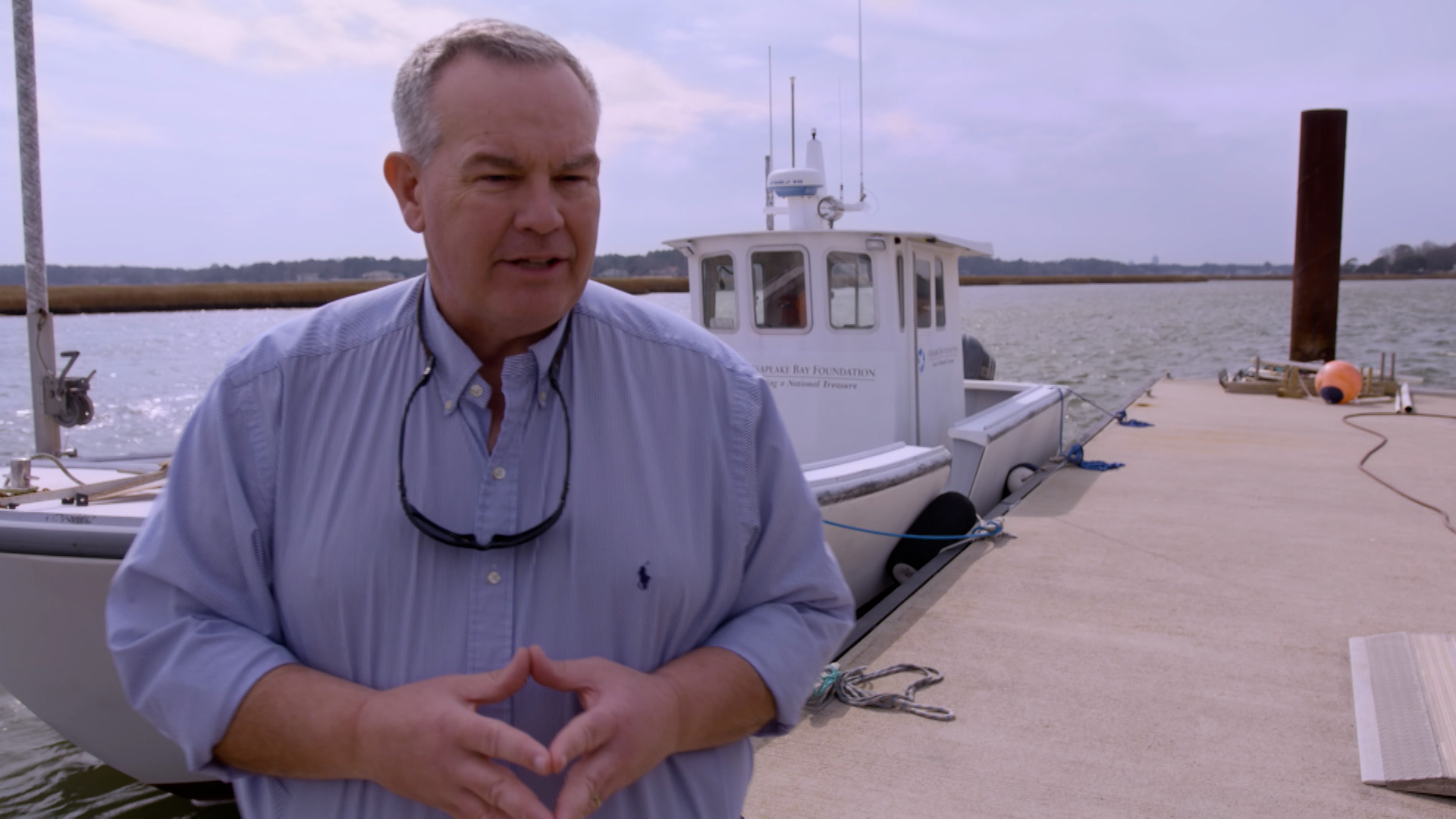
“With climate change, you can see the types of fish coming into the Chesapeake Bay are changing, and the rate they are coming into the Chesapeake Bay is changing,” said Chris Moore, Virginia executive director of the Chesapeake Bay Foundation. “A lot of the headwater areas, there’s changing in those streams happening. We’ve actually seen some of our waterways like the Shenandoah River actually be closed to recreation over the last two years.”
“Shad season starts about the second week in March,” said chief Kevin Brown of the Pamunkey Indian Tribe. “It’s cut down, because the numbers aren’t what they used to be. We used to catch 100 on a tide. Now, you’re lucky if you catch five or six. We started getting moss growing on the bottom of the river. There never used to be moss.”
While Moore sees the fruit of water restoration efforts in the Chesapeake Bay, there has been significant damage done.
“Water quality was probably the best around the time of first contact when there were 50 (thousand) to 100,000 Native Americans in the watershed,” the Chesapeake Bay Foundation executive director said. “We had very vibrant oyster reefs. We have very vibrant maritime forests. Now we have 17 million people and growing in the watershed. We have impervious surfaces. We as residents of the Chesapeake Bay water system can have profound impacts, good and bad, on the ecosystem.”
Multiple factors lead to the change.
“We’re starting to see changes, because we’re starting to see the impact of the globe getting warmer, because of CO2 emissions, ocean acidification, rising sea levels,” Dusci said. “These are all things that have a ripple effect.”
The damage isn’t irreversible.
“I believe nature, if you give it time, will heal itself,” Dusci said. “And we can help with that.”
The state of the environment isn’t the only variable. There are still unanswered questions about aquaponics.
Ryan Blosser runs the educational farm for Waynesboro Public Schools. He loves biomimicry of aquaponics as much as he loves teaching middle schoolers the benefits of getting their hands in the dirt.
However, he acknowledges that it’s not a completely closed system.
“It’s all about pattern recognition, using nature as a model and then designing systems from that,” said Blosser, farm educator for Waynesboro Education Farm. “A deconstructed ecosystem like we have here with aquaponics, it’s not really a closed-looped system like folks say. I’m still agnostic in terms of whether it is truly sustainable. For now, we feed fish food that we buy. To me, that’s the vulnerability of the system.”
The other big question is how to do it profitably.
“We’re still finding our footing in terms of what’s profitable and what’s not,” Dusci said. “It’s been such a slow process to get things where they need to be with the program. Sustainability is a funny term, because you can be sustainable in terms of resource efficiencies and conservation, but then from an economic sustainability perspective, too. You can be as sustainable as possible, but if you’re not going to make money doing it, no one’s going to adopt it. It’s not going to have the grand impacts that it could have.”
Even without all the answers, there’s reason for hope.
“Farming and figuring the future out is going to require a spirit of adaptability and experimentation,” Ryan Blosser said. “Being successful, no matter what scale, is messy, and it’s not a straight line. If we fall in love with aquaponics, we can scale this up. It’s how you build resilience one piece at a time.”
Balderson knows she’s on to something with aquaponics.
“I still get goose bumps and chills every time I walk into that greenhouse,” she said. “Because I’m living a life of purpose here, where I was born and raised, helping people I know need me. And I think we’ve only just brushed the surface of what this facility can do.”
This article is based on the “Aquaponics” episode from VPM’s Life in the Heart Land Season 3 docuseries. The series gets to the heart of those creating unique solutions to rural Virginia’s toughest challenges.
Watch Thursdays at 8:00 p.m. and 8:30 p.m. on VPM PBS or anytime on the PBS App
or VPM’s YouTube (under “Documentaries”)
Visit vpm.org/heartland to learn more.
Chris Lassiter is a freelance writer, member of VPM’s Community Advisory Board and Director of Engagement & Inclusion at The Community Foundation of the Central Blue Ridge in Staunton, Va.


